Some reactions catch you off guard: a flash of envy, a sharp reply, a sting from a small comment. These shadow work journal prompts help you look at those moments on paper, slowly and with curiosity.
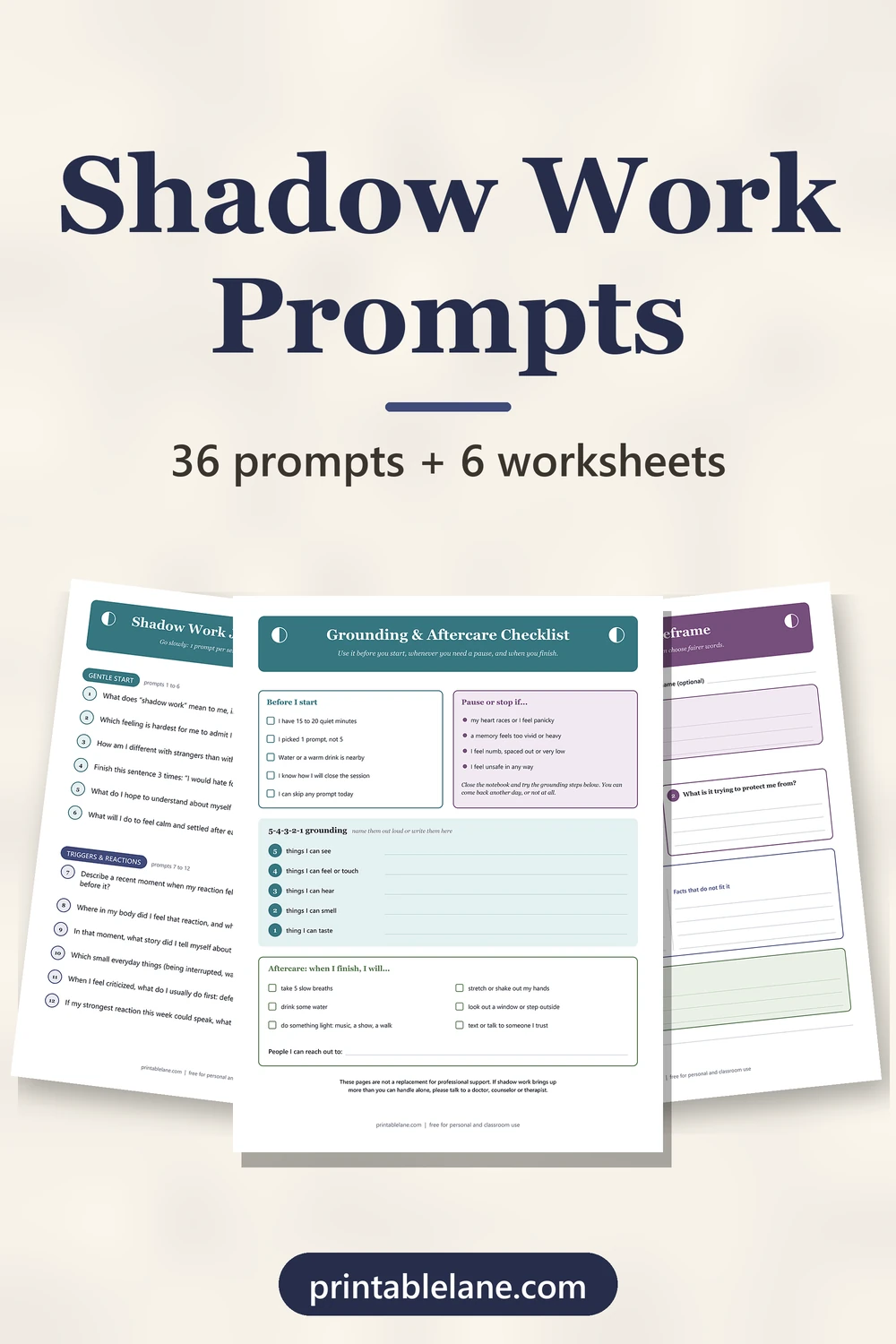
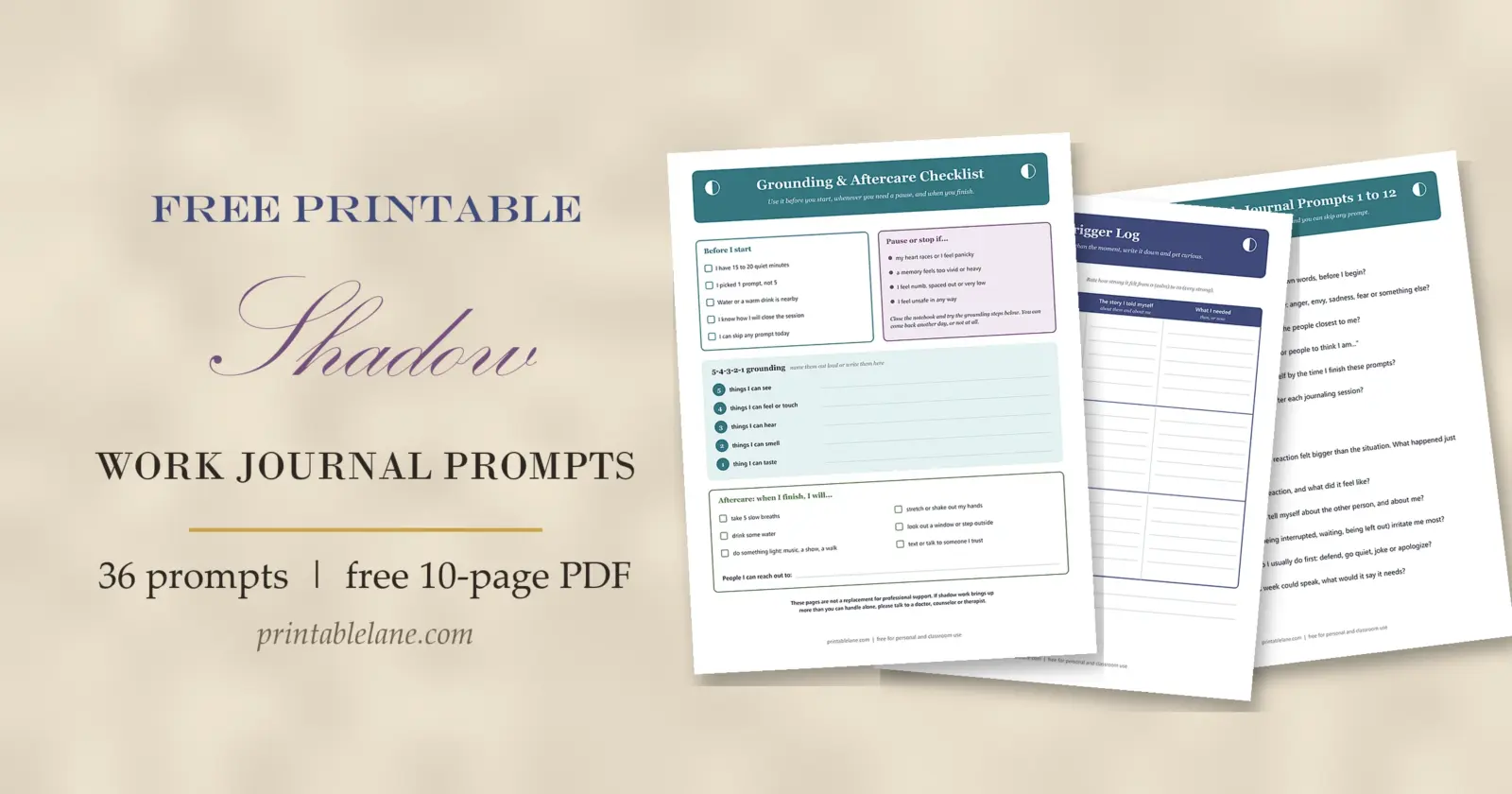
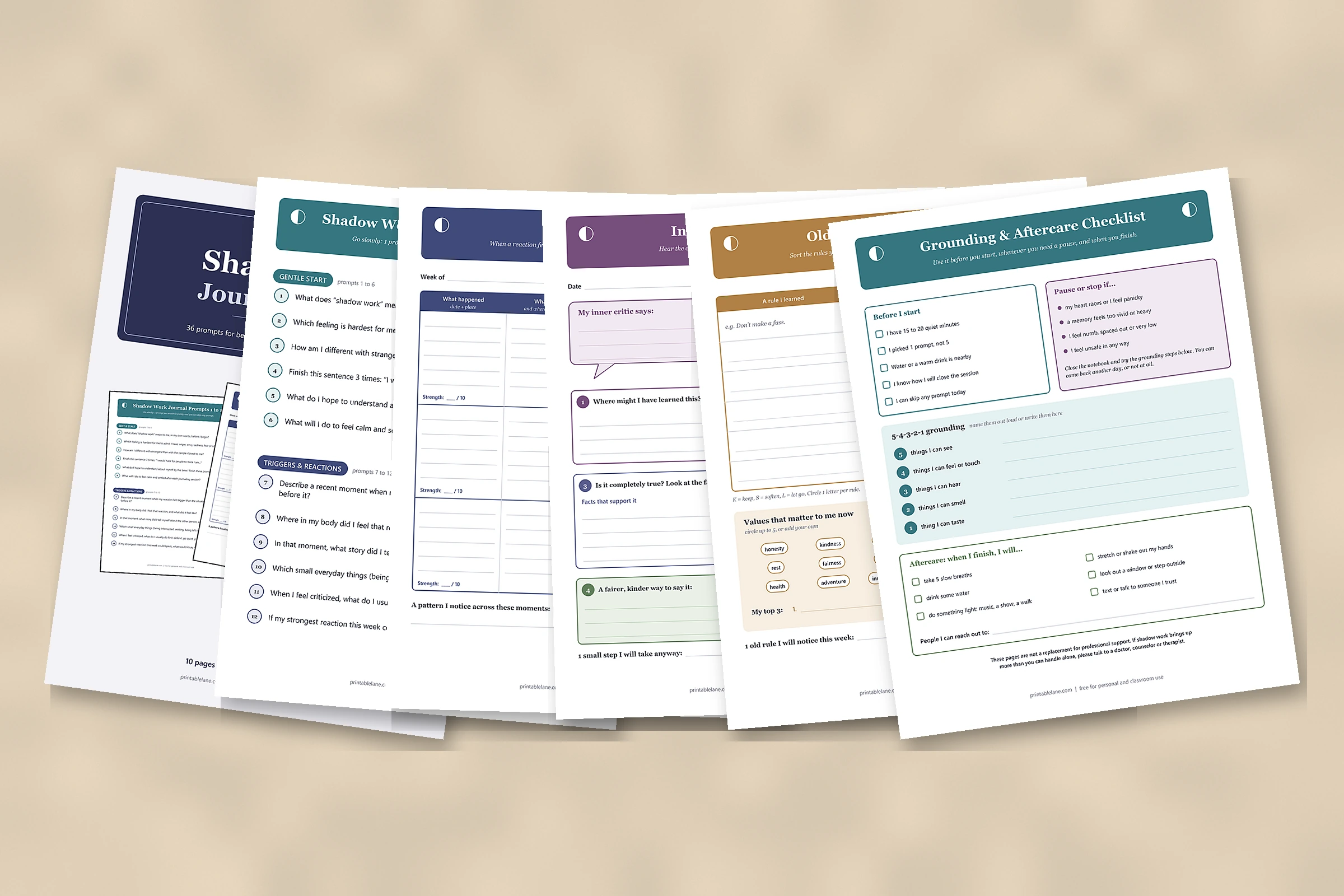
The 36 prompts for beginners come in 6 themes. The free 10-page PDF adds 6 worksheets, including a trigger log and a grounding and aftercare checklist.
Where the idea of the “shadow” comes from
Swiss psychiatrist Carl Jung (1875–1961), founder of analytical psychology, used “shadow” for the parts of our personality we do not see or accept in ourselves. It can hold hidden strengths too, and we often notice these traits first in other people.
“Shadow work” is a popular name for journaling about them: a reflection practice, not a treatment, and not a replacement for professional support. If a prompt feels overwhelming, stop and use page 10.
What’s in the PDF (10 pages)
- Page 1: cover
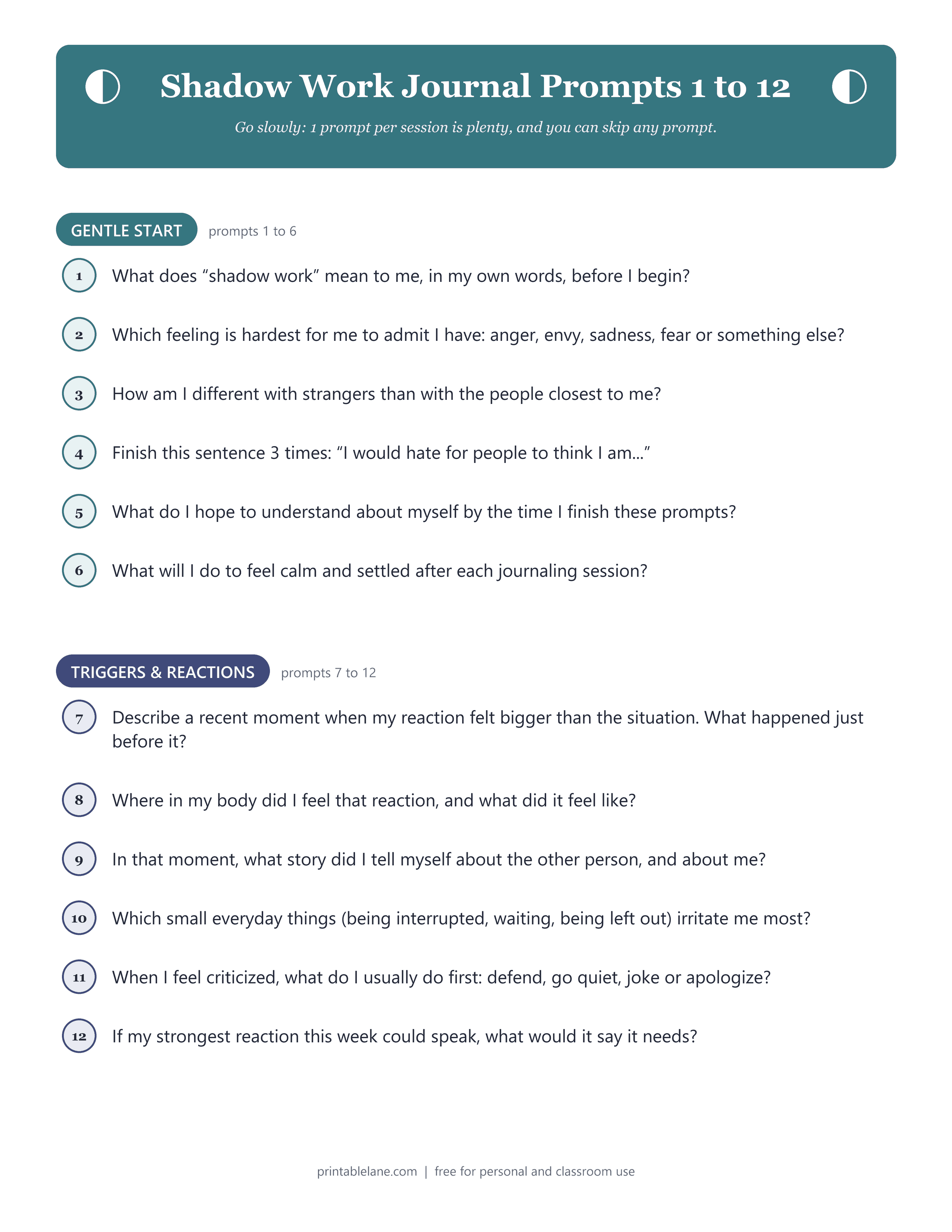
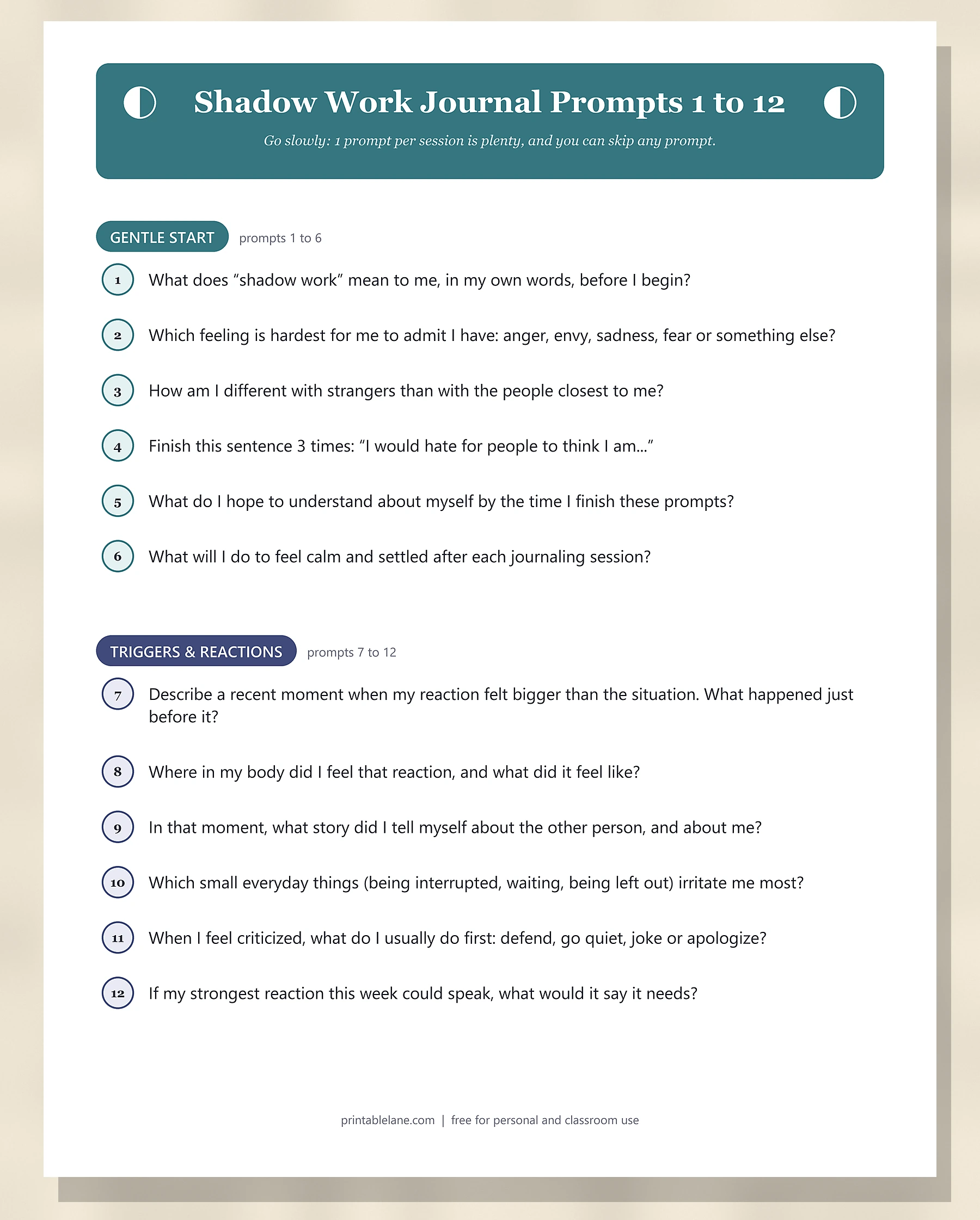
- Page 2: Shadow Work Journal Prompts 1 to 12
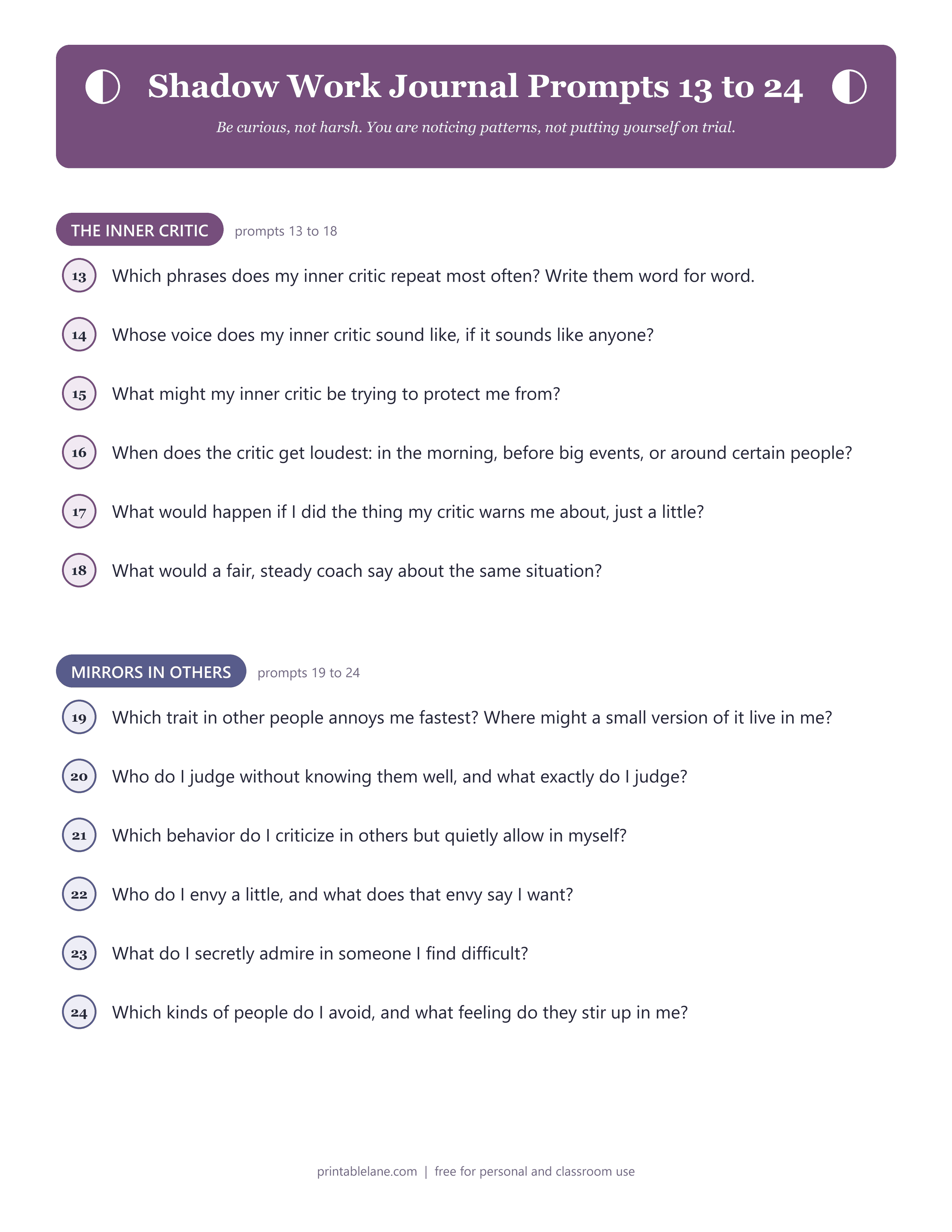
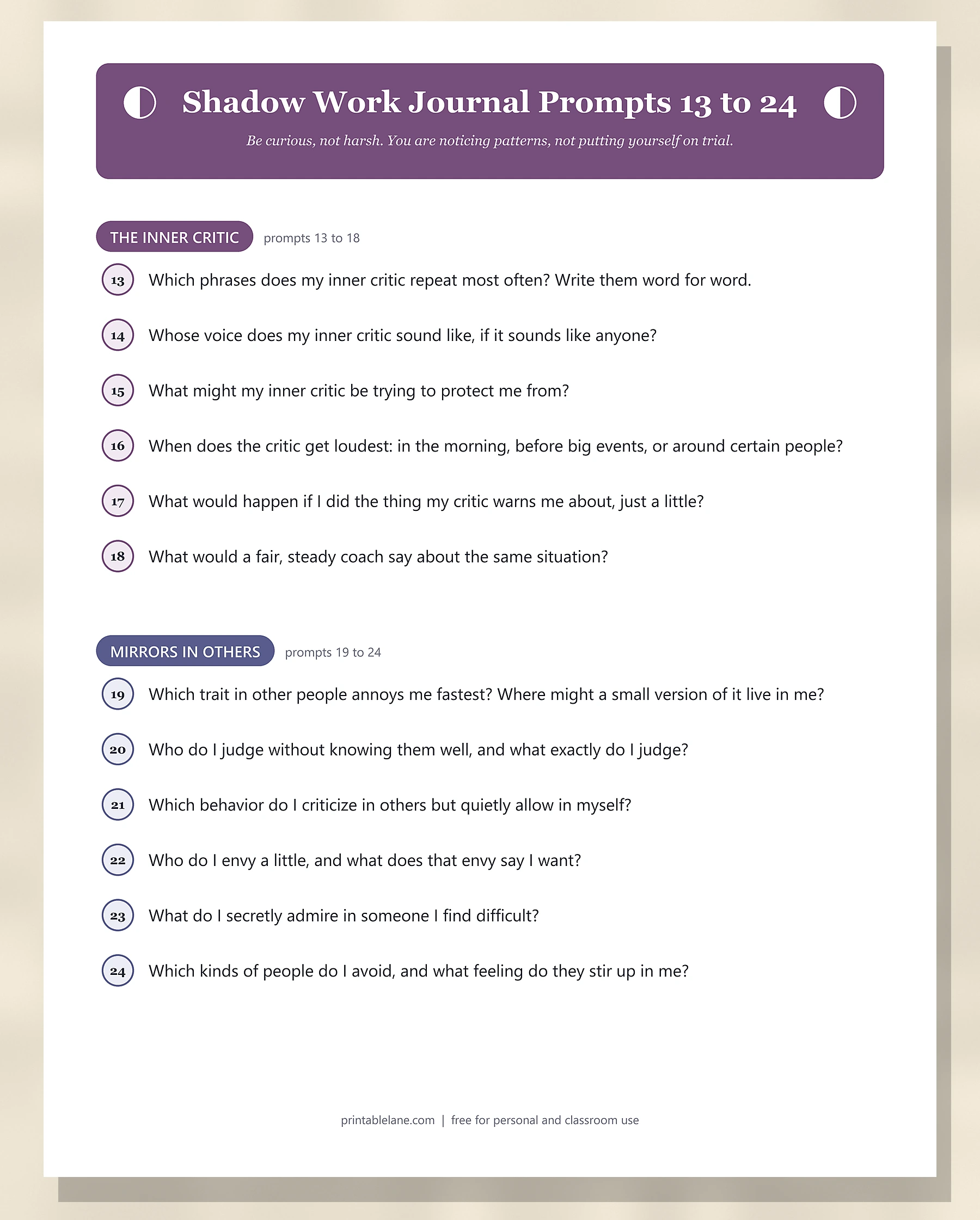
- Page 3: Shadow Work Journal Prompts 13 to 24
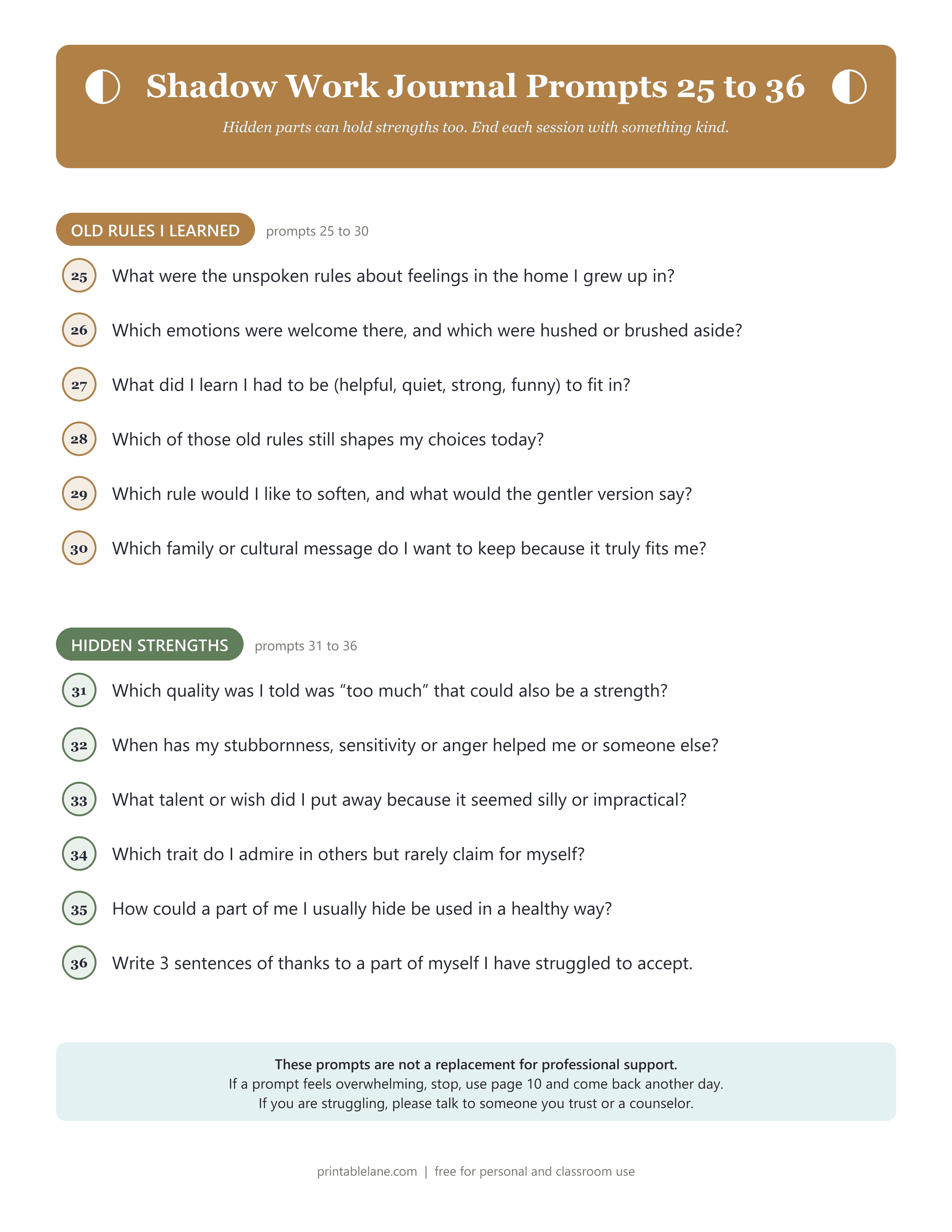
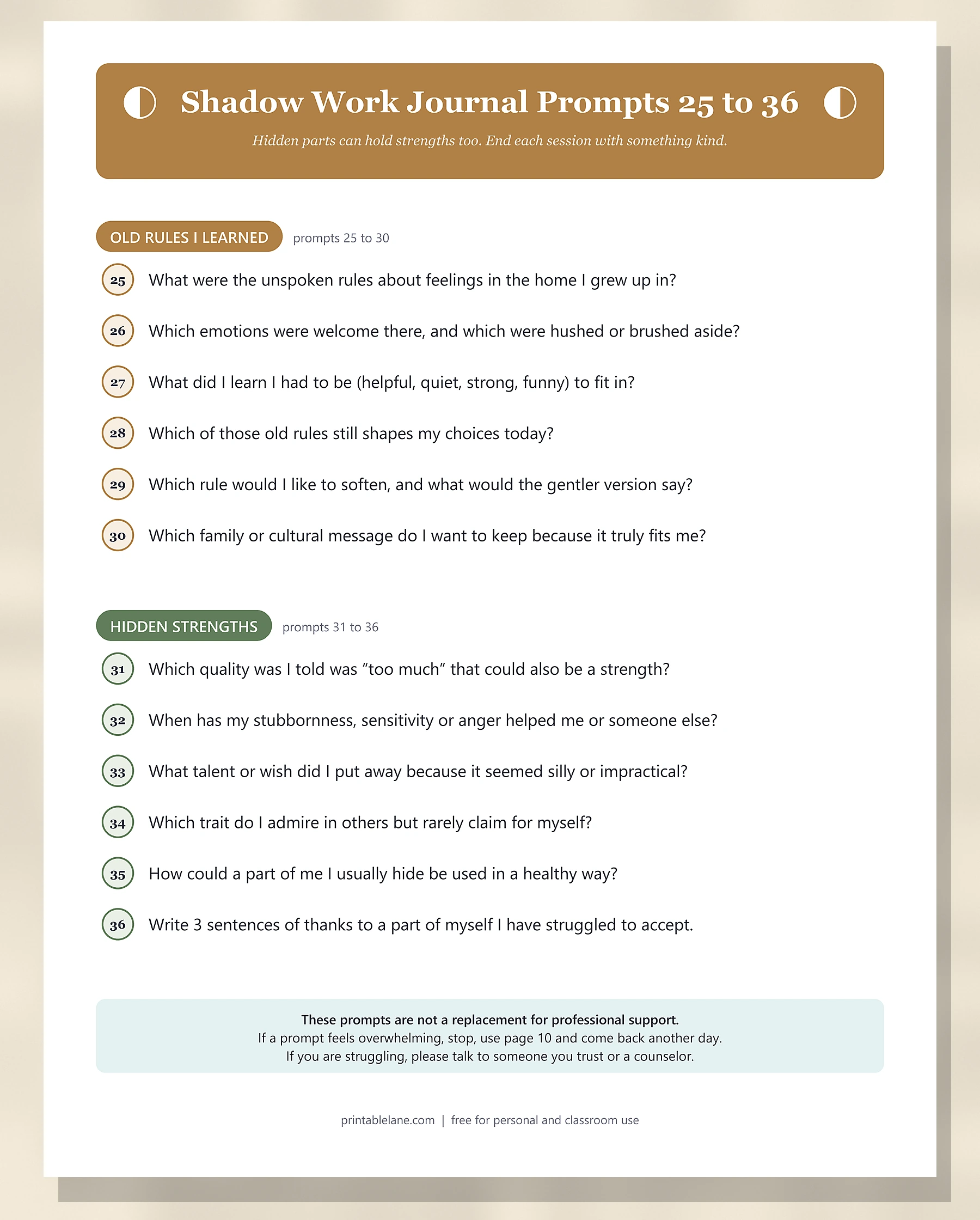
- Page 4: Shadow Work Journal Prompts 25 to 36
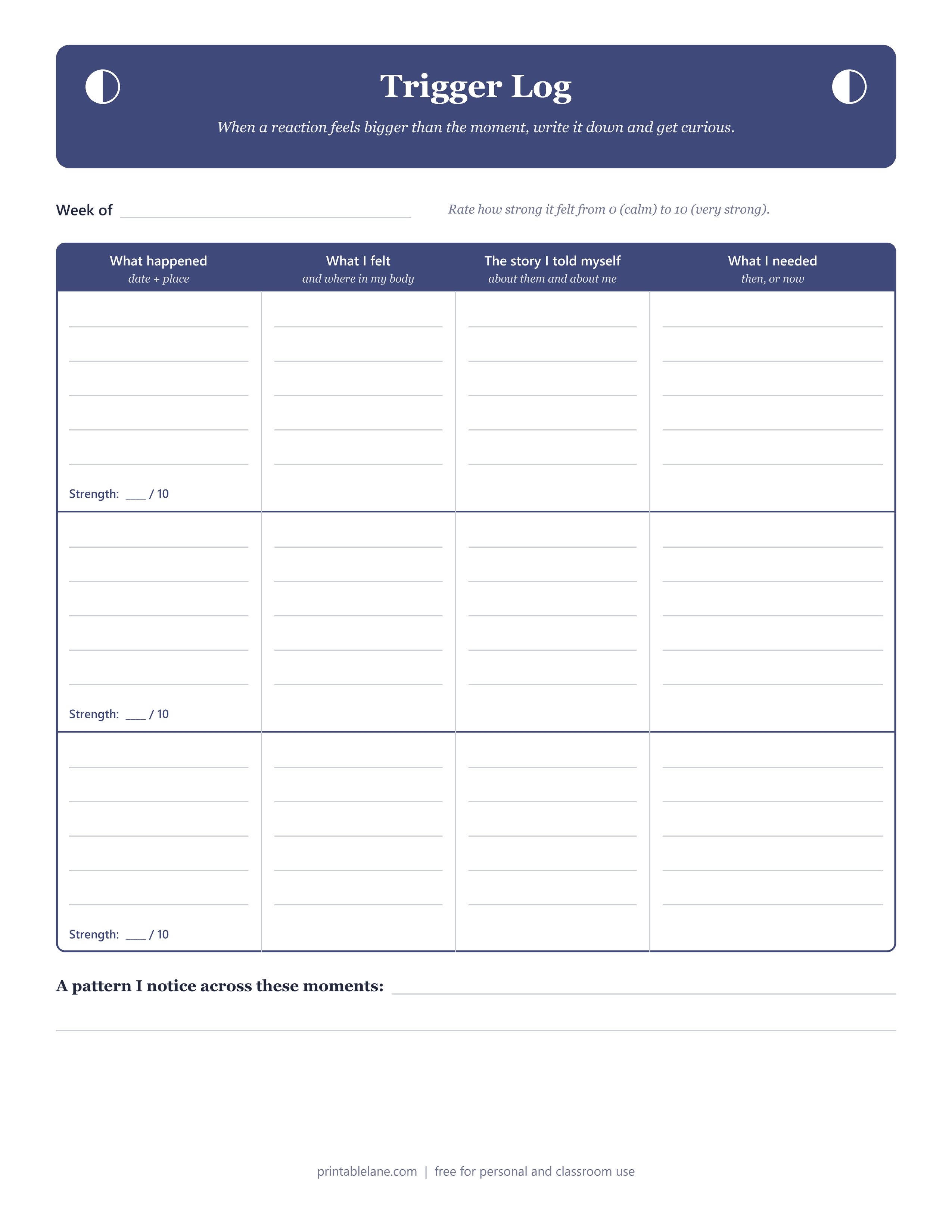
- Page 5: Trigger Log
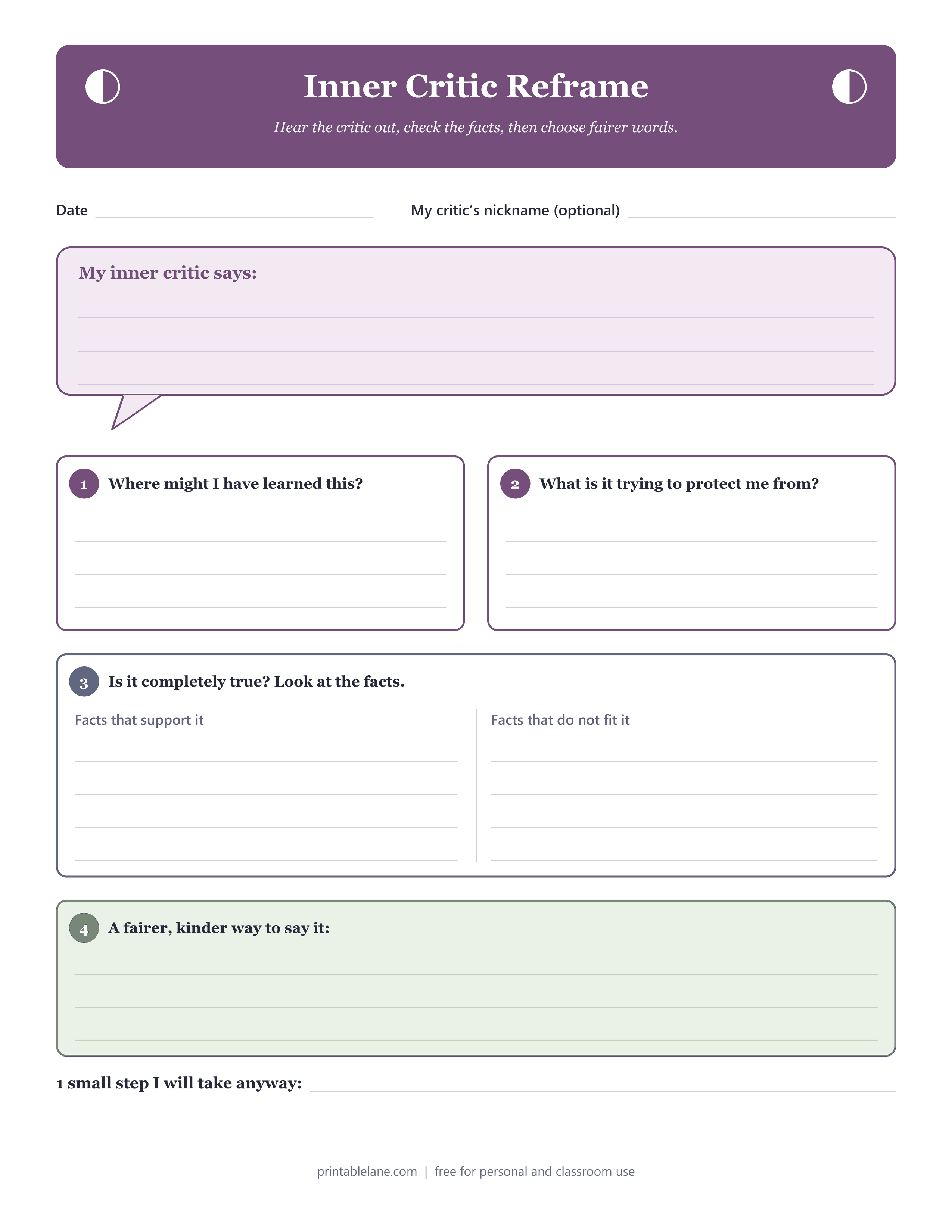
- Page 6: Inner Critic Reframe
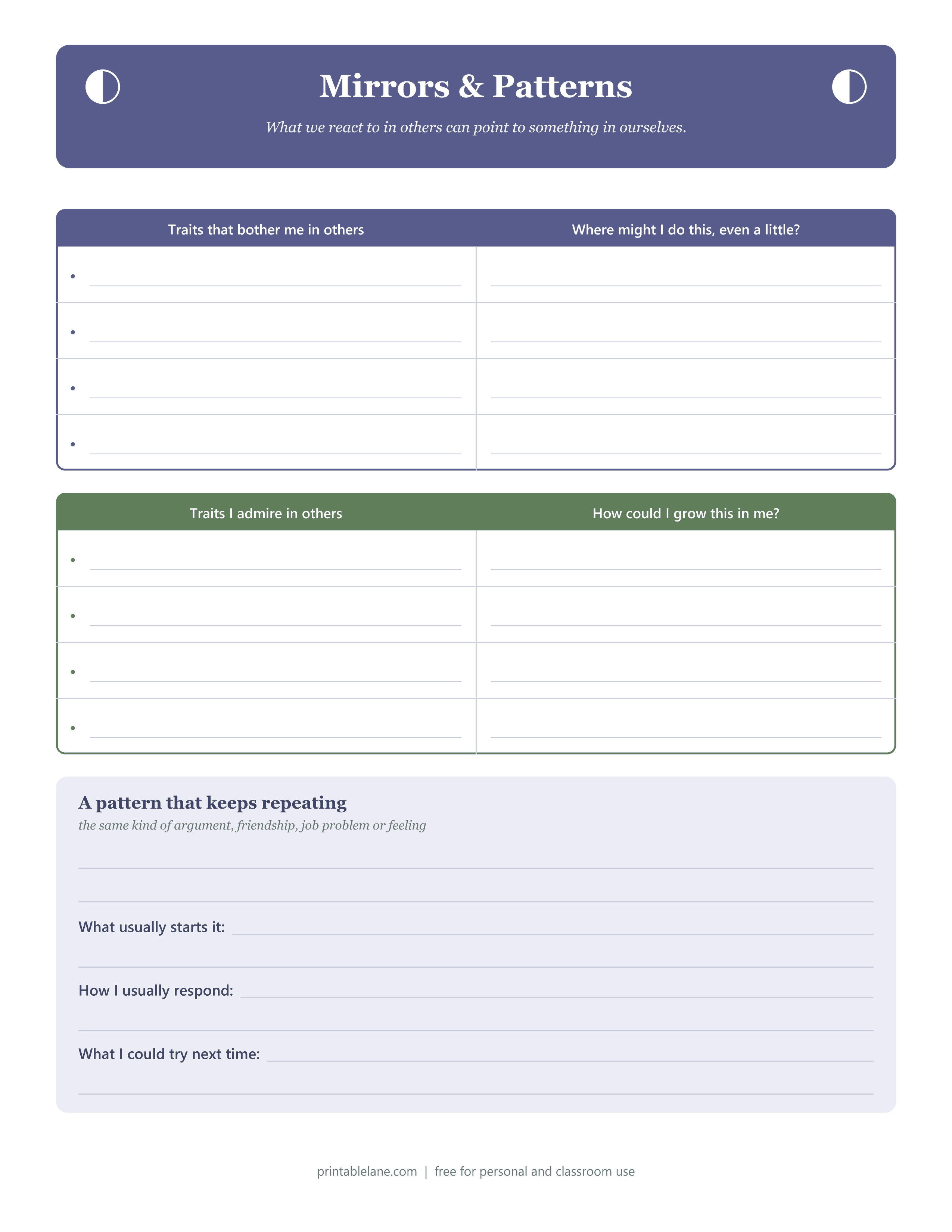
- Page 7: Mirrors & Patterns
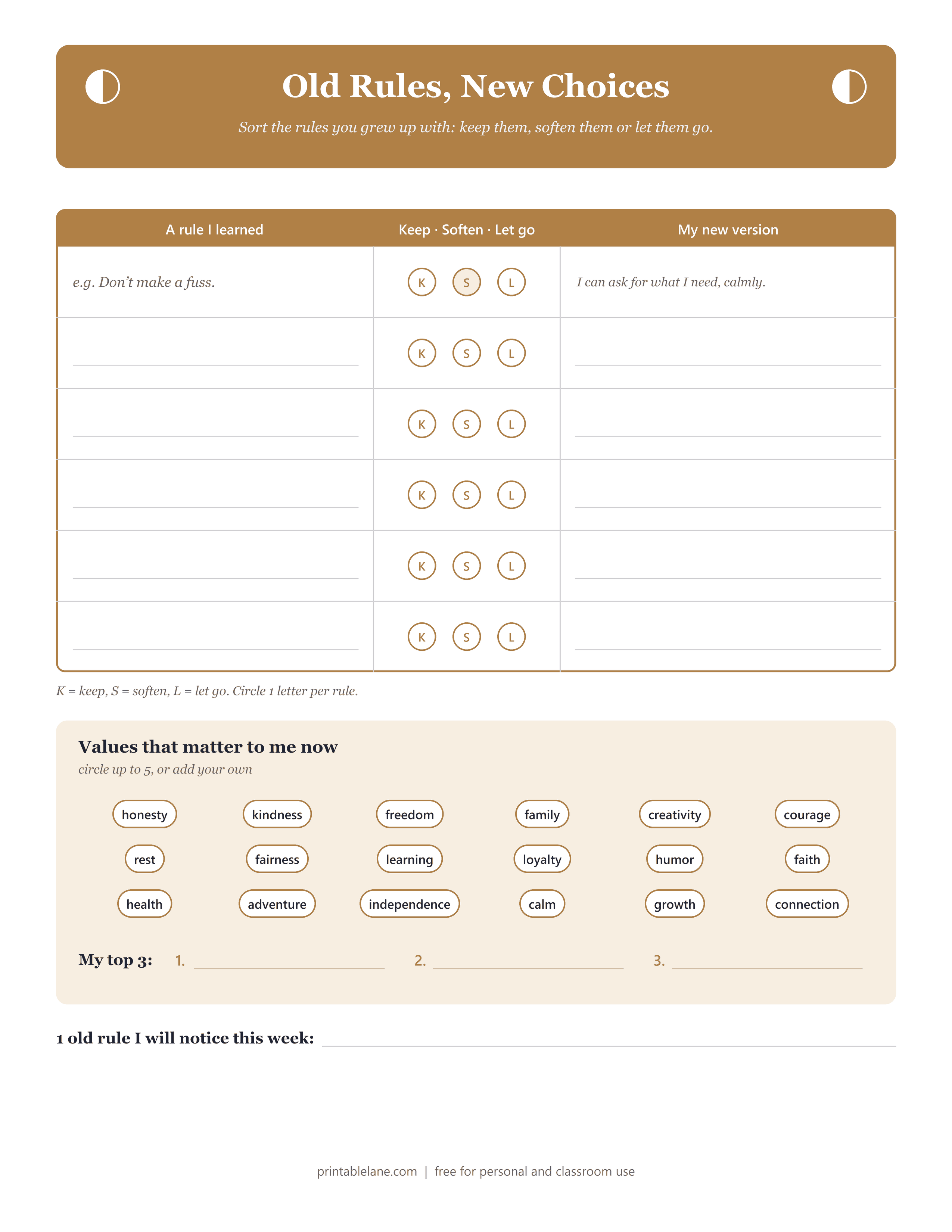
- Page 8: Old Rules, New Choices
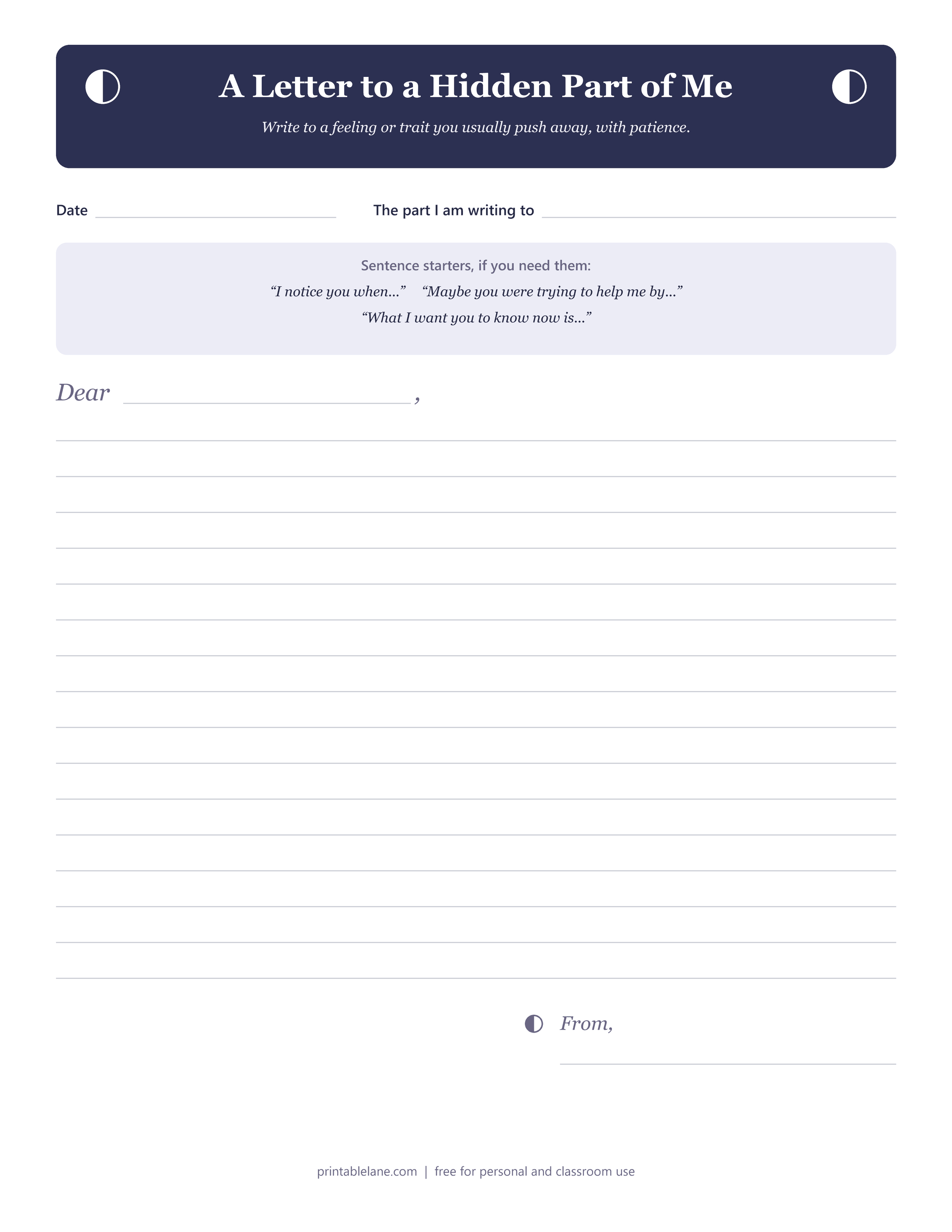
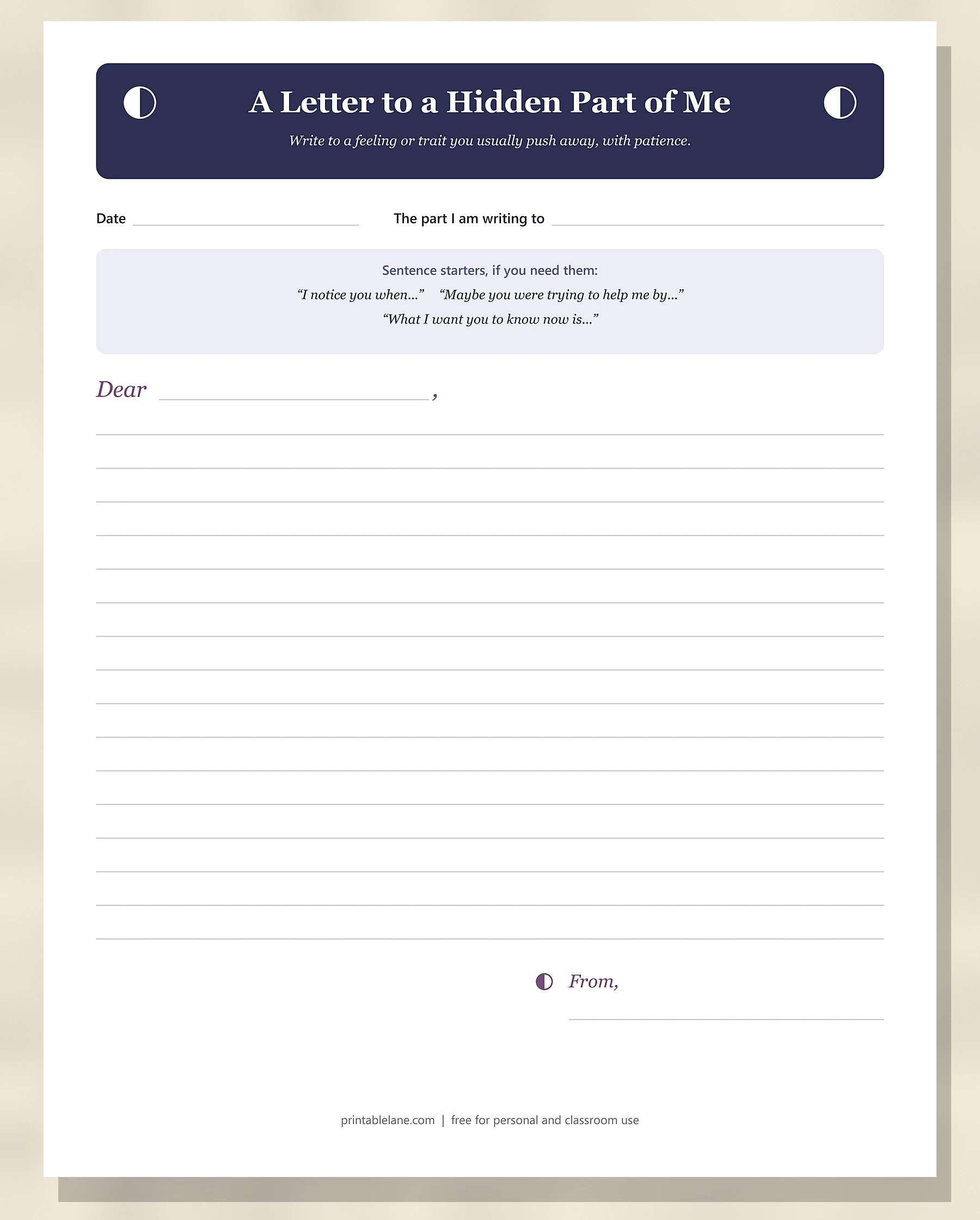
- Page 9: A Letter to a Hidden Part of Me
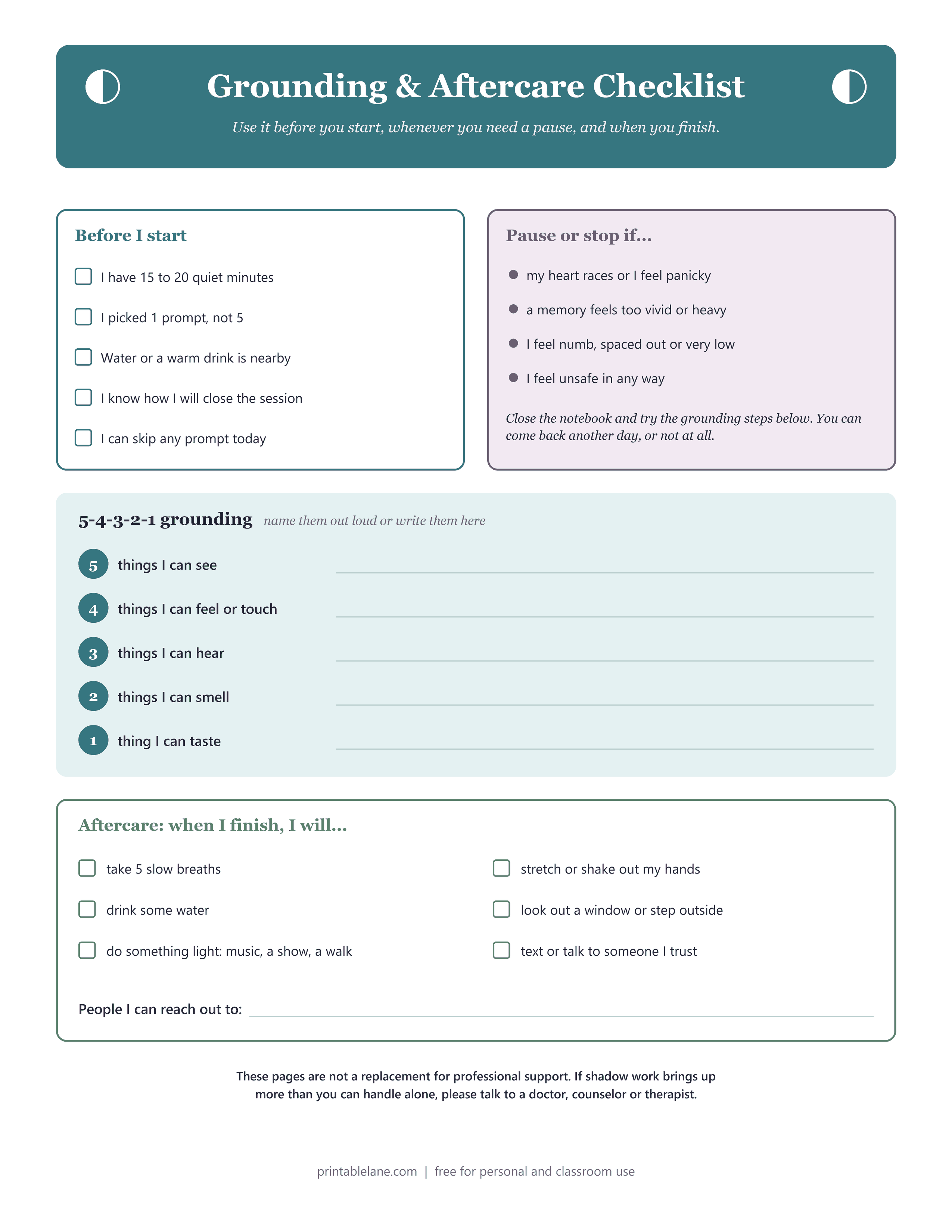
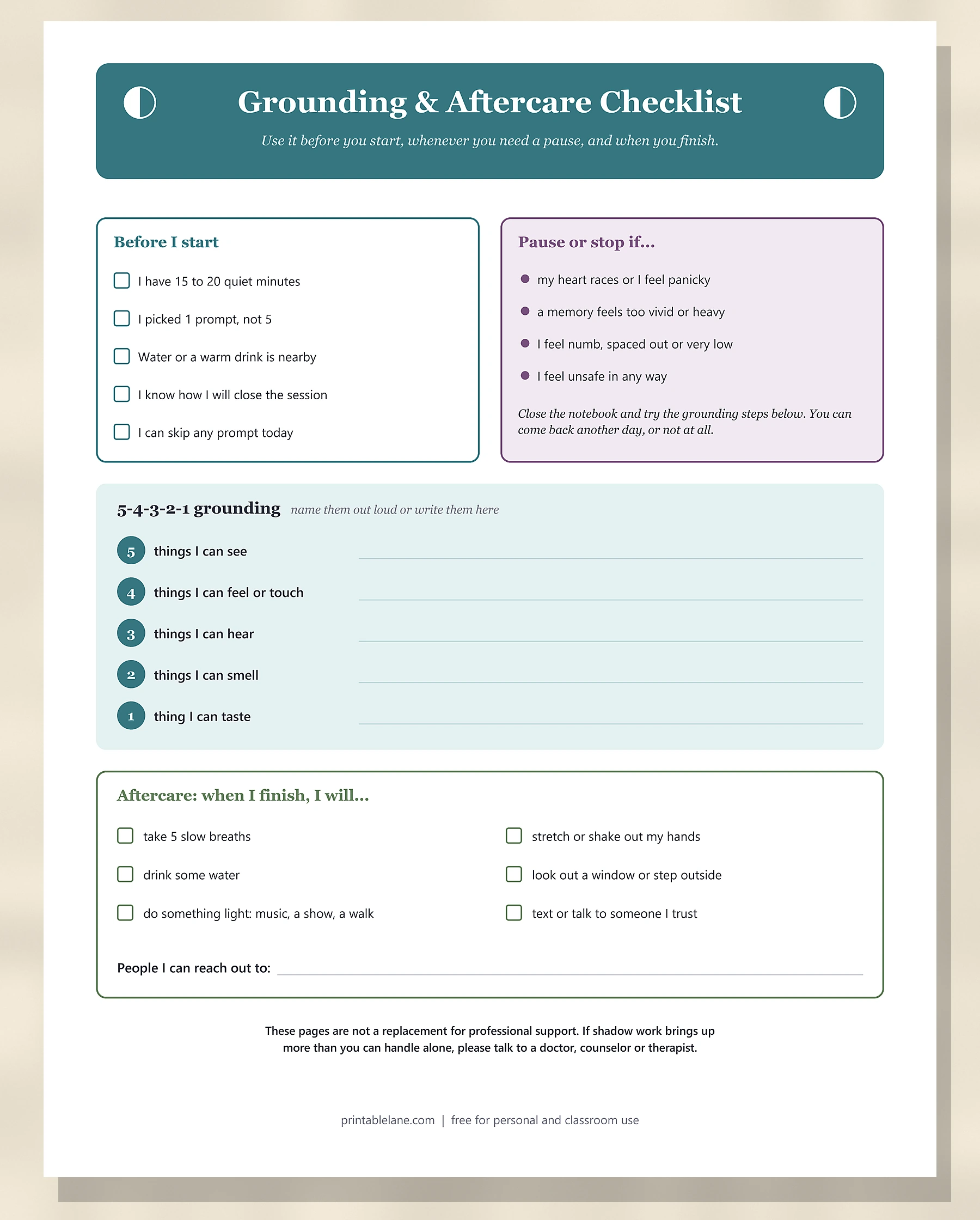
- Page 10: Grounding & Aftercare Checklist
All 36 journal prompts for shadow work
None of them repeat the self reflection journal prompts, so you can use both.
Shadow Work Journal Prompts 1 to 12
Gentle Start (prompts 1 to 6)
- 1. What does “shadow work” mean to me, in my own words, before I begin?
- 2. Which feeling is hardest for me to admit I have: anger, envy, sadness, fear or something else?
- 3. How am I different with strangers than with the people closest to me?
- 4. Finish this sentence 3 times: “I would hate for people to think I am…”
- 5. What do I hope to understand about myself by the time I finish these prompts?
- 6. What will I do to feel calm and settled after each journaling session?
Triggers & Reactions (prompts 7 to 12)
- 7. Describe a recent moment when my reaction felt bigger than the situation. What happened just before it?
- 8. Where in my body did I feel that reaction, and what did it feel like?
- 9. In that moment, what story did I tell myself about the other person, and about me?
- 10. Which small everyday things (being interrupted, waiting, being left out) irritate me most?
- 11. When I feel criticized, what do I usually do first: defend, go quiet, joke or apologize?
- 12. If my strongest reaction this week could speak, what would it say it needs?
Shadow Work Journal Prompts 13 to 24
The Inner Critic (prompts 13 to 18)
- 13. Which phrases does my inner critic repeat most often? Write them word for word.
- 14. Whose voice does my inner critic sound like, if it sounds like anyone?
- 15. What might my inner critic be trying to protect me from?
- 16. When does the critic get loudest: in the morning, before big events, or around certain people?
- 17. What would happen if I did the thing my critic warns me about, just a little?
- 18. What would a fair, steady coach say about the same situation?
Mirrors in Others (prompts 19 to 24)
- 19. Which trait in other people annoys me fastest? Where might a small version of it live in me?
- 20. Who do I judge without knowing them well, and what exactly do I judge?
- 21. Which behavior do I criticize in others but quietly allow in myself?
- 22. Who do I envy a little, and what does that envy say I want?
- 23. What do I secretly admire in someone I find difficult?
- 24. Which kinds of people do I avoid, and what feeling do they stir up in me?
Shadow Work Journal Prompts 25 to 36
Old Rules I Learned (prompts 25 to 30)
- 25. What were the unspoken rules about feelings in the home I grew up in?
- 26. Which emotions were welcome there, and which were hushed or brushed aside?
- 27. What did I learn I had to be (helpful, quiet, strong, funny) to fit in?
- 28. Which of those old rules still shapes my choices today?
- 29. Which rule would I like to soften, and what would the gentler version say?
- 30. Which family or cultural message do I want to keep because it truly fits me?
Hidden Strengths (prompts 31 to 36)
- 31. Which quality was I told was “too much” that could also be a strength?
- 32. When has my stubbornness, sensitivity or anger helped me or someone else?
- 33. What talent or wish did I put away because it seemed silly or impractical?
- 34. Which trait do I admire in others but rarely claim for myself?
- 35. How could a part of me I usually hide be used in a healthy way?
- 36. Write 3 sentences of thanks to a part of myself I have struggled to accept.
The 6 worksheets, page by page
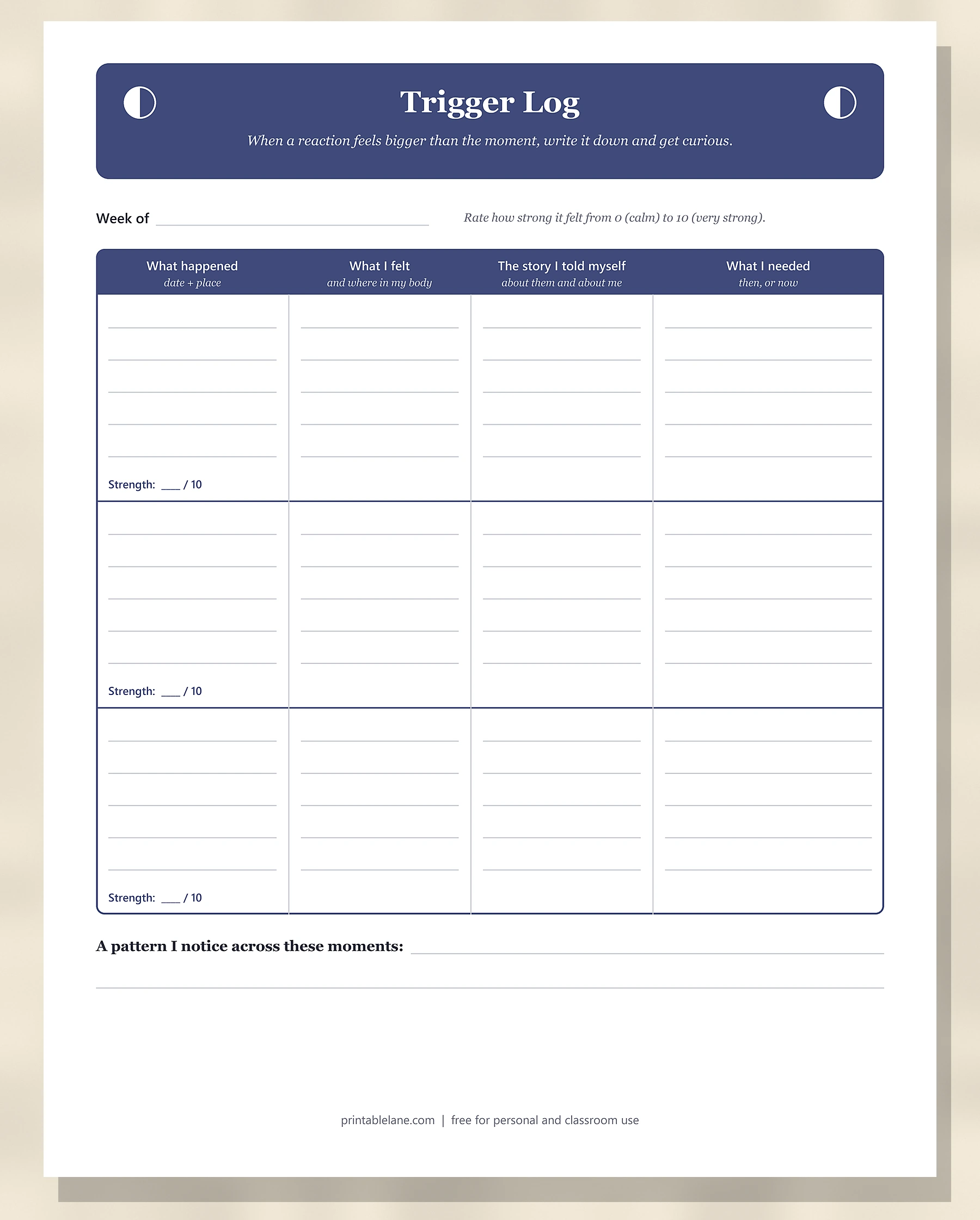
Trigger Log
PDF page 5: 3 entries with What happened, What I felt, The story I told myself and What I needed columns, a Strength ___ / 10 score each and a pattern line.
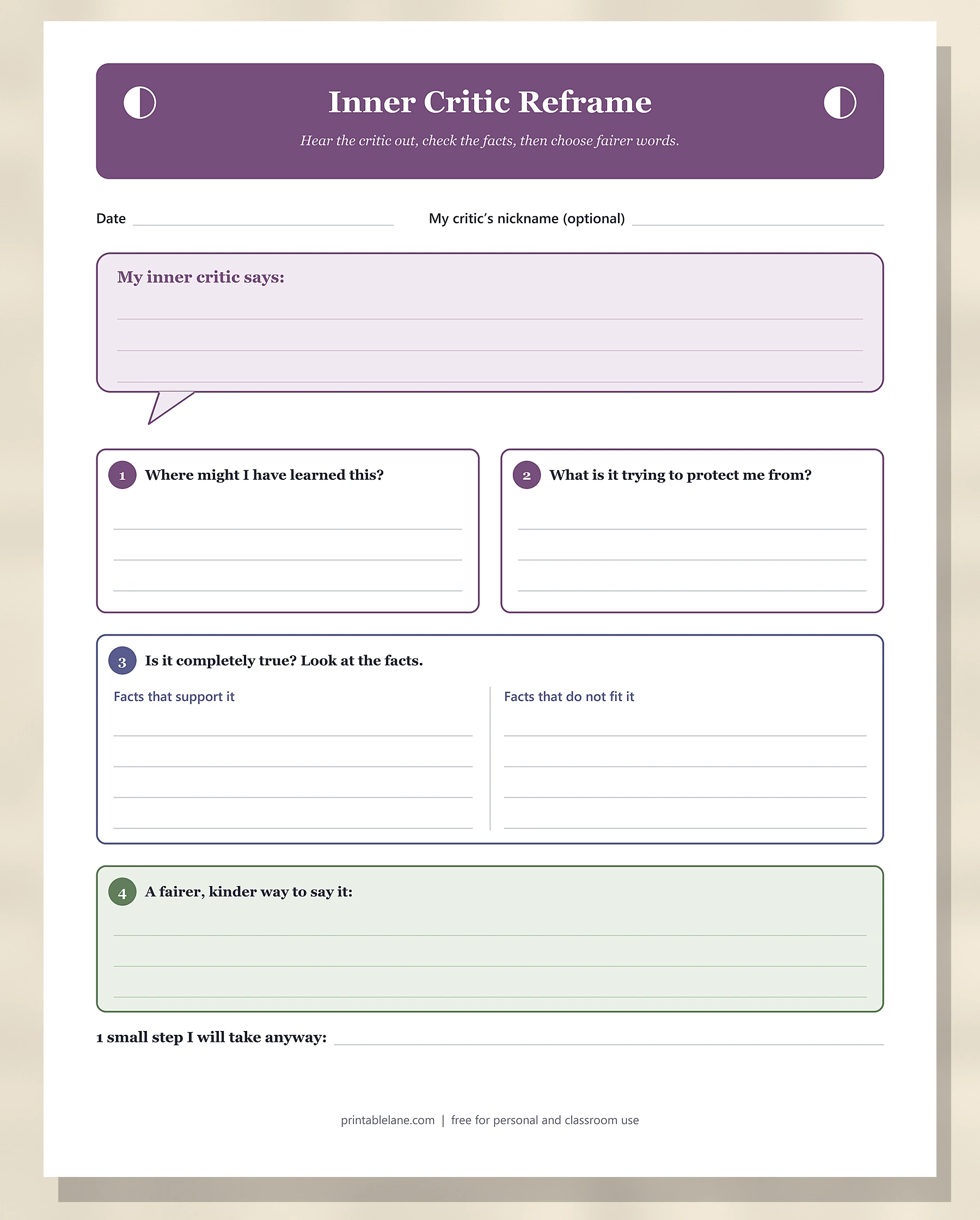
Inner Critic Reframe
PDF page 6: a “My inner critic says:” speech bubble, then 4 steps (where you learned it, what it protects you from, facts for and against, a fairer way to say it) and 1 small step.
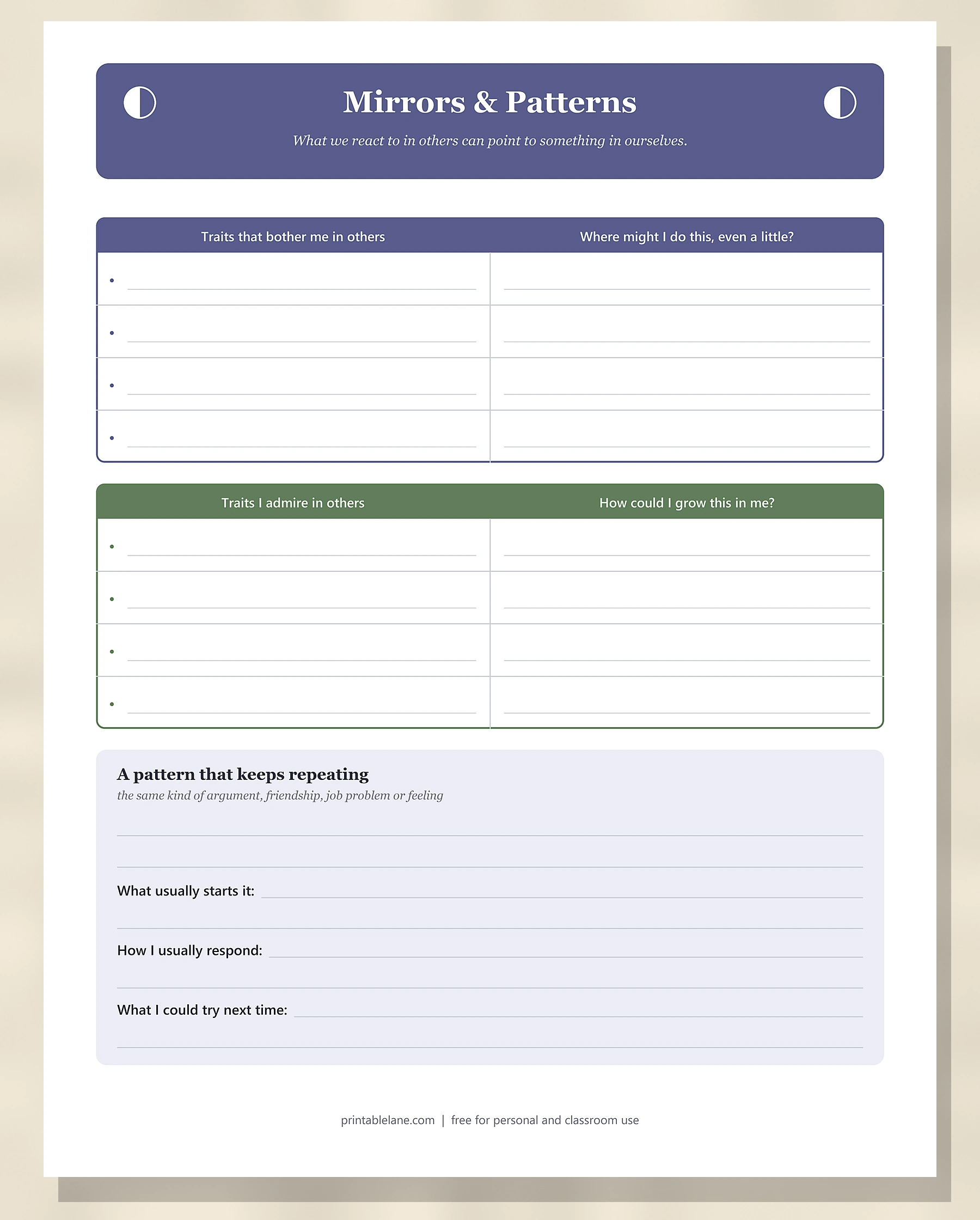
Mirrors & Patterns
PDF page 7: 2 tables of 4 rows (traits that bother me in others, traits I admire in others) and a box for A pattern that keeps repeating.
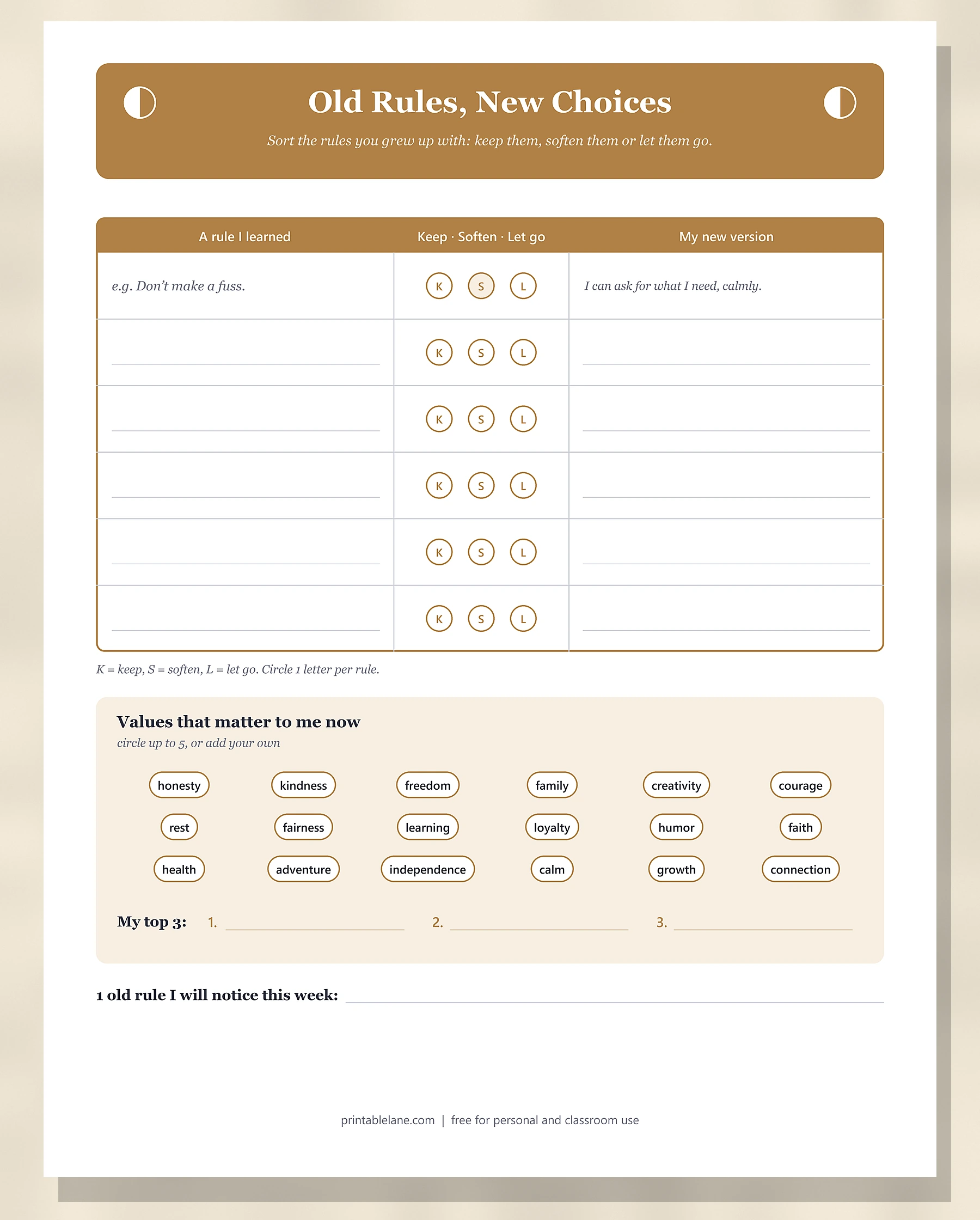
Old Rules, New Choices
PDF page 8: 6 rule rows with K, S and L circles (keep, soften, let go) and My new version, plus 18 value words to circle and a My top 3 line.
A Letter to a Hidden Part of Me
PDF page 9: The part I am writing to line, 3 sentence starters, “Dear ___,” and 16 writing lines.
Grounding & Aftercare Checklist
PDF page 10: Before I start (5 boxes), Pause or stop if… (4 signs), 5-4-3-2-1 grounding by the senses, 6 aftercare boxes and a People I can reach out to line.
Your first 3 sessions: a slow plan
- Session 1: read page 10, then answer prompts 1 and 6 only.
- Session 2: log 1 moment on the Trigger Log and answer prompt 8 about it.
- Session 3: pick a Hidden Strengths prompt and end with 2 aftercare boxes.
Signs a prompt is too much for today
Mild discomfort is normal. Panic, numbness or a too-vivid memory means stop and do the 5-4-3-2-1 steps. If old pain keeps returning, a therapist can help.
Printing and paper
- US Letter: print at 100%.
- A4: Fit to page or 100% both work, since no worksheet box has a set size.
- Paper: plain copy paper works for every page.
- More room: long letters fit on sheets of free printable lined paper.
Print only the pages you need
Need a fresh Trigger Log each week? Each inside page is its own PNG.
- Shadow Work Journal Prompts 1 to 12 (PNG)
- Shadow Work Journal Prompts 13 to 24 (PNG)
- Shadow Work Journal Prompts 25 to 36 (PNG)
- Trigger Log (PNG)
- Inner Critic Reframe (PNG)
- Mirrors & Patterns (PNG)
- Old Rules, New Choices (PNG)
- A Letter to a Hidden Part of Me (PNG)
- Grounding & Aftercare Checklist (PNG)
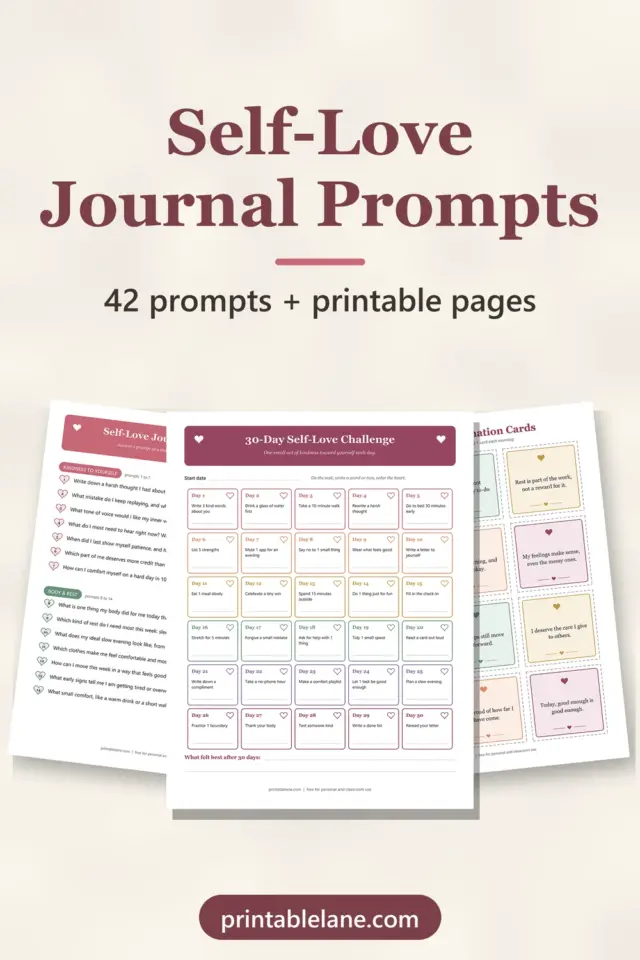
After a heavy session, the self-love journal prompts or bullet journal mood tracker ideas make a kind follow-up.
Frequently asked questions
How many pages are in the PDF?
10 pages: the cover, all 36 prompts on pages 2 to 4 and 6 worksheets on pages 5 to 10.
Can I print the shadow work pages on A4 paper?
Yes, at 100% or Fit to page. The 0.5 in side margins are wider than the 0.12 in A4 trims per side.
Is shadow work safe for beginners?
The prompts start gently and any can be skipped. Stop if you feel overwhelmed and keep page 10 close.
Can shadow work replace therapy?
No. It is a journaling practice, not treatment. If strong feelings keep coming up, talk to a doctor, counselor or therapist.
Can teenagers use these prompts?
Older teens can try the Gentle Start and Hidden Strengths themes. Younger writers may prefer the journal prompts for teens.