Rockets, planets and astronauts are some of the most requested coloring pictures, and it is easy to see why: space has room for every kid’s imagination. These space coloring pages mix real things to learn about, like the solar system and a space station, with silly ones, like a cat in a space helmet riding a rocket.
There are 8 coloring pages, and the free PDF has 9 pages: a cover and 8 coloring pages. Every page uses bold, friendly line art with big areas to fill, so preschoolers can color with crayons and older kids can add shading with markers or pencils. They pair well with a science lesson, a space-themed birthday or a rainy afternoon.
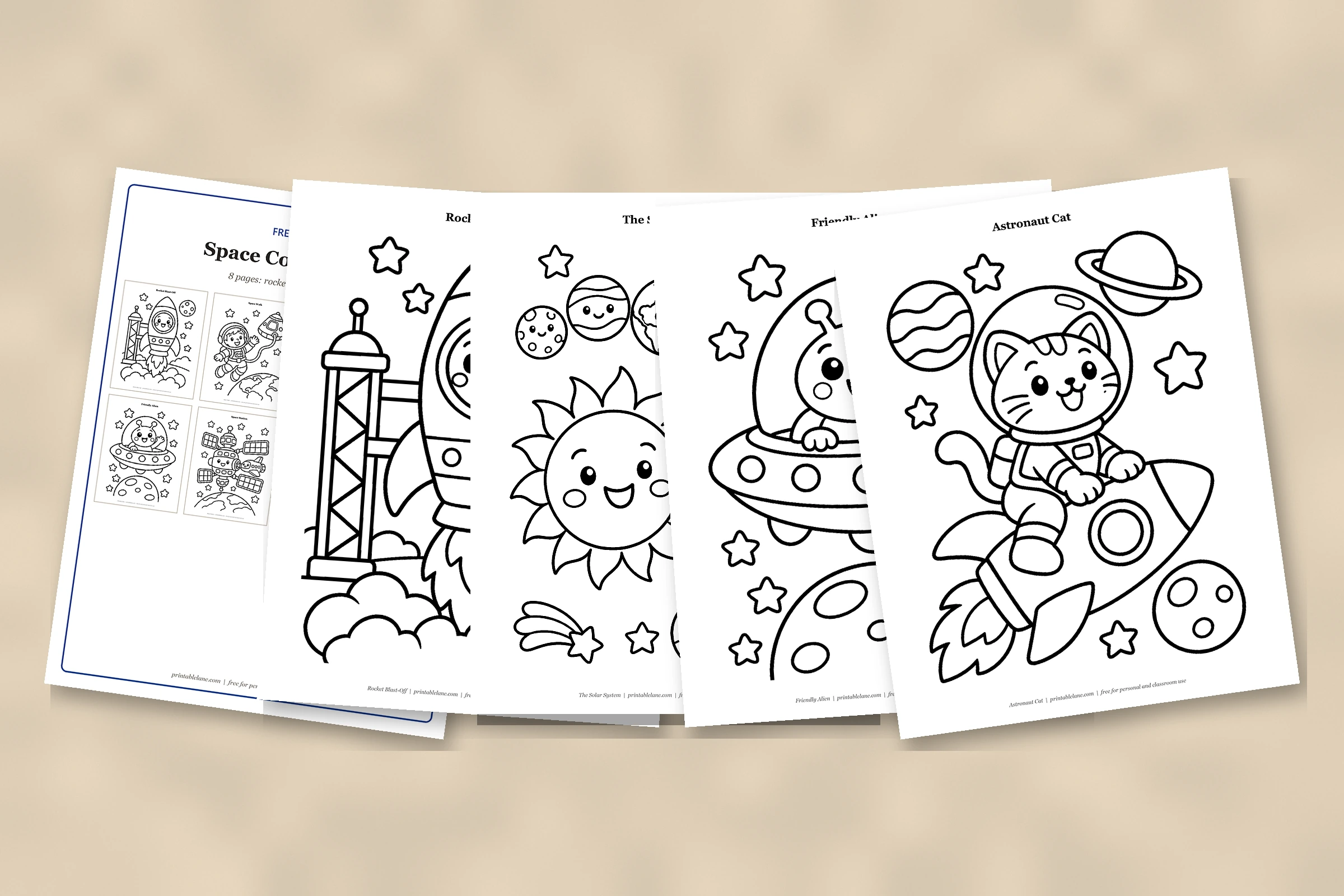
What’s in the PDF (9 pages)
- Page 1: cover
- Page 2: Rocket Blast-Off (Easy)
- Page 3: Space Walk (Easy)
- Page 4: The Solar System (Medium)
- Page 5: A Garden on the Moon (Medium)
- Page 6: Friendly Alien (Easy)
- Page 7: Space Station (Medium)
- Page 8: Astronaut Cat (Easy)
- Page 9: Stargazing (Medium)
Which page should you start with?
Start with a single big object floating in space, then move on to the scenes with more parts. The medium pages also have the most to talk about, so they work well when you want coloring and learning at the same time.
- Easy (10 to 20 minutes): Rocket Blast-Off, Space Walk, Friendly Alien, Astronaut Cat
- Medium (20 to 40 minutes): The Solar System, A Garden on the Moon, Space Station, Stargazing
The 8 space coloring pages
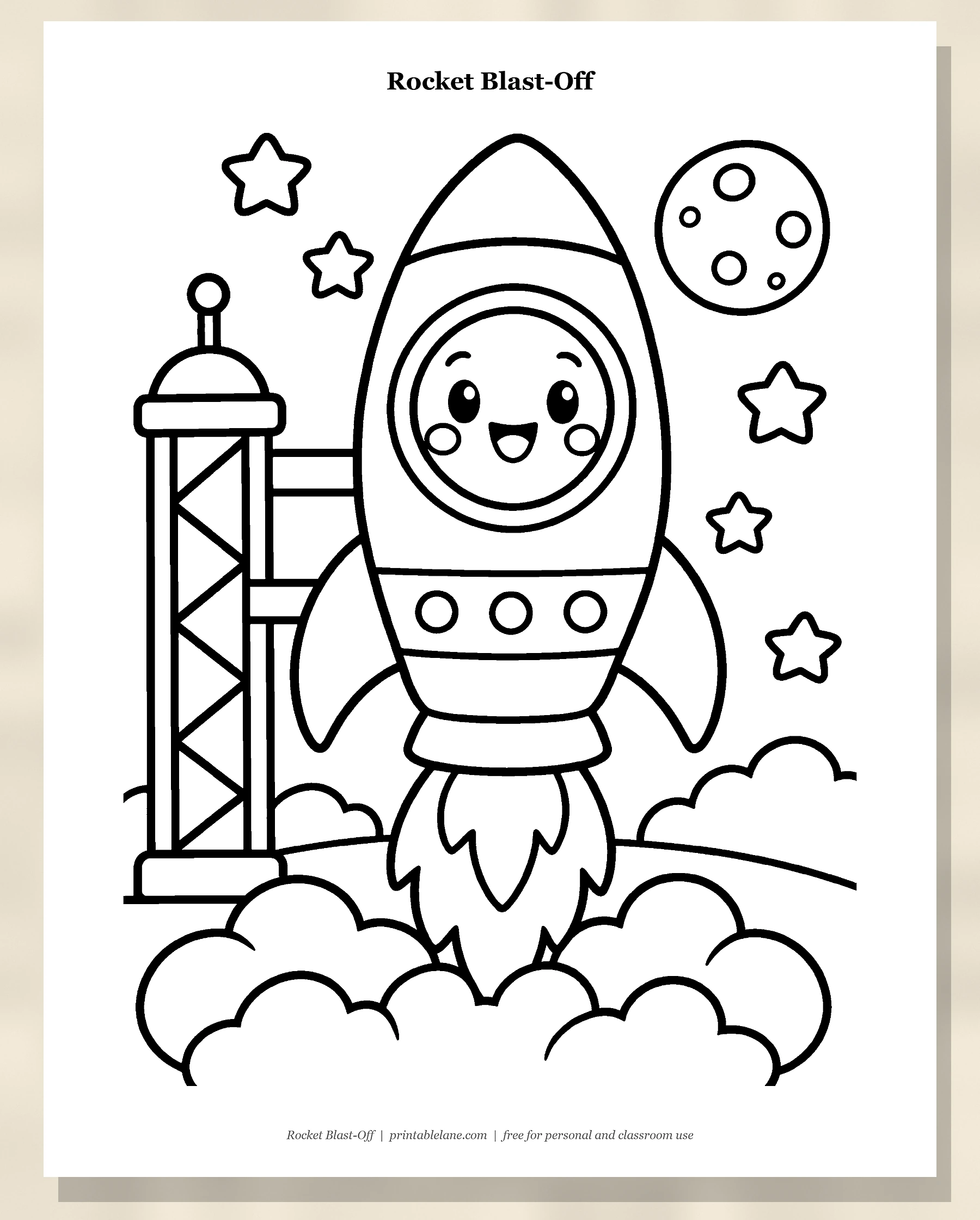
Rocket Blast-Off
Easy · PDF page 2
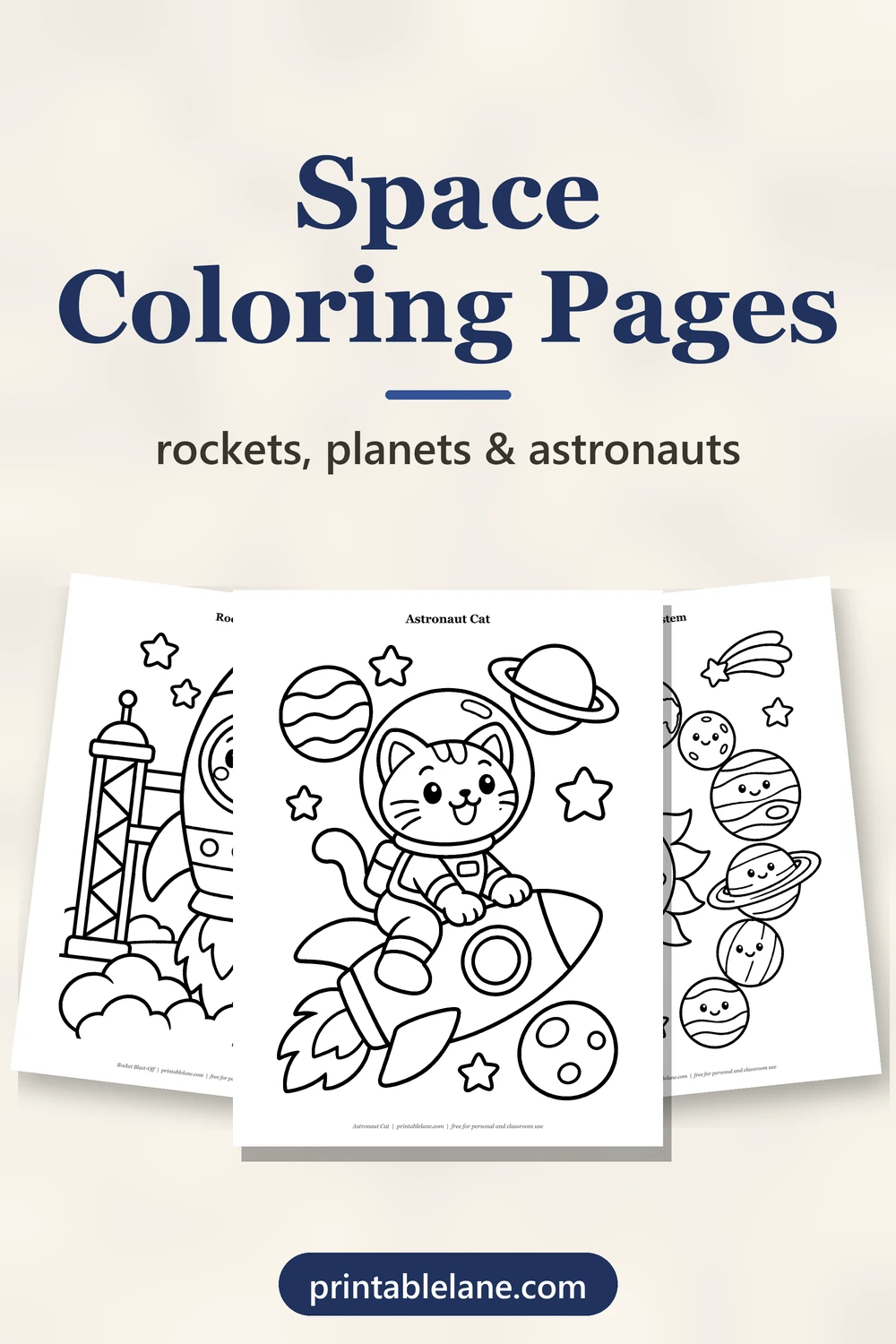
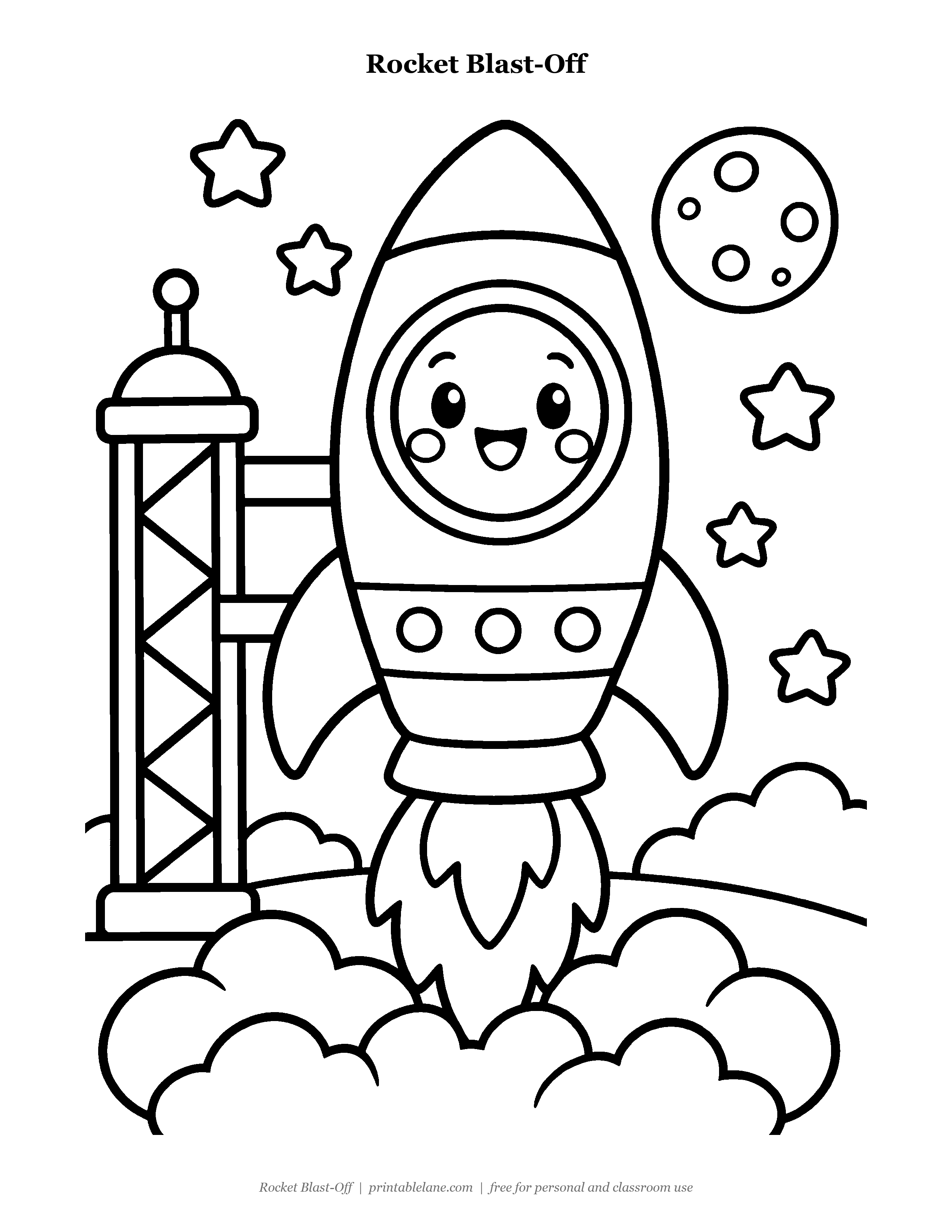
A rocket with a smiling face in its round porthole lifts off on a big flame. Puffy smoke clouds billow at the bottom, a launch tower stands on the left, and a cratered moon hangs among the stars. The shapes are large and simple, a perfect first page.
Space Walk
Easy · PDF page 3
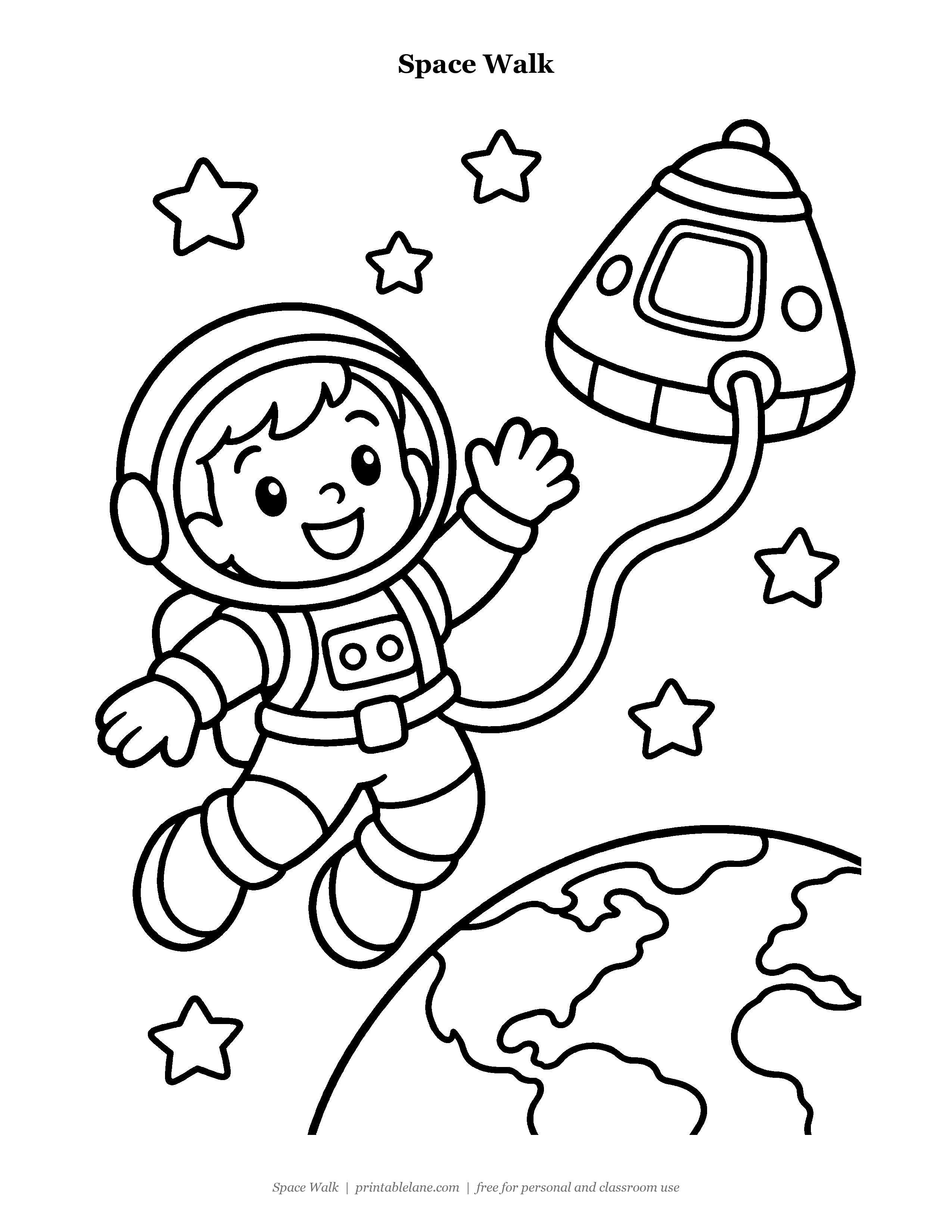
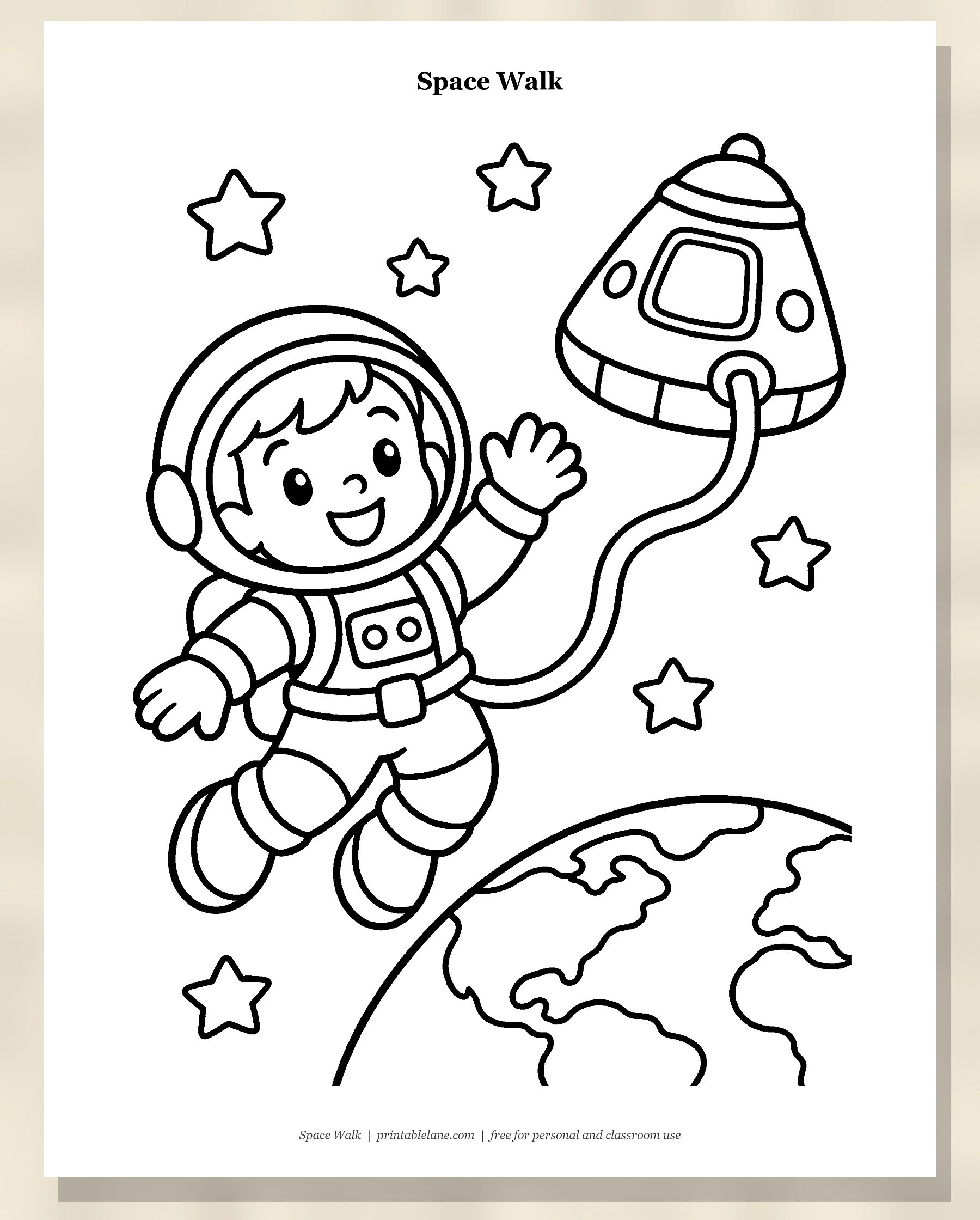
A child astronaut floats in space and waves, tied by a curly tether to a capsule in the top corner. The curve of Earth fills the bottom of the page, with stars all around. Point out the tether: real astronauts stay clipped on during space walks so they can’t drift away.
The Solar System
Medium · PDF page 4
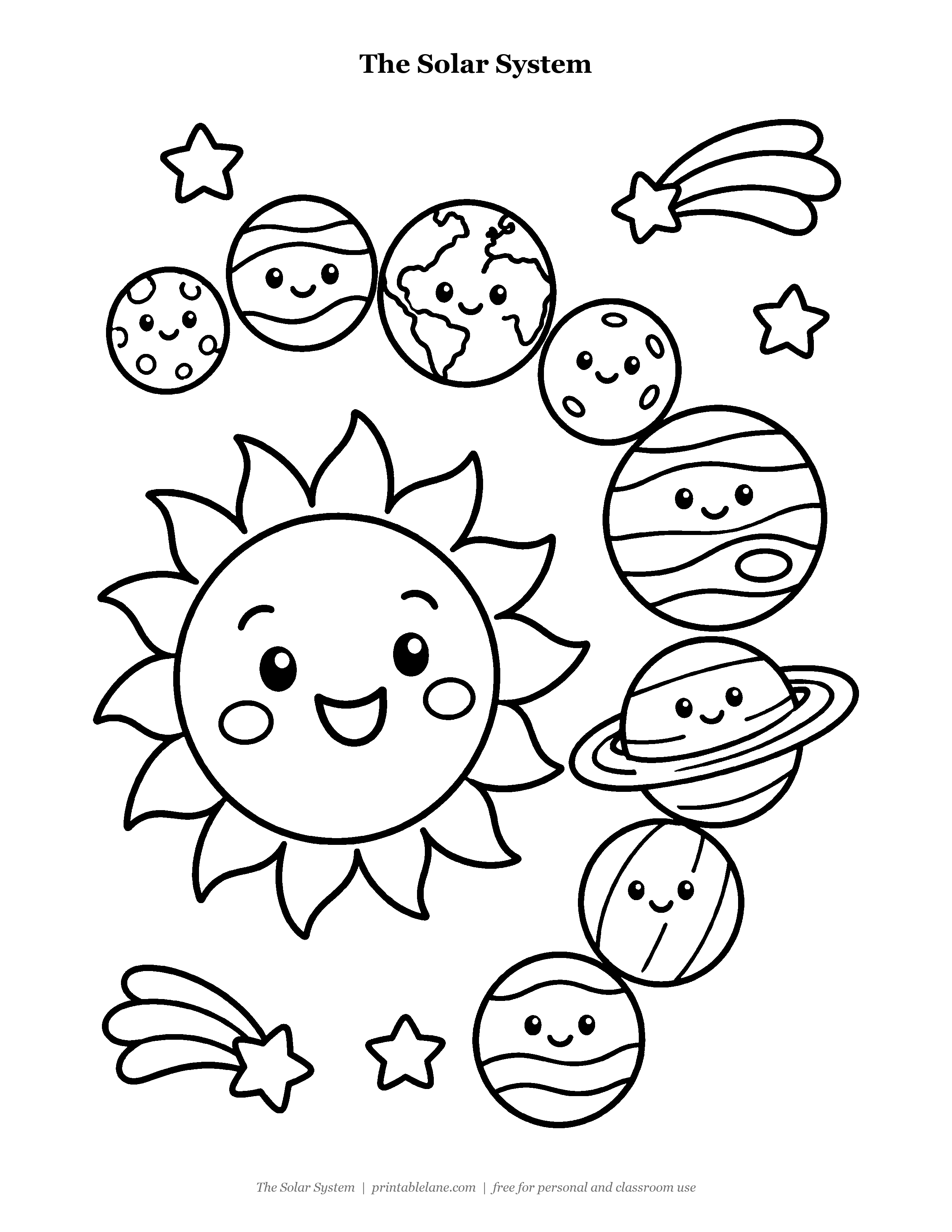
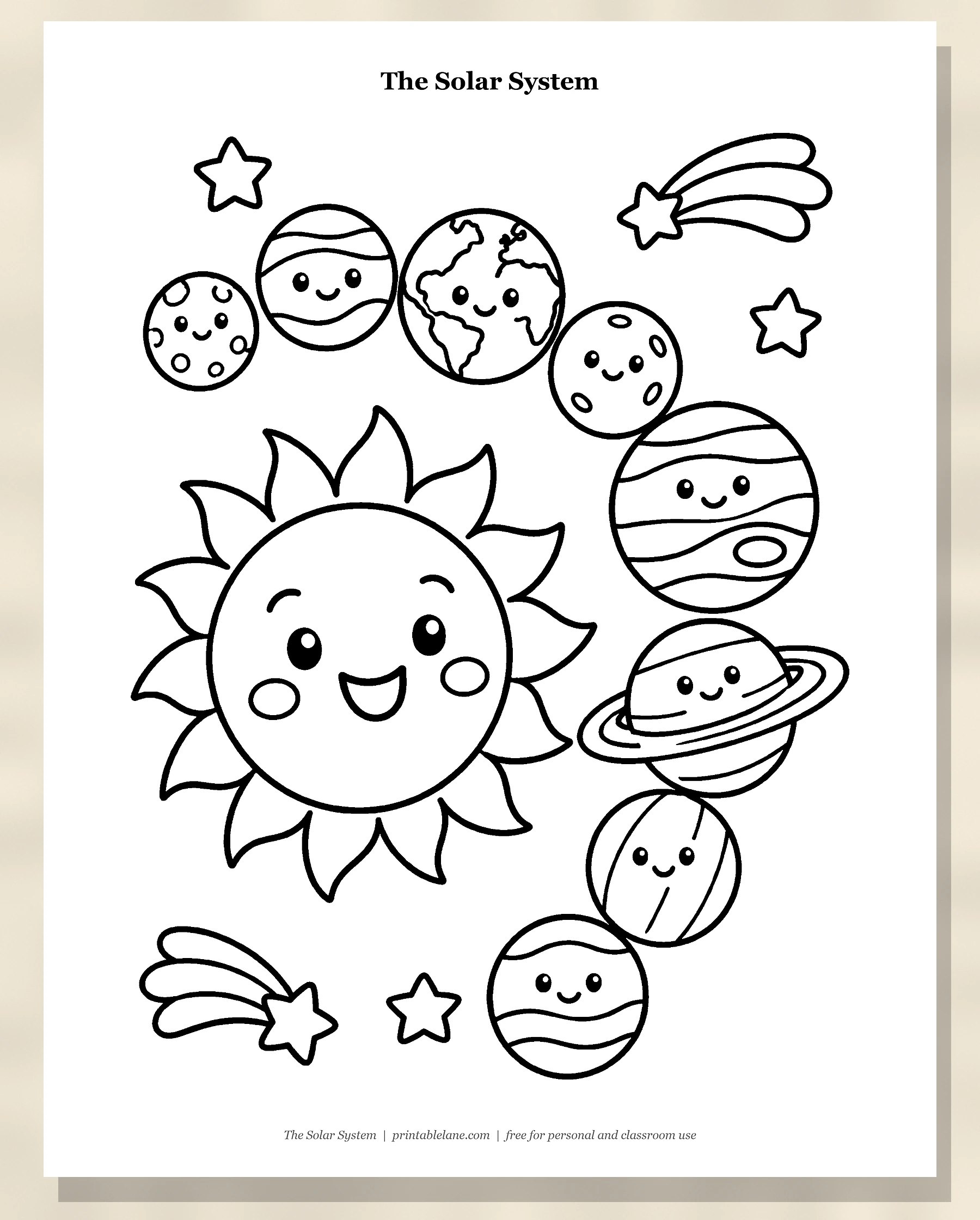
A smiling sun with wavy rays sits on the left, and 8 smiling planets curve around it, with 2 shooting stars and a few small stars in the gaps. Follow the arc from the small cratered planet at the top left and the order matches the real planets: Earth, with its continents, is third, and ringed Saturn is sixth.
A Garden on the Moon
Medium · PDF page 5
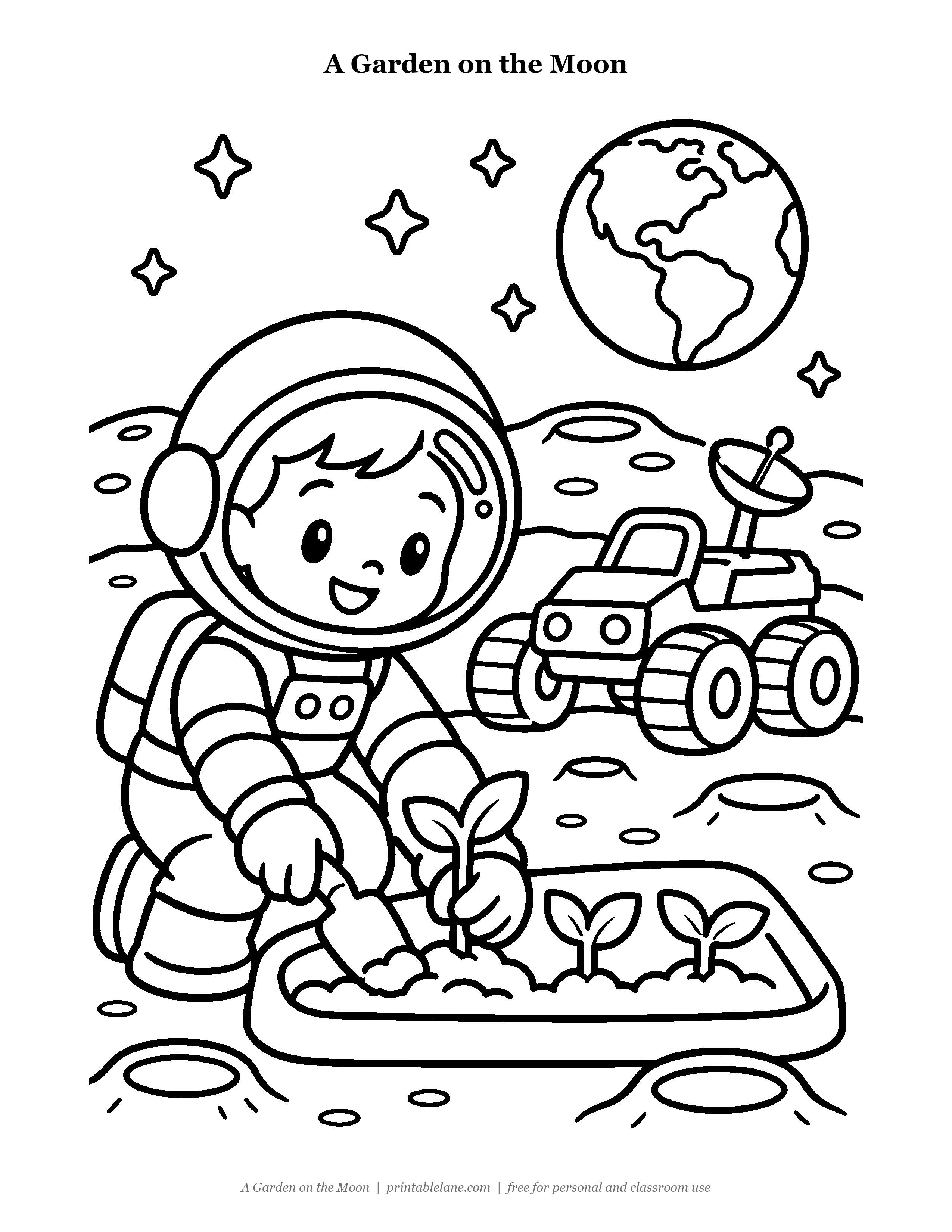
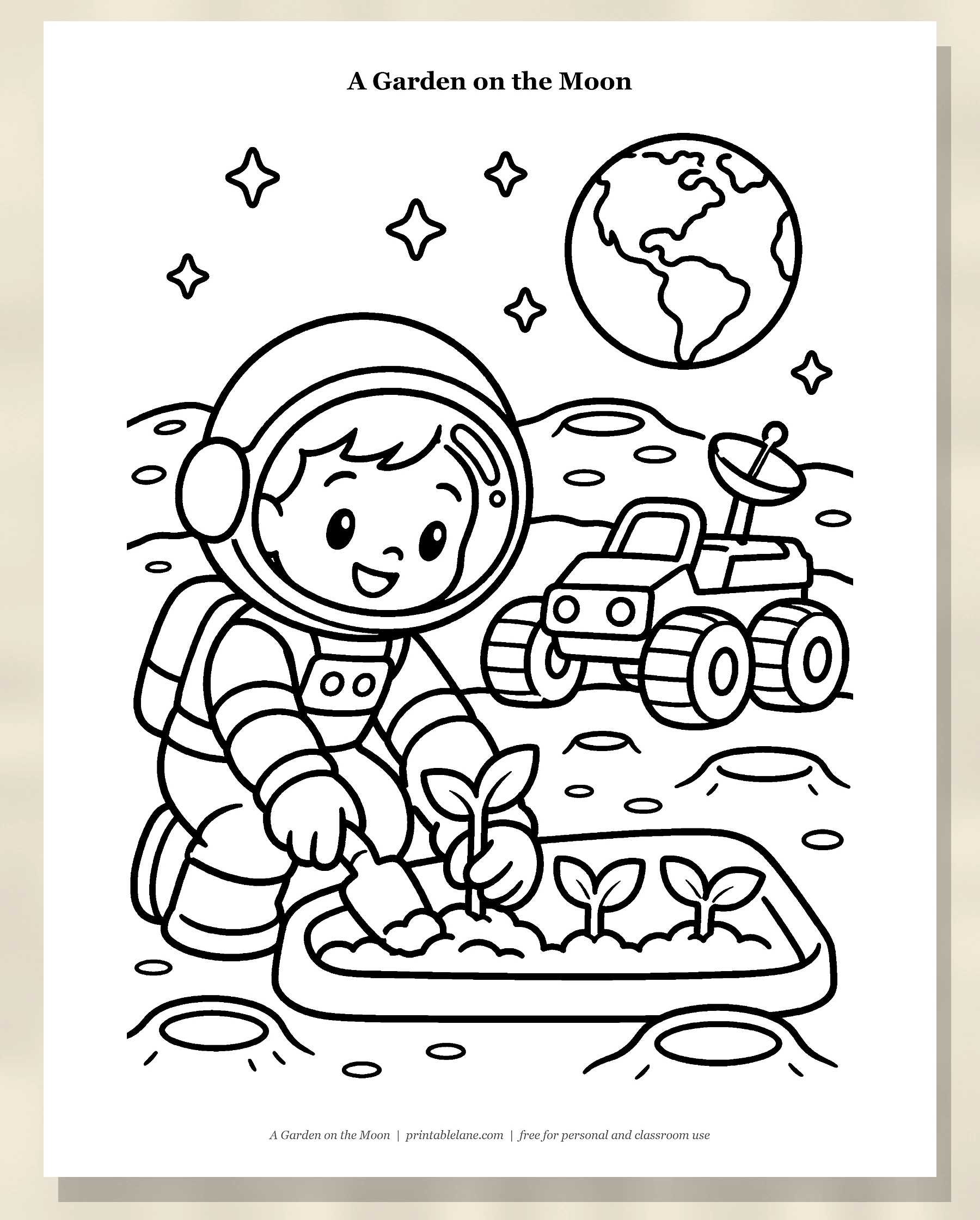
A young astronaut kneels on the cratered moon, planting seedlings in a raised garden box with a little trowel. A moon rover with a dish antenna waits behind, and Earth hangs in the starry sky. It is a fun starting point for the question “could we grow food in space?”
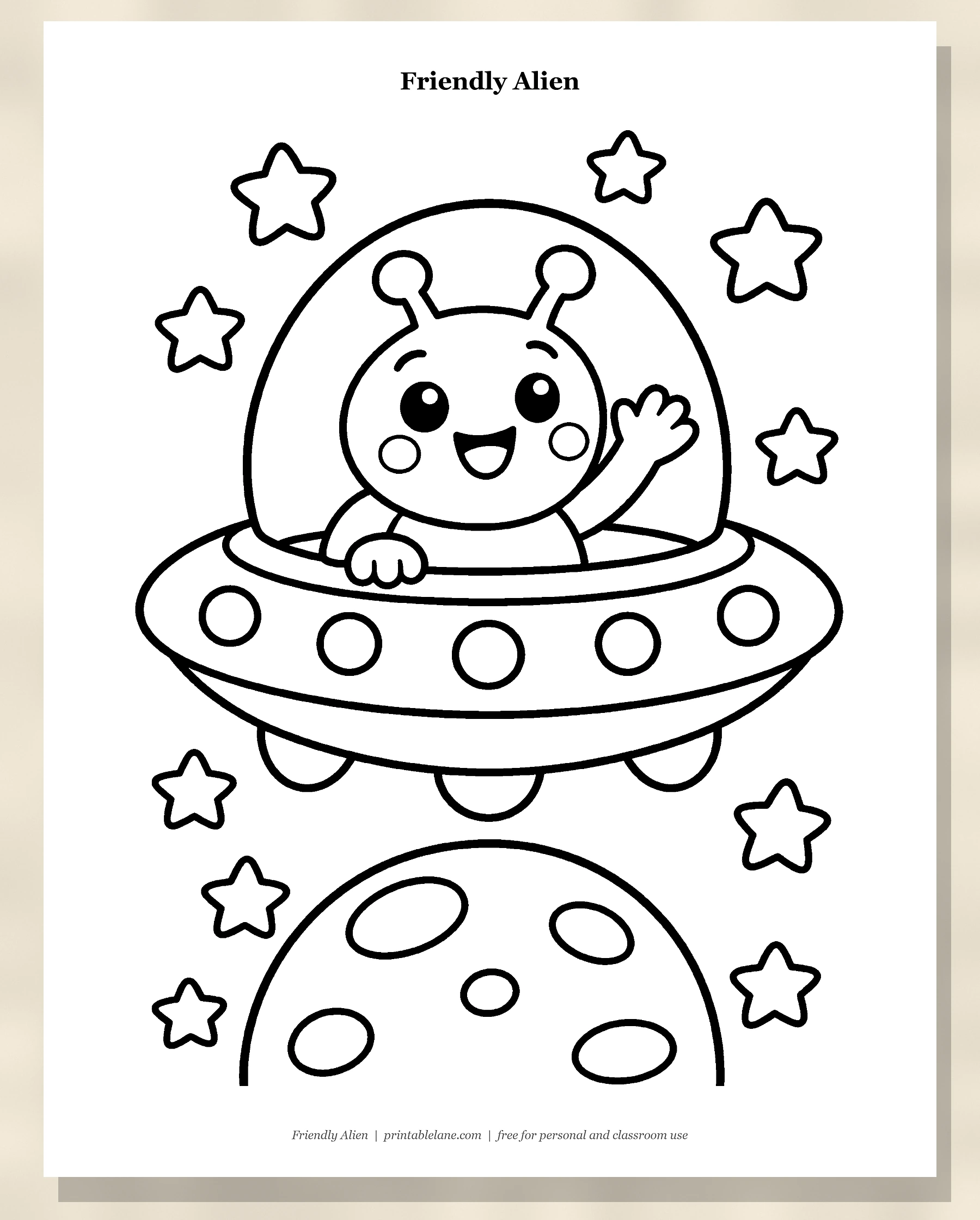
Friendly Alien
Easy · PDF page 6
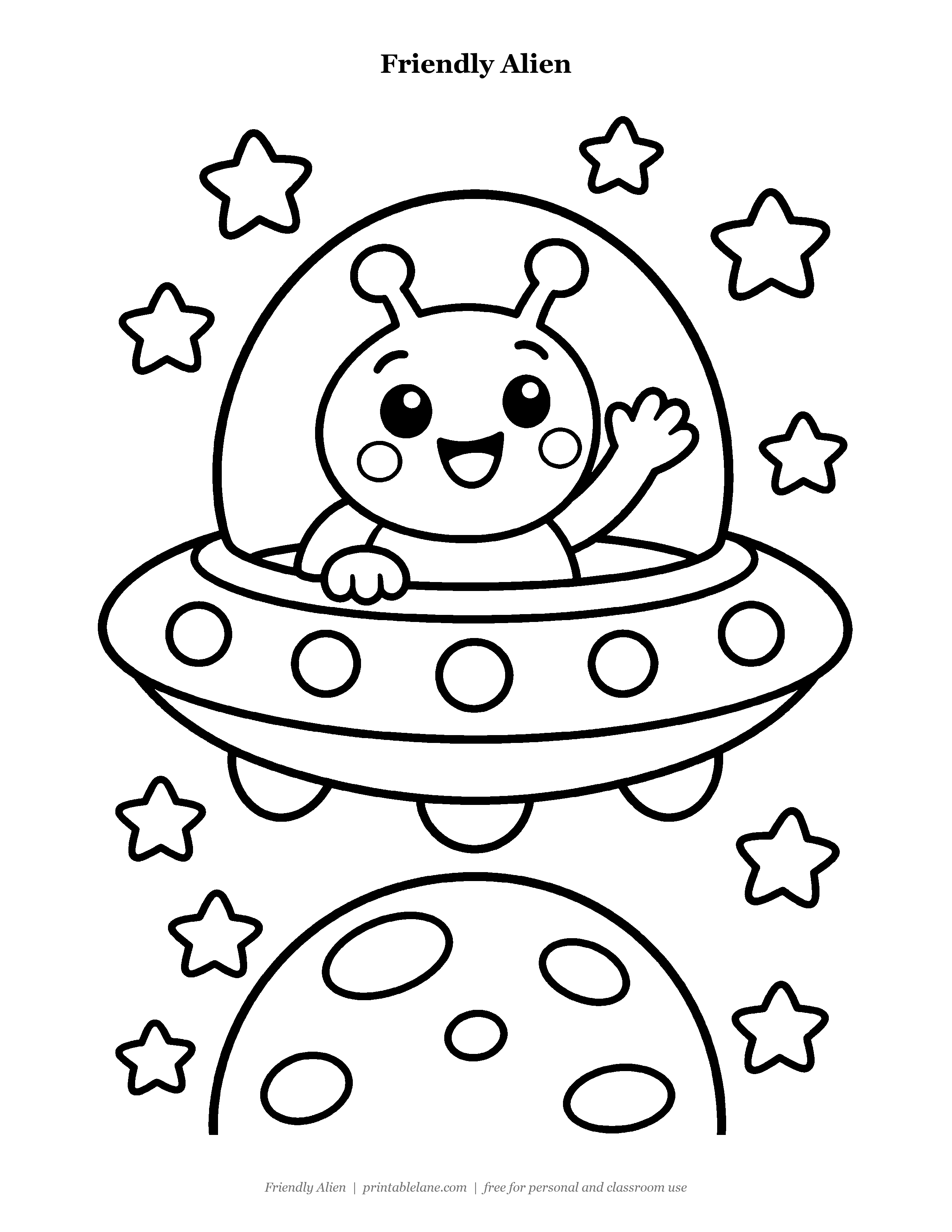
A happy alien with 2 antennae waves from the glass dome of a flying saucer. The saucer has a row of round lights, and a cratered planet curves across the bottom of the page among lots of stars.
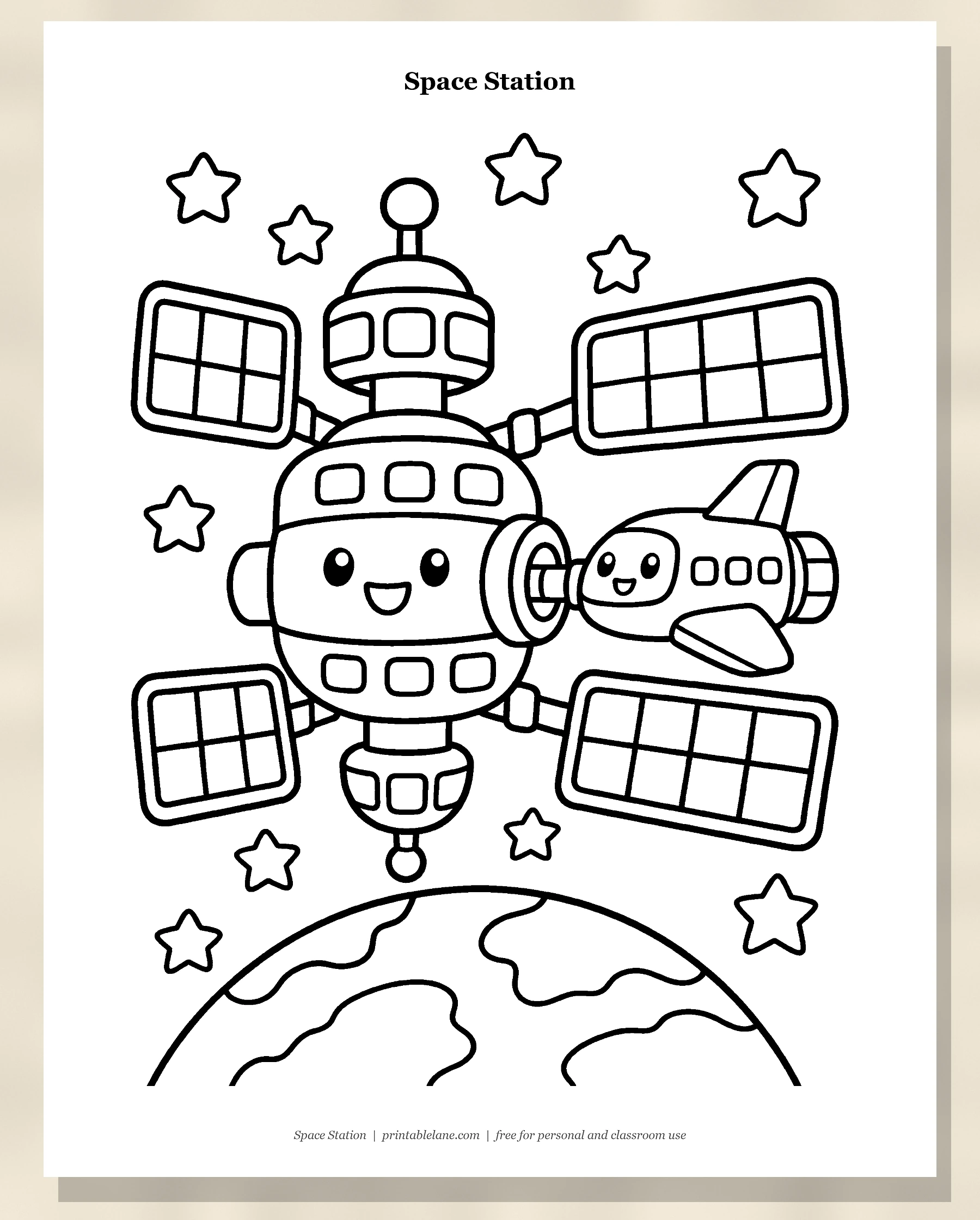
Space Station
Medium · PDF page 7
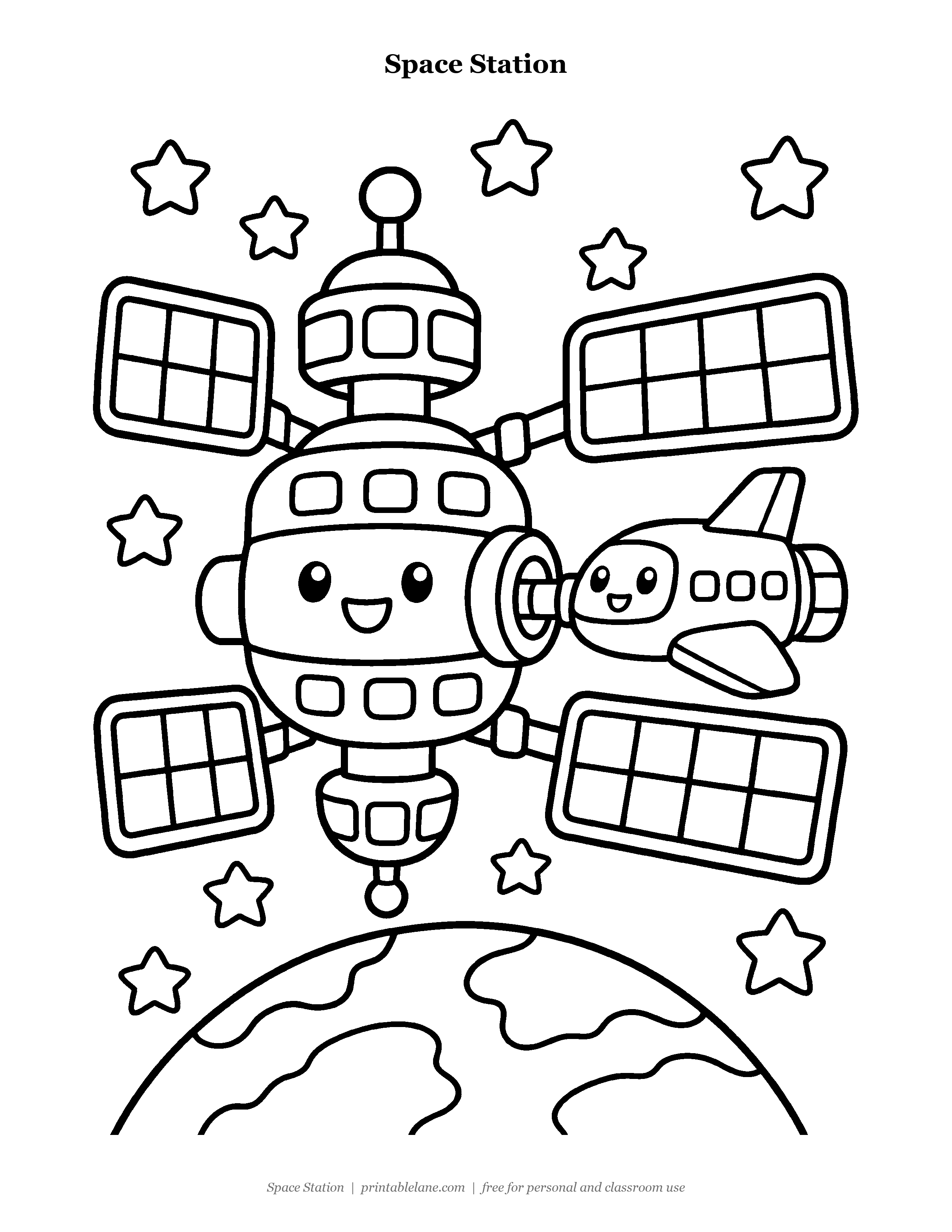
A smiling space station with 4 grid-like solar panels and stacked round modules floats above Earth. A small smiling shuttle docks on its right side, and stars fill the sky. Each solar panel square can be a different shade of blue.
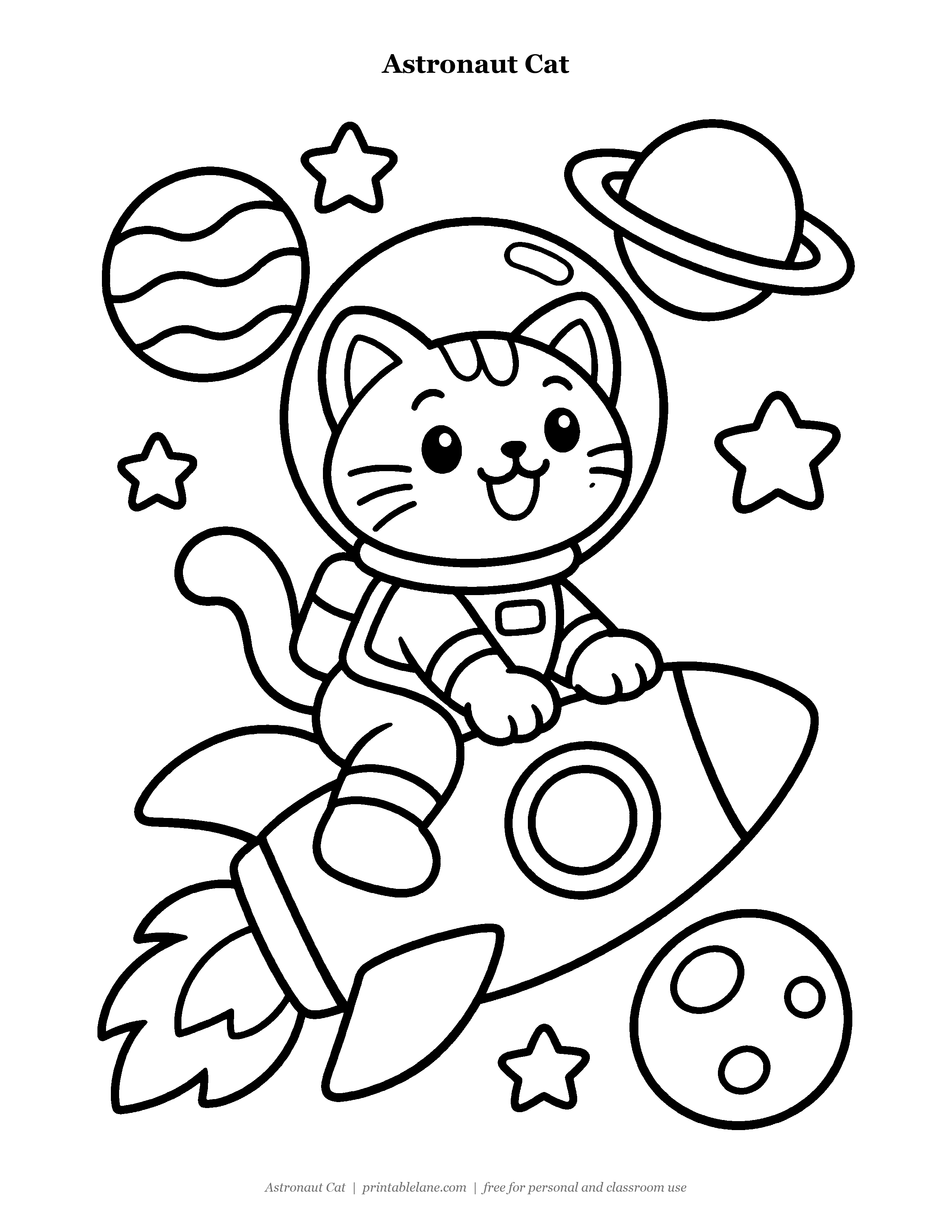
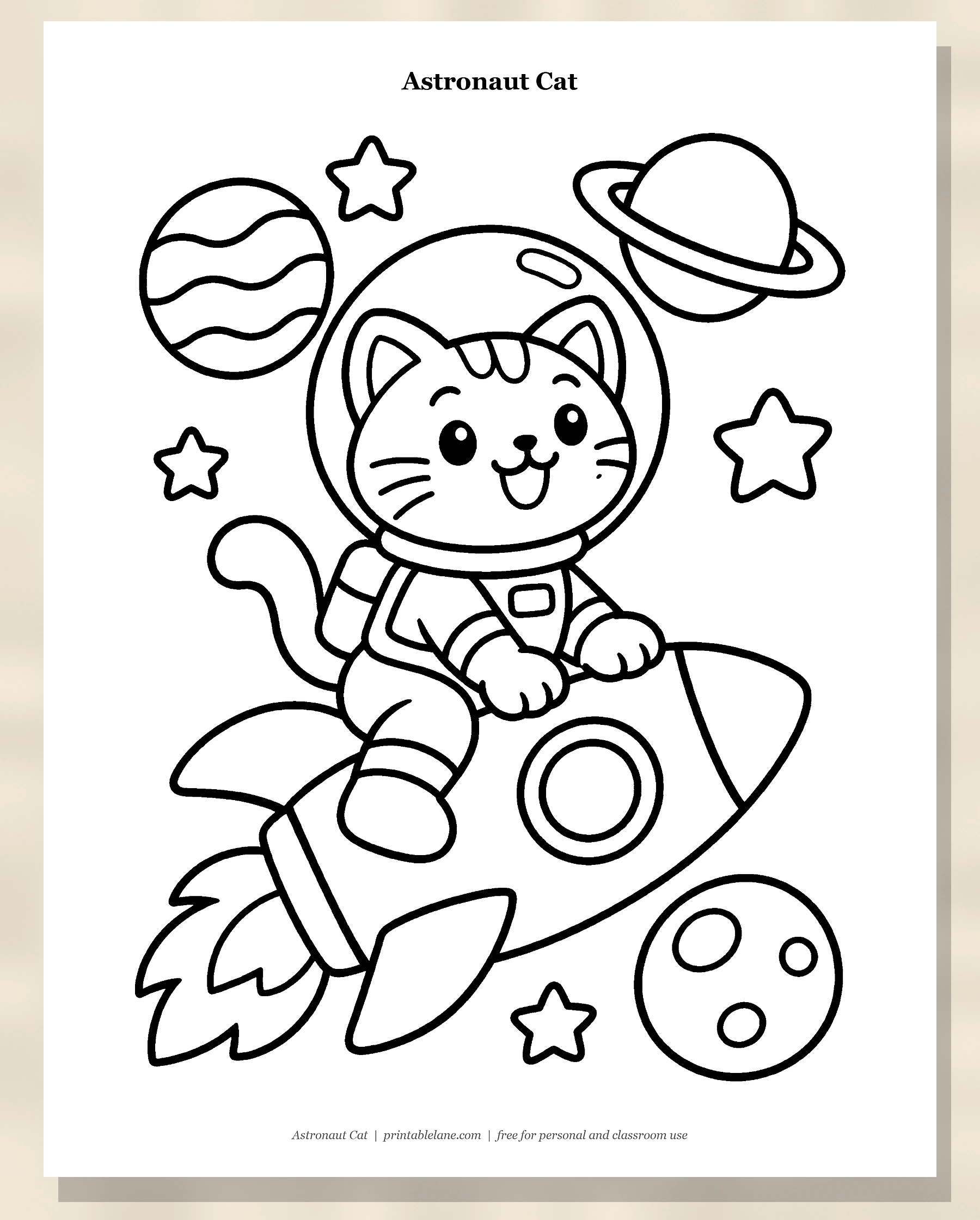
Astronaut Cat
Easy · PDF page 8
A striped cat in a space helmet and suit rides a rocket through space. A ringed planet, a striped planet and a cratered moon surround it, with stars scattered in between. Younger kids usually pick this one first.
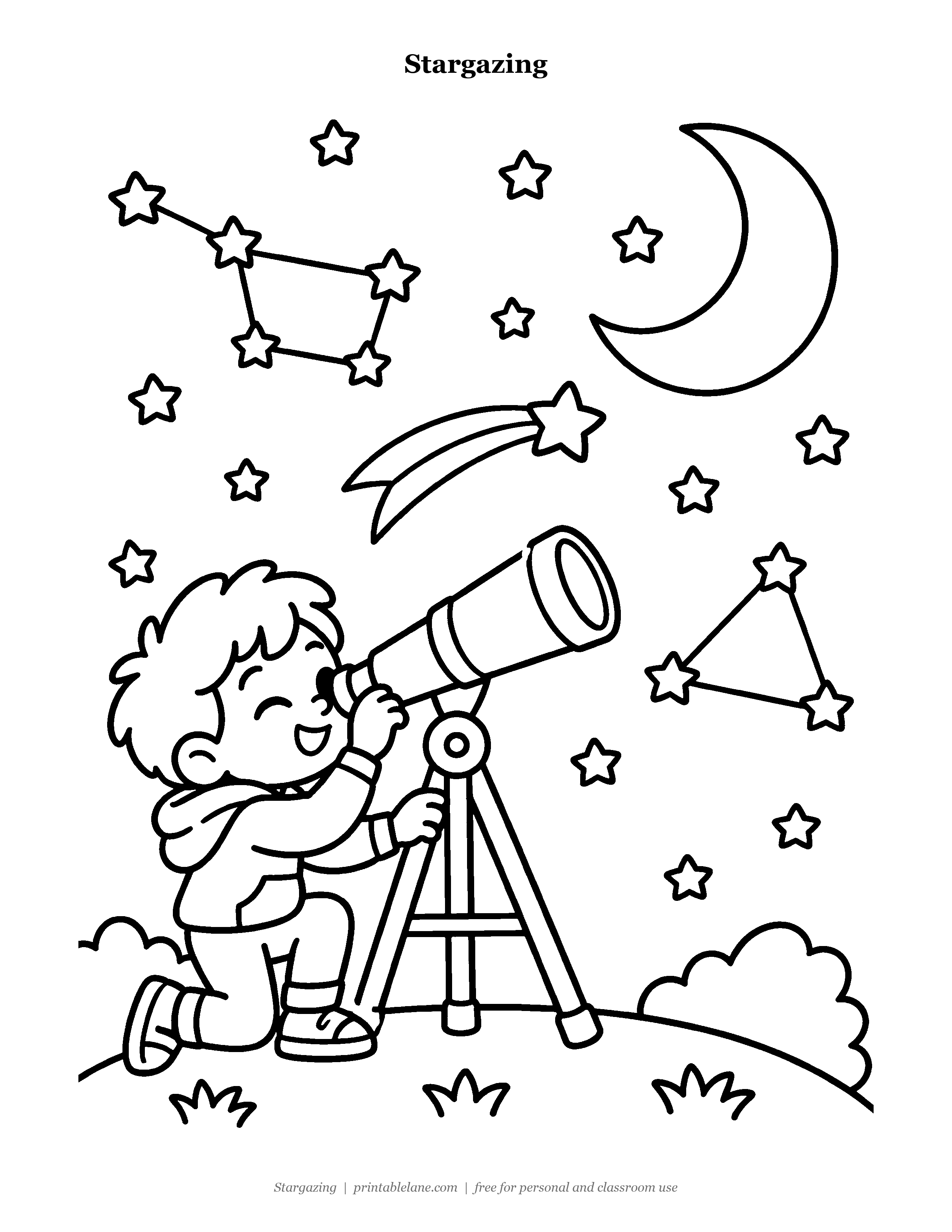
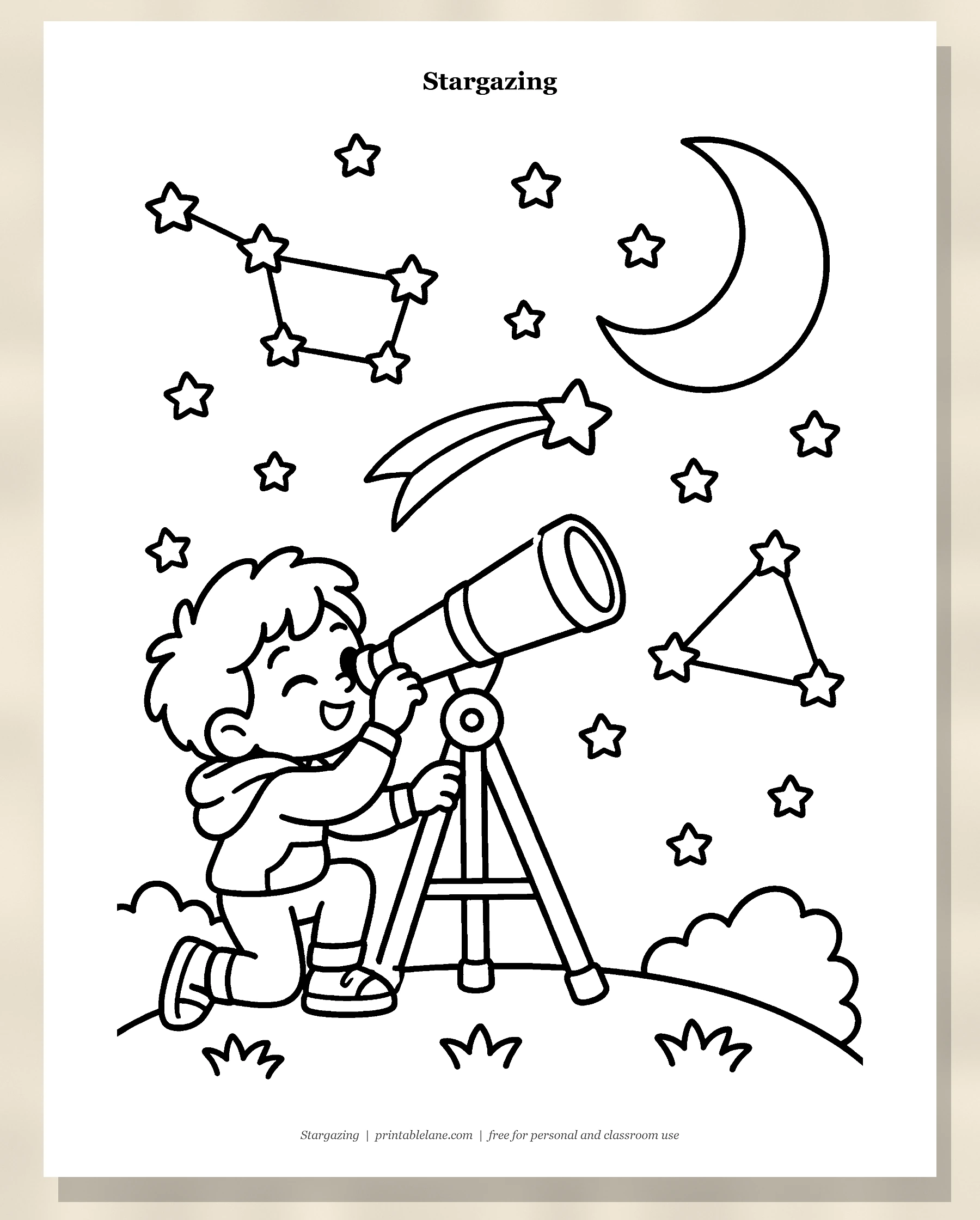
Stargazing
Medium · PDF page 9
A kid kneels on a grassy hill and looks through a telescope on a tripod. Above are a crescent moon, a shooting star, many small stars and 2 constellation shapes joined by lines: one made of 5 stars and a triangle of 3.
Color the planets like the real ones
The solar system page doubles as a science lesson. Here are colors close to what each planet really looks like, in order from the Sun:
- Mercury: gray, with darker gray craters.
- Venus: pale yellow and cream, because thick clouds cover it.
- Earth: blue oceans, green and brown land, and white clouds.
- Mars: rusty red-orange, from iron-rich dust.
- Jupiter: cream, tan and brown stripes with a red-orange spot, a storm bigger than Earth.
- Saturn: pale gold with tan rings.
- Uranus: light blue-green.
- Neptune: deep blue.
To remember the order, say this sentence while you color: “My Very Excellent Mother Just Served Us Nachos.” The first letter of each word is a planet.
Space facts to share while you color
- Astronauts on the International Space Station see about 16 sunrises and 16 sunsets every day, because the station circles Earth roughly every 90 minutes.
- The Moon has no wind or rain, so astronaut footprints there can last for a very long time.
- Saturn’s rings are made of chunks of ice and rock, some as tiny as grains of sand and some as big as houses.
- Space suits are white because white reflects sunlight and helps keep astronauts cool.
- The Sun is a star, the closest one to Earth. The stars on the stargazing page are suns too, just much farther away.
- Astronauts have grown real plants, including lettuce, on the International Space Station, so the moon garden page is not as silly as it looks.
Printing tips
- The PDF is made for US Letter. On A4, choose Fit to page or Scale to fit when you print so the stars near the edges are not trimmed.
- PDF page 1 is the cover. Rocket Blast-Off is page 2 and Stargazing is page 9; the page numbers under each heading above match the PDF.
- Printer paper is fine for crayons and colored pencils. If you plan to fill whole night skies with marker, use cardstock so the ink doesn’t soak through.
- For dark backgrounds in pencil, color lightly in small circles and build up 2 or 3 layers instead of pressing hard once.
Download the pages one by one
Teaching the planets this week? Grab just the solar system page as a PNG for the whole class. Every page has its own link below, and the full 9-page PDF is in the download box.
- Rocket Blast-Off (PNG)
- Space Walk (PNG)
- The Solar System (PNG)
- A Garden on the Moon (PNG)
- Friendly Alien (PNG)
- Space Station (PNG)
- Astronaut Cat (PNG)
- Stargazing (PNG)
Ready for another adventure? Try the dinosaur coloring pages, the dragon coloring pages, the car coloring pages or the anime coloring pages.
Frequently asked questions
What age are these space coloring pages for?
They are made for ages 3 to 9. The rocket, alien, space walk and astronaut cat have big shapes for little kids, while the solar system, moon garden, space station and stargazing pages have more detail.
How many pages are in the PDF?
9 pages: a cover and 8 space coloring pages.
Can I print a single page, or print on A4 paper?
Yes. Click the PNG link for that page, or print just its PDF page number, remembering that the cover is page 1. On A4, choose Fit to page.
What should kids color space scenes with?
Crayons work on the easy pages. Markers are quickest for big dark skies, and a white or metallic gel pen adds extra stars on top once the background is dry.
How many planets are in the solar system?
8: Mercury, Venus, Earth, Mars, Jupiter, Saturn, Uranus and Neptune. Pluto is called a dwarf planet, which is why it is not on the solar system page.
Can I use these in my classroom?
Yes. The solar system and space station pages fit a planets or space exploration unit, and the easy pages make good early-finisher activities.