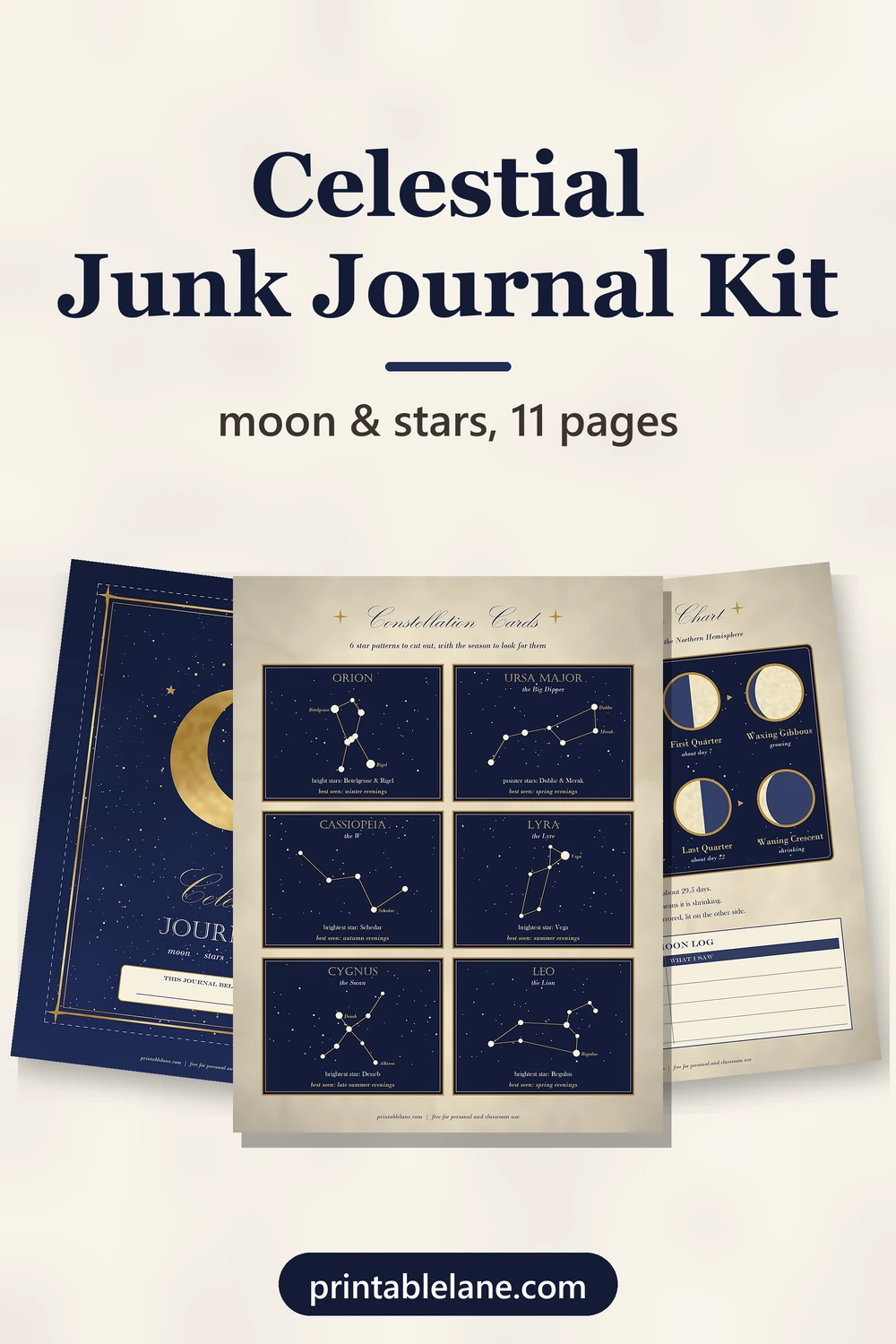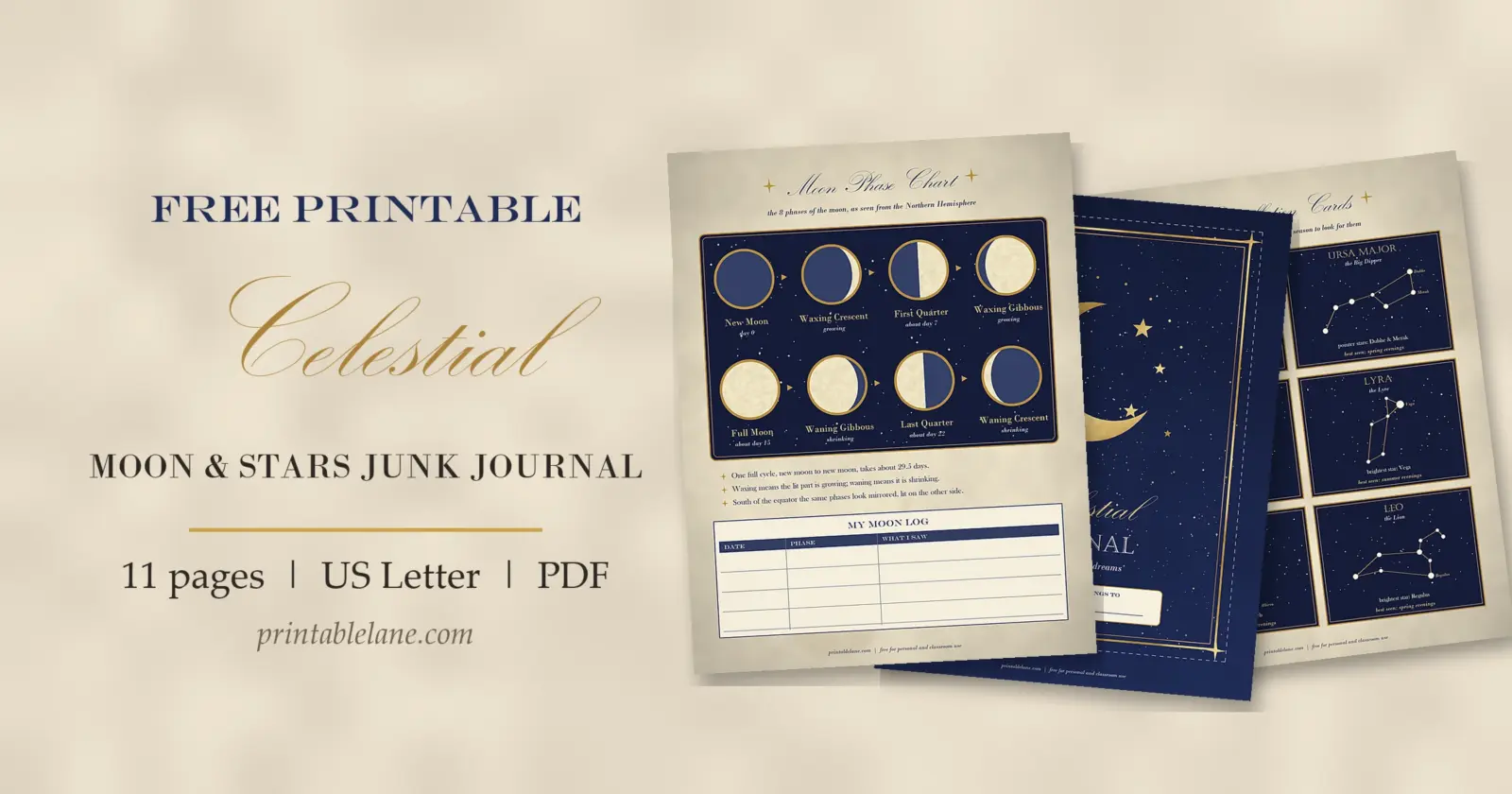
A celestial junk journal is an easy theme to pull together: navy paper, a little gold, a few moons and stars, and every page already looks like a night sky. This free kit gives you all of it in one PDF, in midnight navy, antique gold and cream parchment, so any 2 pieces match.
It is also a kit you can learn from: the moon phase chart shows the 8 real phases in order, and the constellation cards use real star patterns.
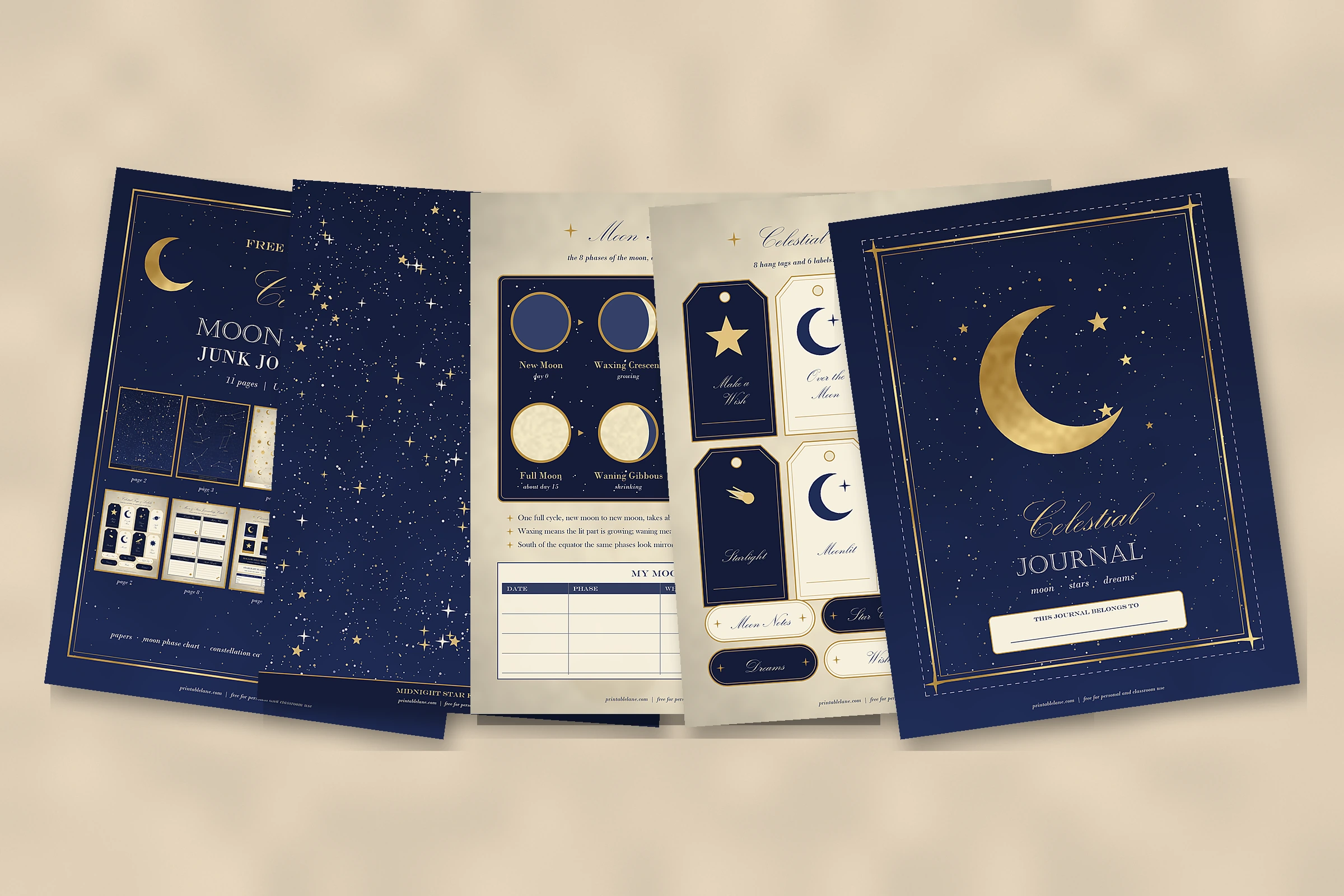
What’s in the PDF (11 pages)
- Page 1: cover with page thumbnails.
- Page 2: Midnight Star Field Paper.
- Page 3: Constellation Map Paper.
- Page 4: Gold Celestial Pattern Paper.
- Page 5: Moon Phase Chart, with a moon log.
- Page 6: Constellation Cards (6 cards per page).
- Page 7: Celestial Tags & Labels (8 tags, 6 labels).
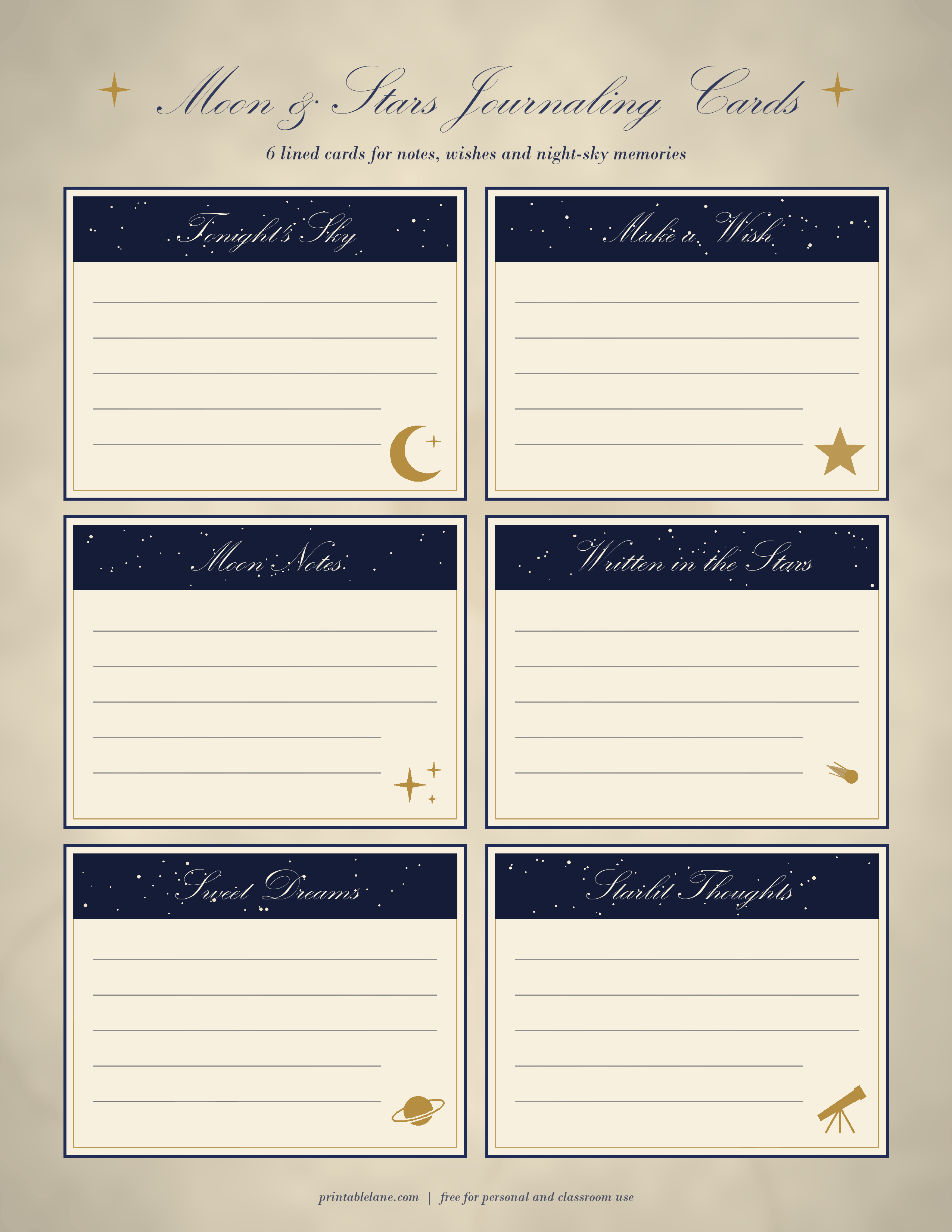
- Page 8: Moon & Stars Journaling Cards (6 cards per page).
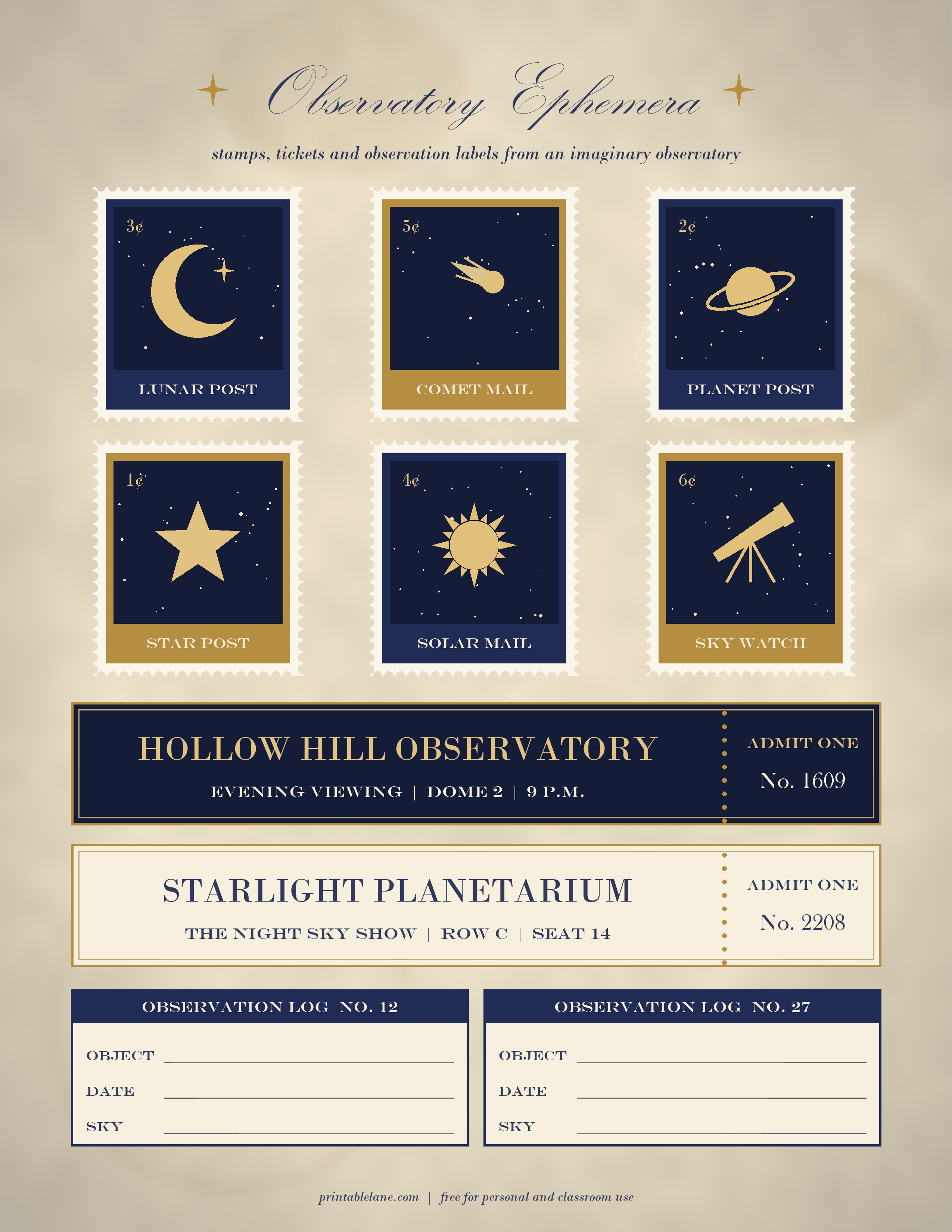
- Page 9: Observatory Ephemera.
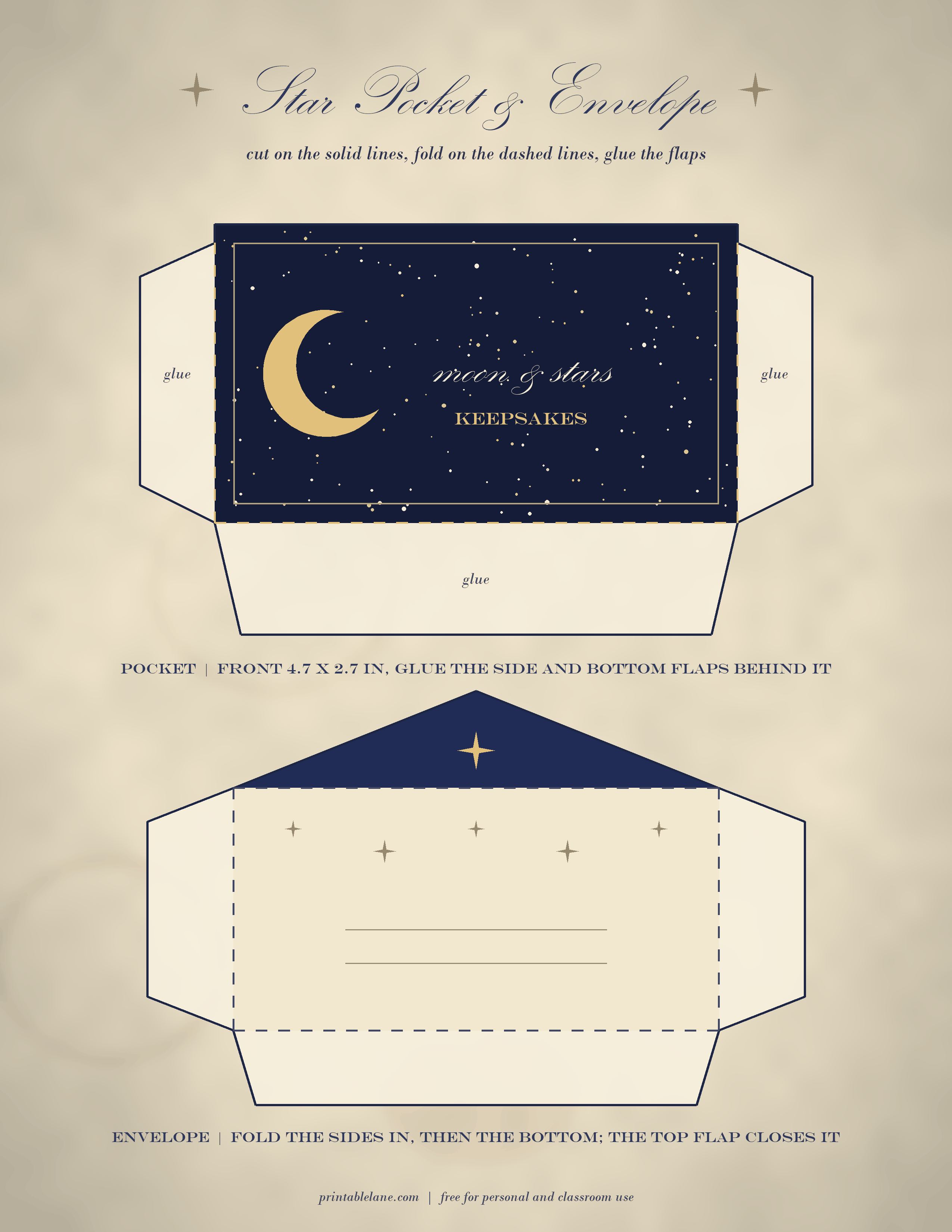
- Page 10: Star Pocket & Envelope.
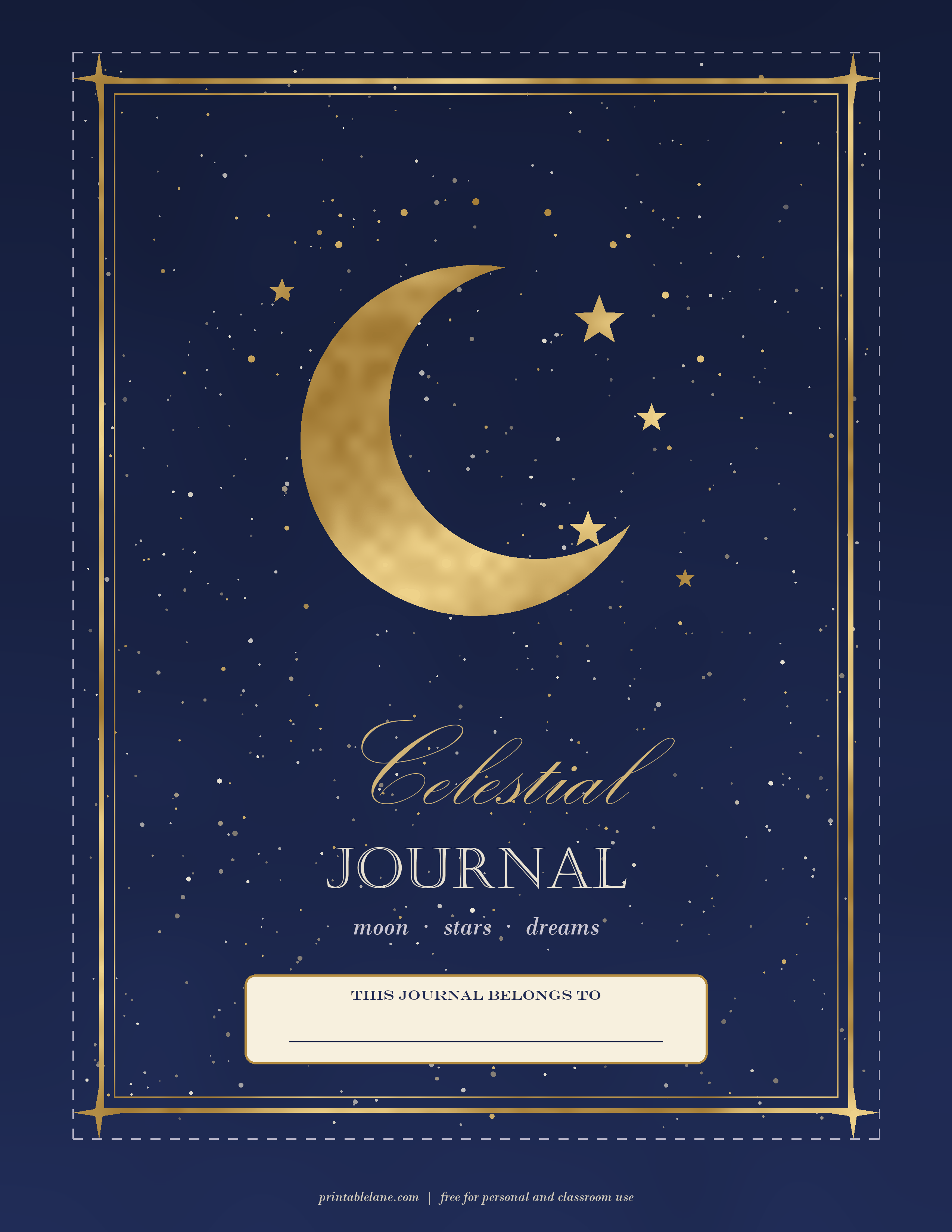
- Page 11: Celestial Journal Cover.
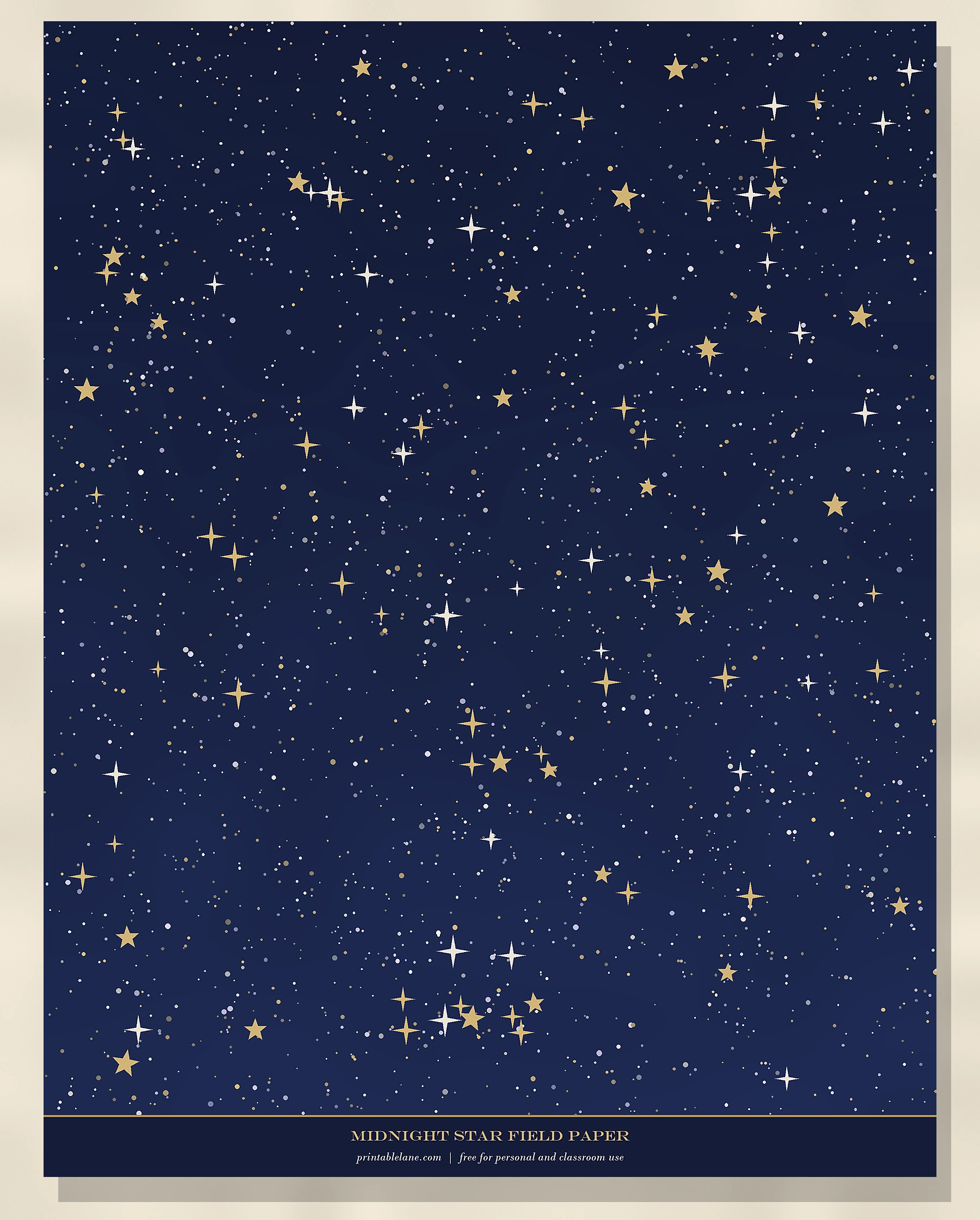
Midnight Star Field Paper
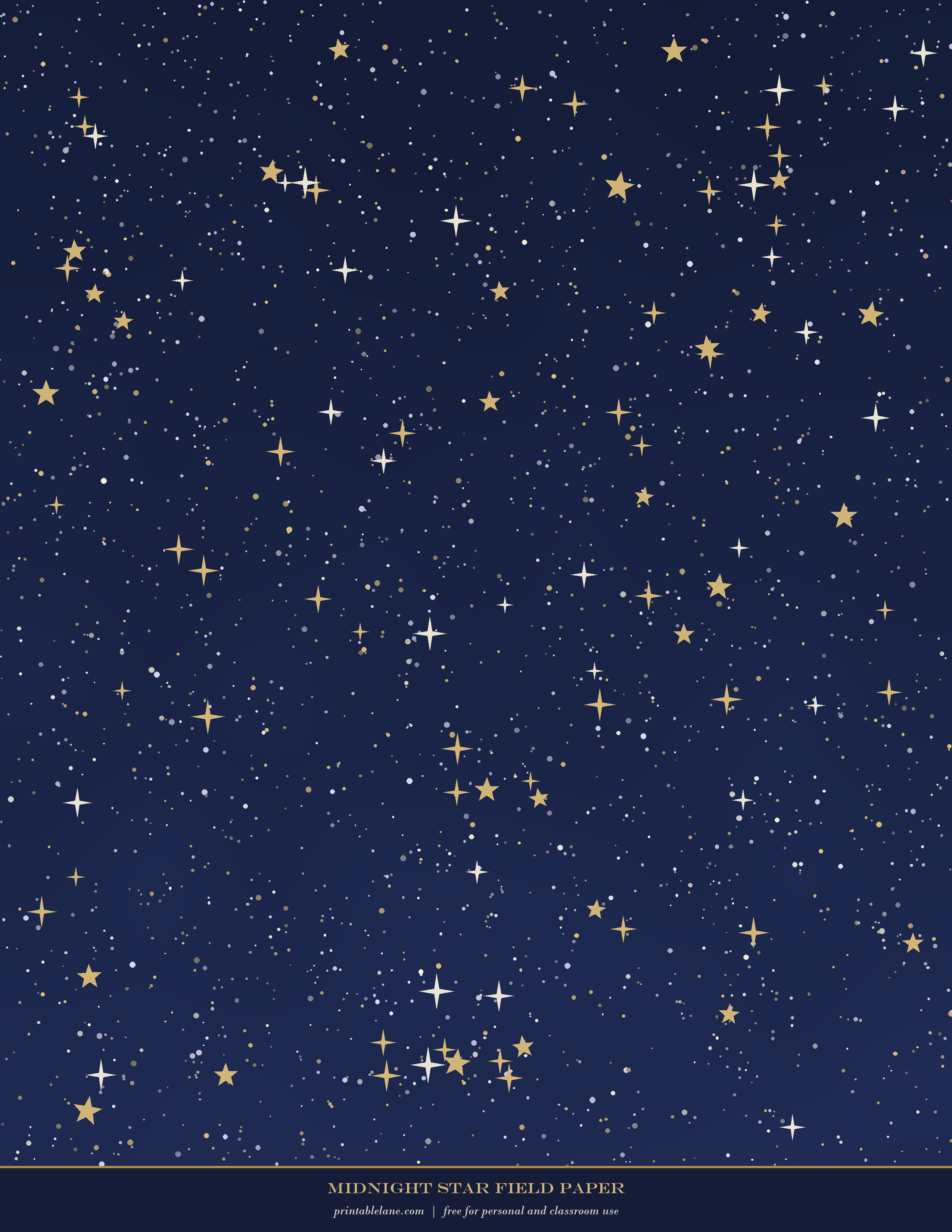
PDF page 2: a navy sky covered in tiny cream dots, gold sparkles and small gold stars. The paper name sits in a plain band at the bottom that you can trim off.
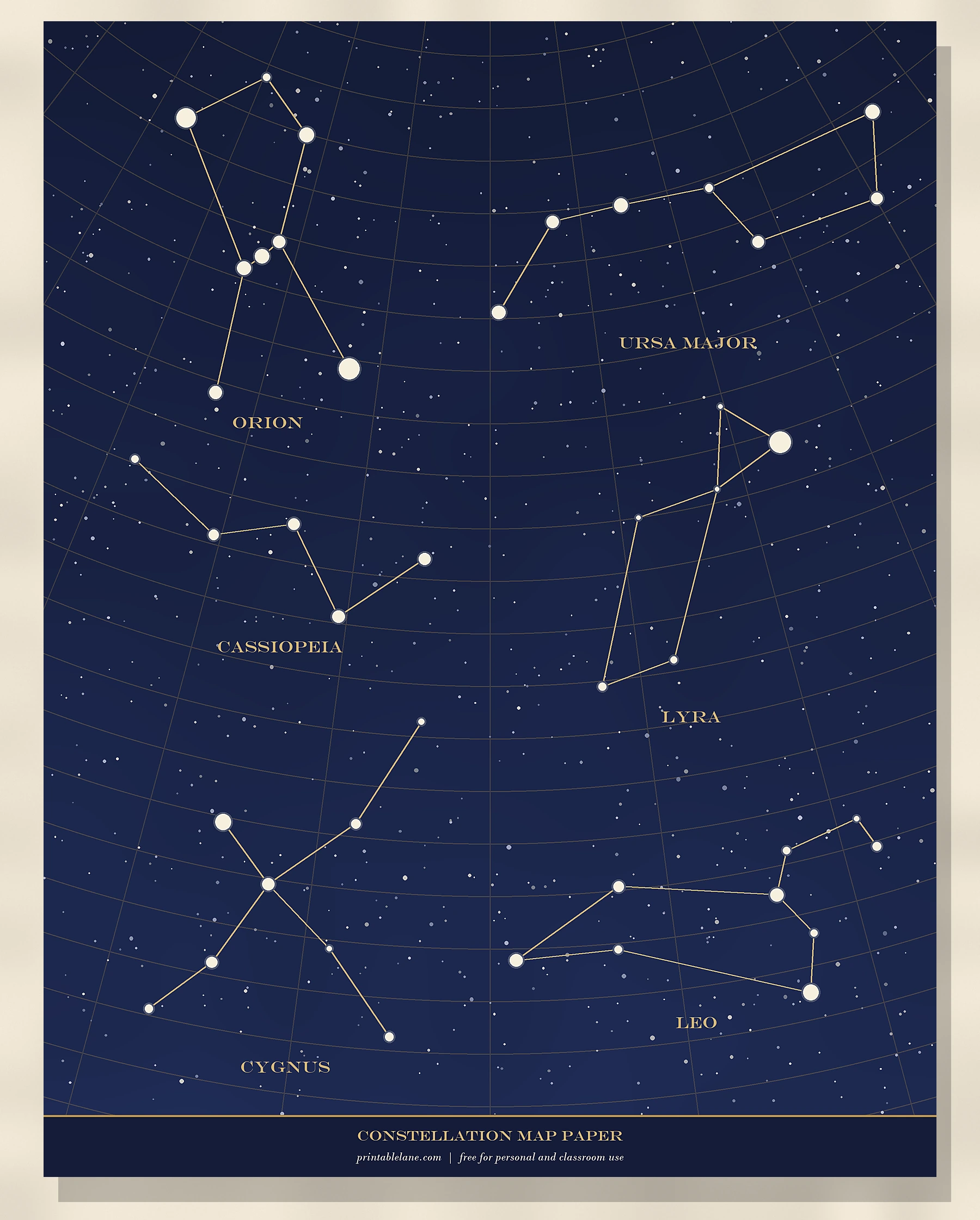
Constellation Map Paper
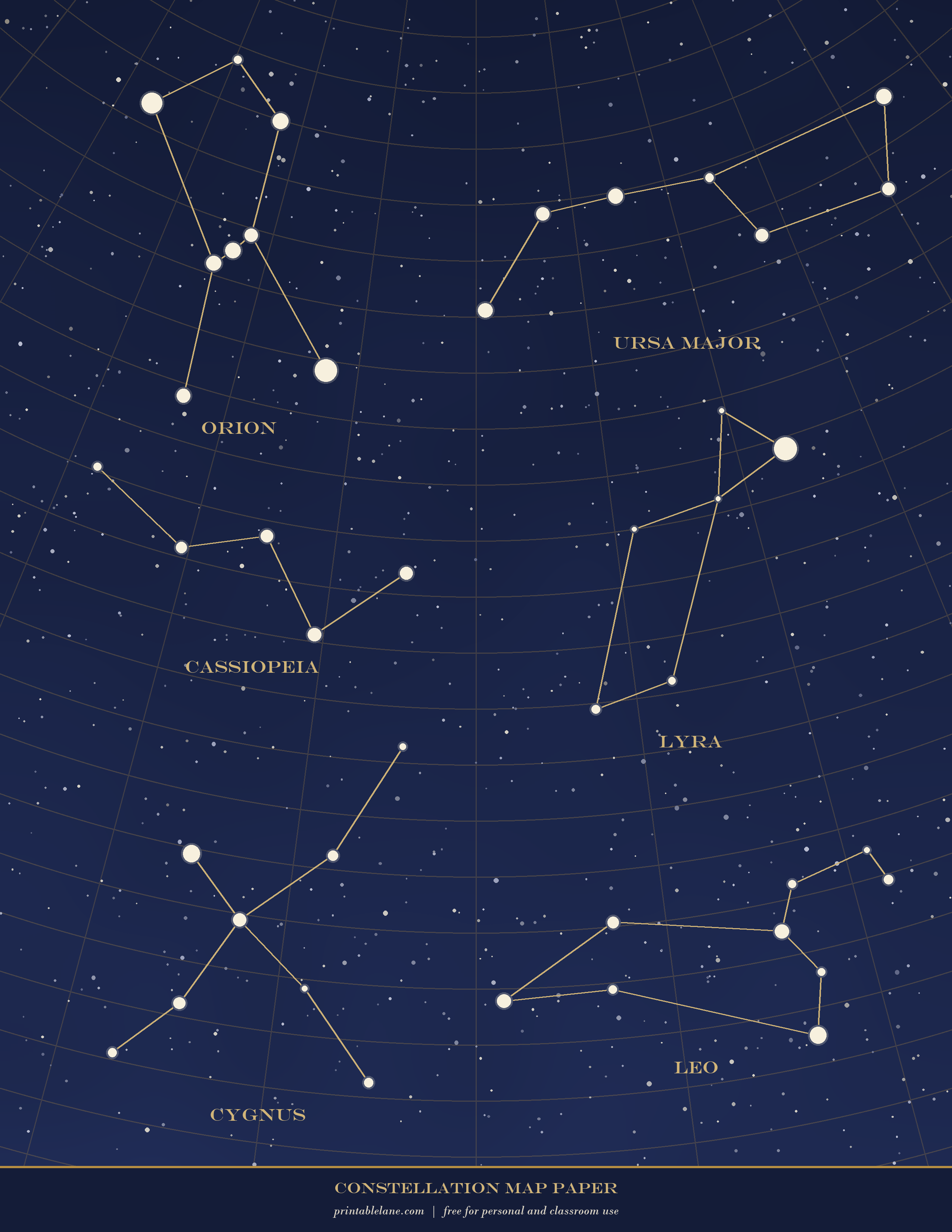
PDF page 3 looks like an old star atlas: curved gold grid lines on navy and 6 labeled constellations (Orion, Ursa Major, Cassiopeia, Lyra, Cygnus and Leo) drawn as gold lines with cream stars.
Gold Celestial Pattern Paper
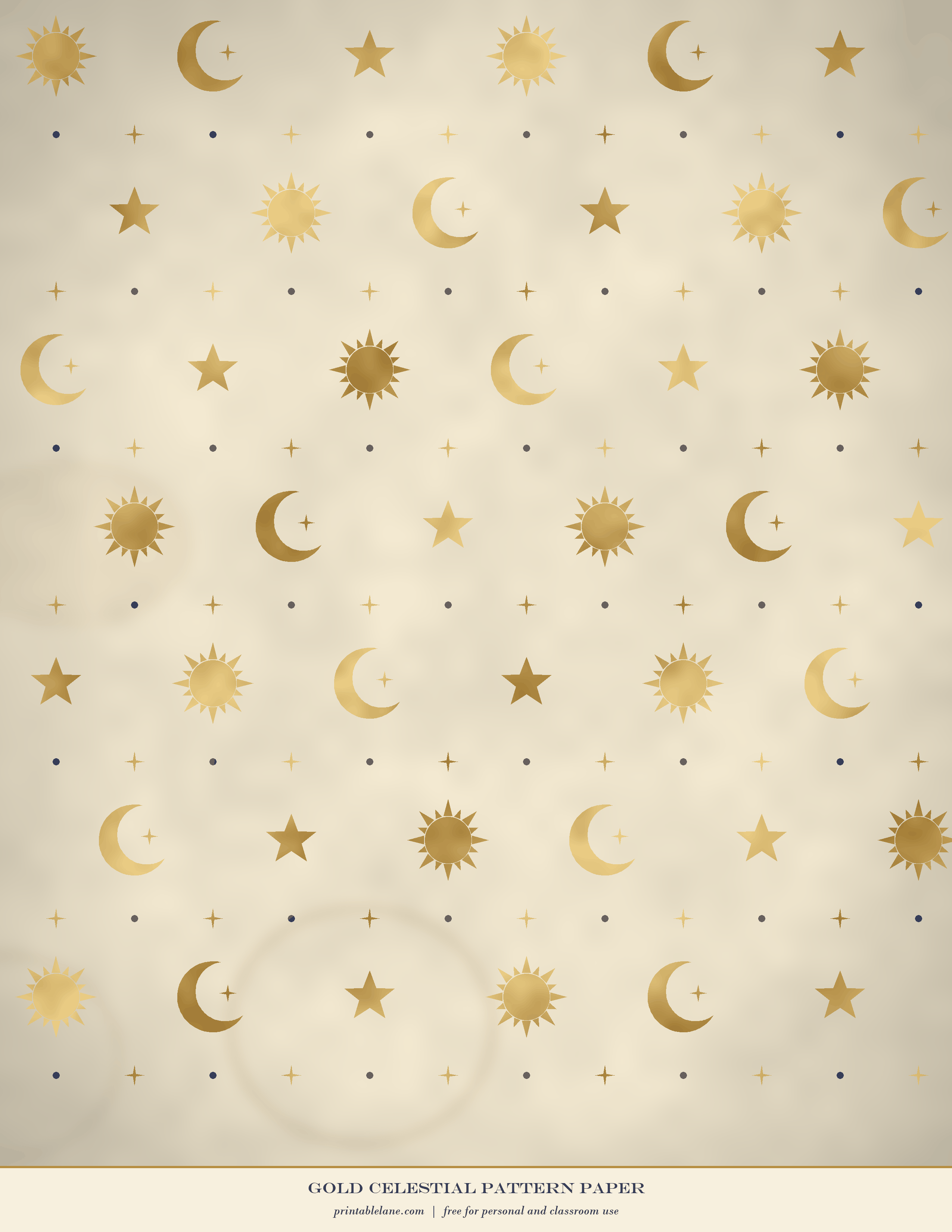
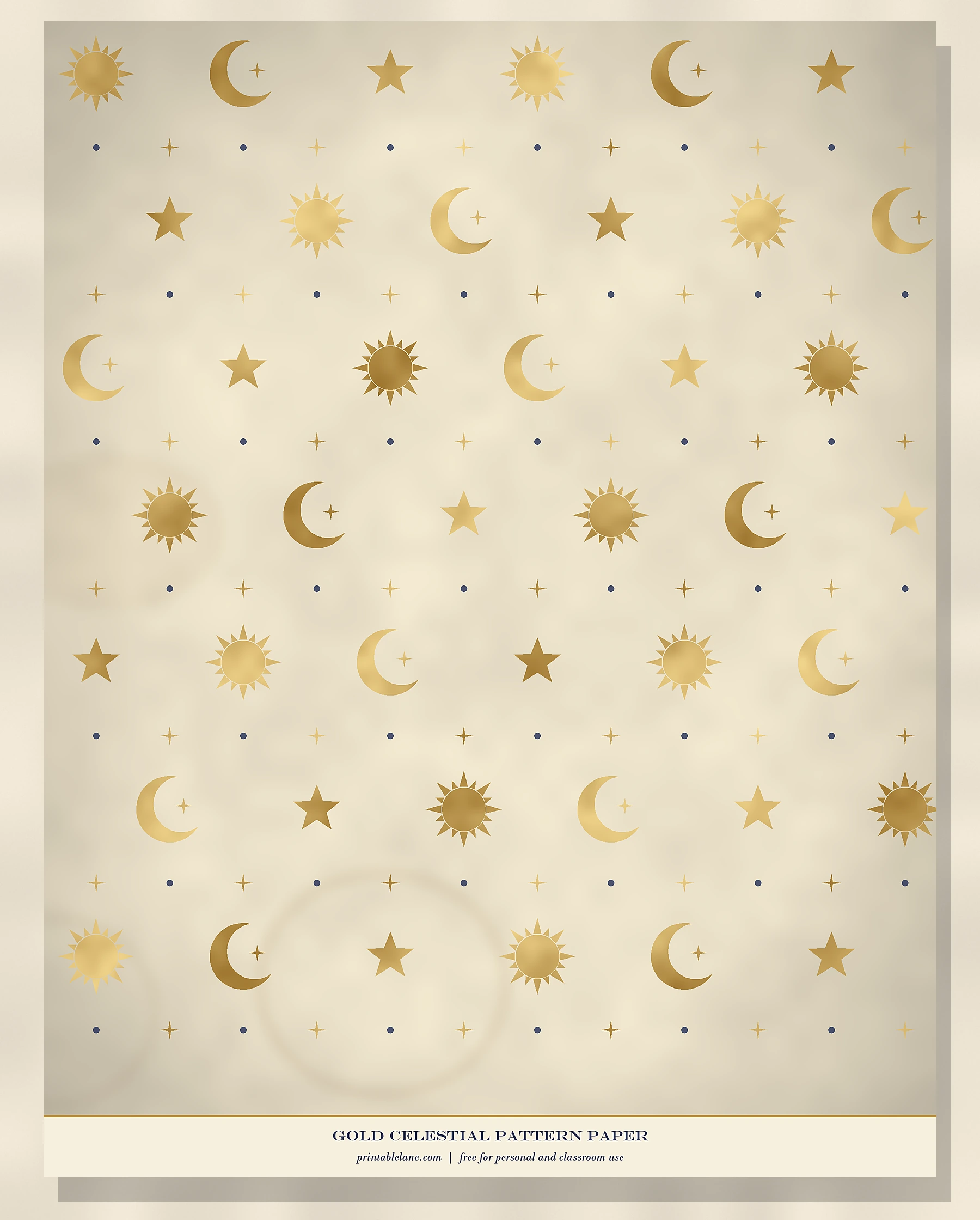
PDF page 4 is the light sheet: cream parchment with rows of gold-foil-look suns, crescent moons, stars and sparkles, plus small navy dots. The gold is printed color, so any home printer handles it.
Moon Phase Chart
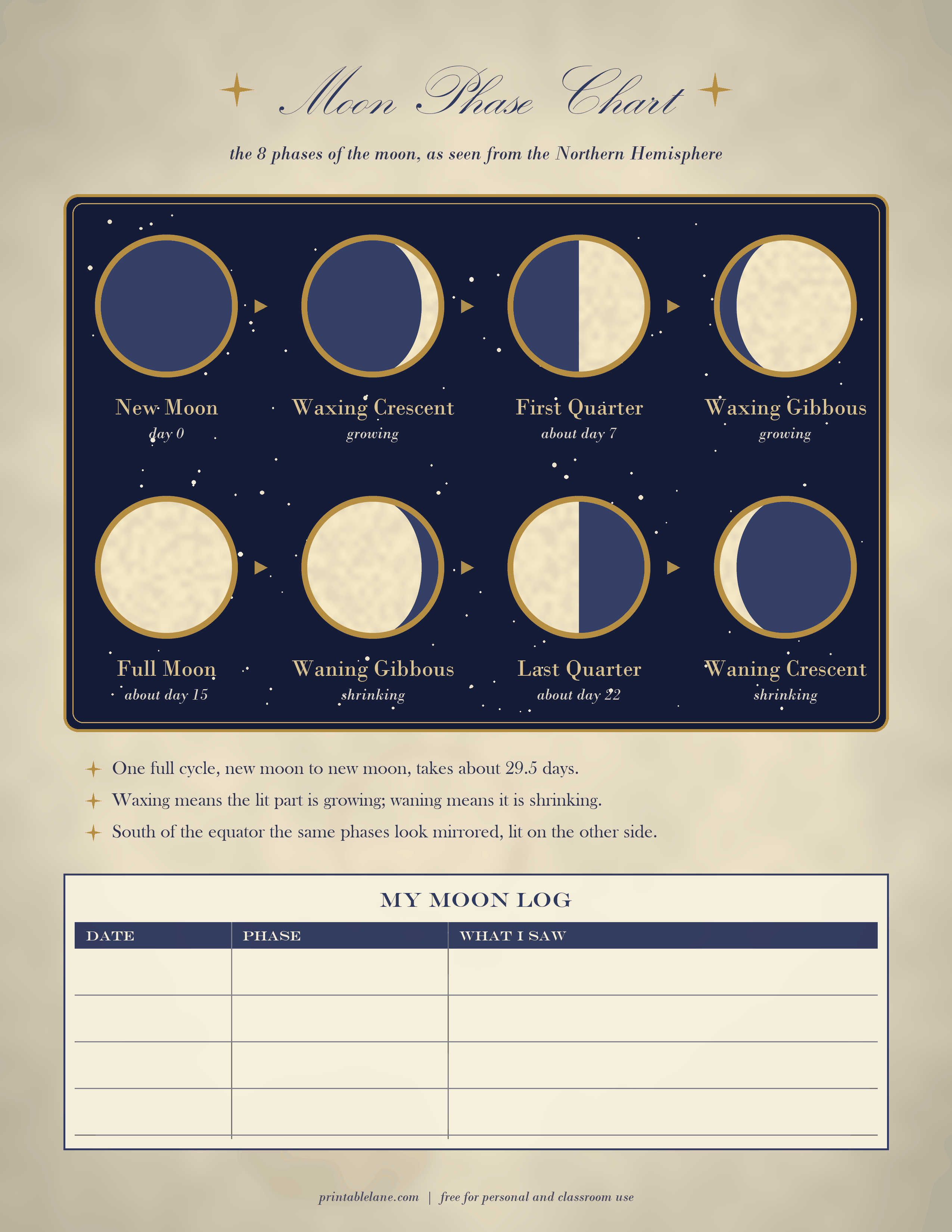
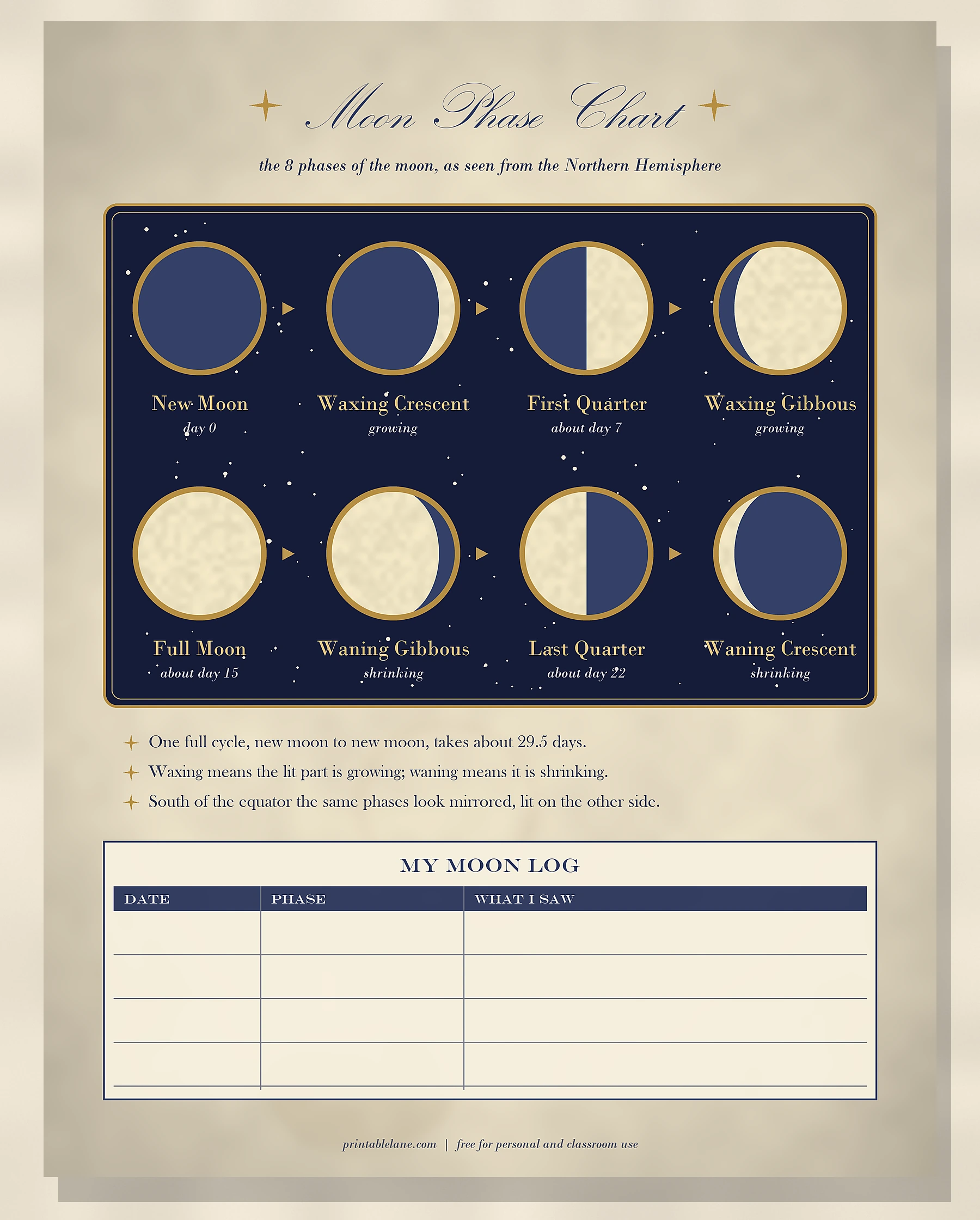
PDF page 5 shows the 8 phases on a navy panel, in 2 rows of 4: New Moon, Waxing Crescent, First Quarter, Waxing Gibbous, Full Moon, Waning Gibbous, Last Quarter and Waning Crescent, with about day 7, 15 and 22 marked. Below are 3 moon facts and a My Moon Log table (Date, Phase, What I Saw). It is drawn for the Northern Hemisphere, where a waxing moon is lit on the right.
Constellation Cards
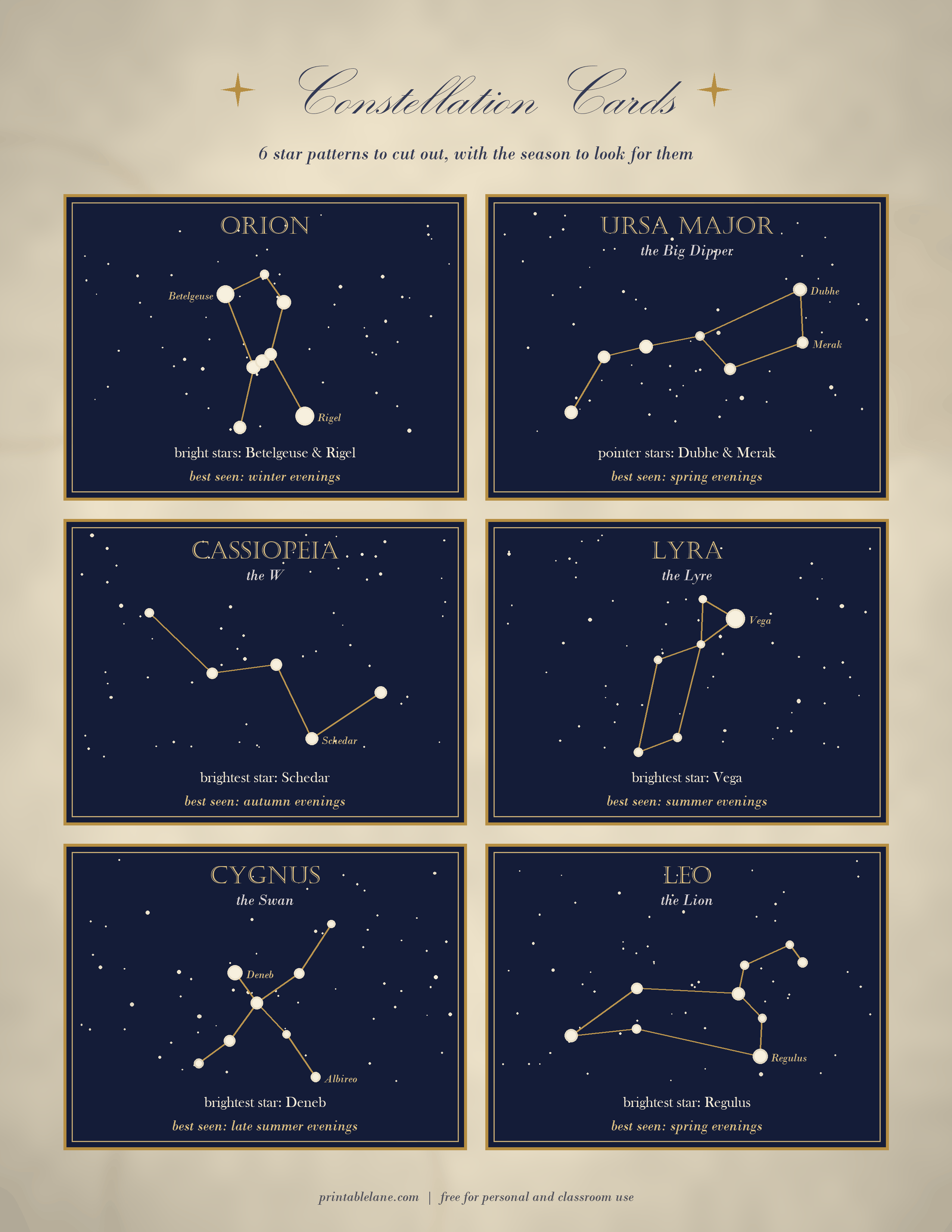
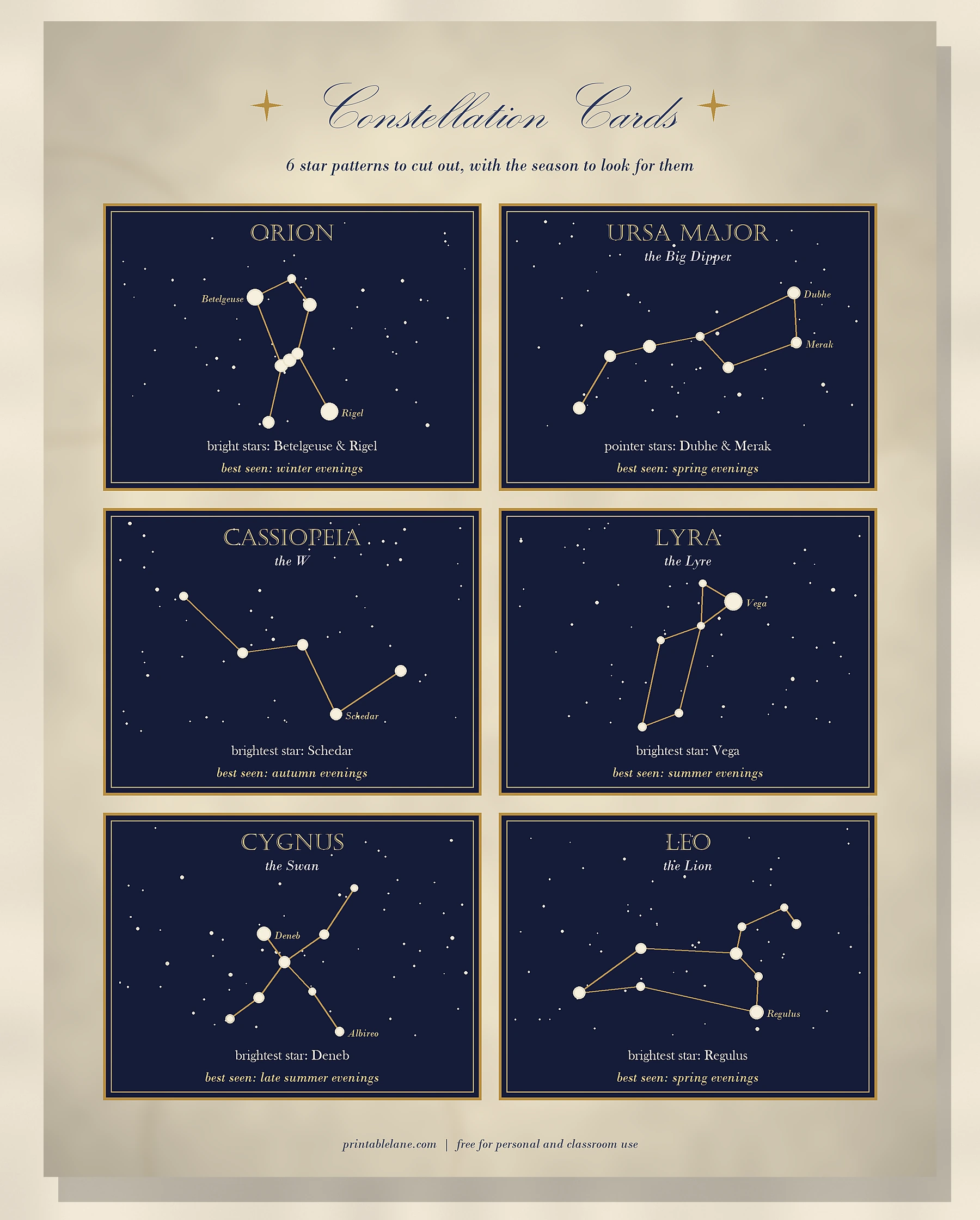
PDF page 6 has 6 navy cards (about 3.6 x 2.7 in), drawn from real star coordinates, with star names and the best season on Northern Hemisphere evenings:
- Orion: Betelgeuse and Rigel, winter.
- Ursa Major (the Big Dipper): pointer stars Dubhe and Merak, spring.
- Cassiopeia (the W): Schedar, autumn.
- Lyra (the Lyre): Vega, summer.
- Cygnus (the Swan): Deneb and Albireo, late summer.
- Leo (the Lion): Regulus, spring.
Celestial Tags & Labels
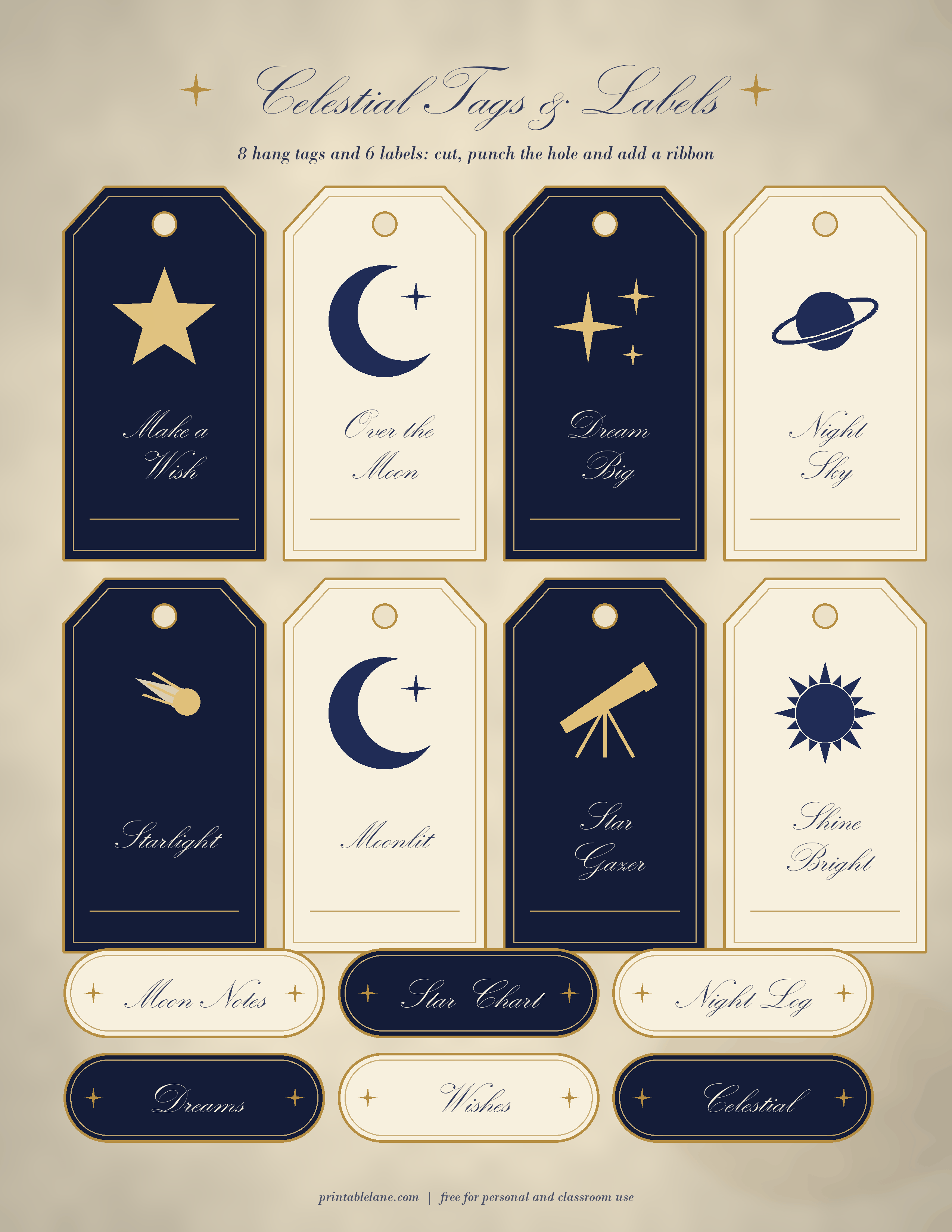
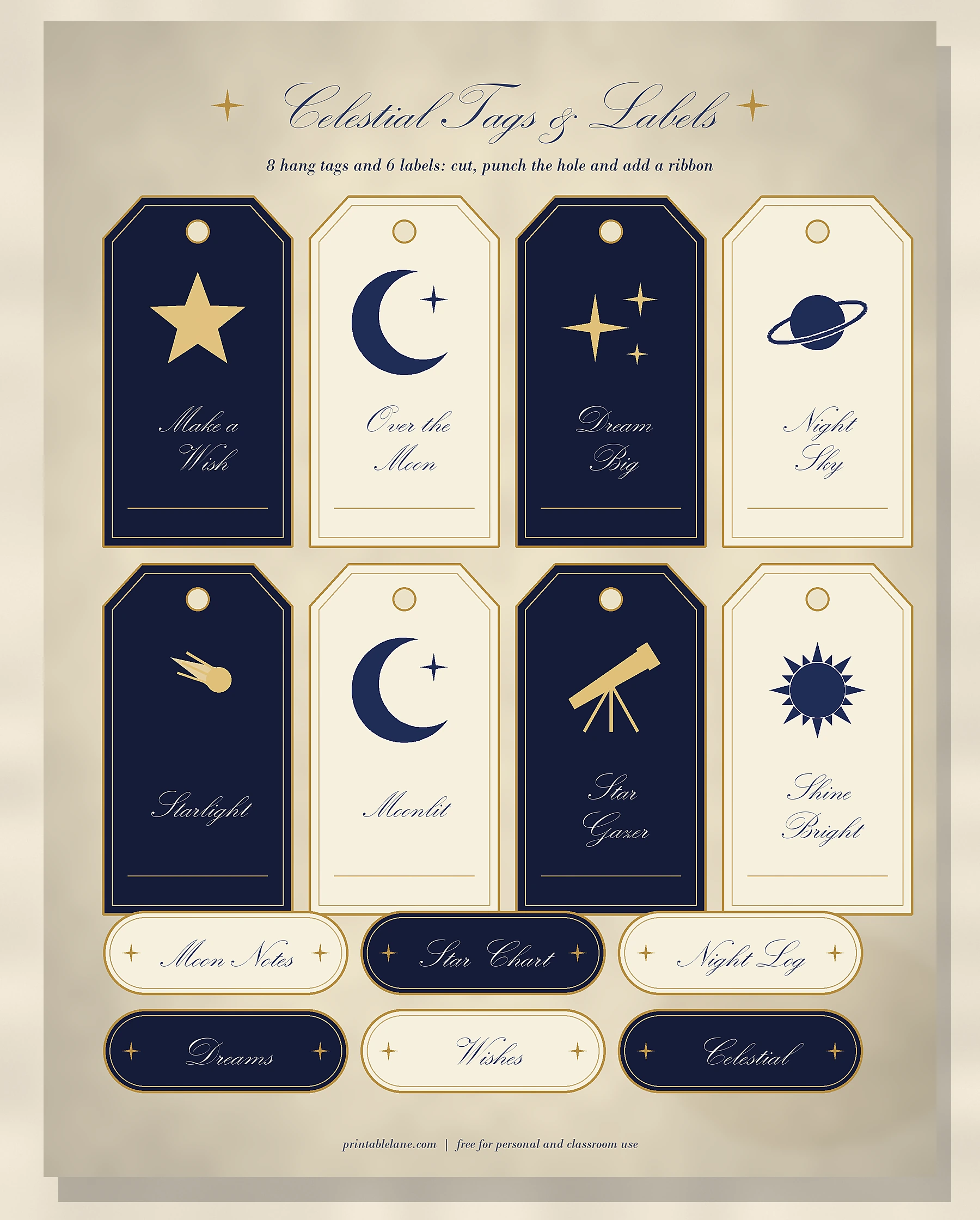
PDF page 7: 8 navy and cream hang tags (about 1.8 x 3.3 in) with a gold motif and a script word (Make a Wish, Over the Moon, Dream Big, Night Sky, Starlight, Moonlit, Star Gazer, Shine Bright), plus 6 labels: Moon Notes, Star Chart, Night Log, Dreams, Wishes and Celestial.
Moon & Stars Journaling Cards
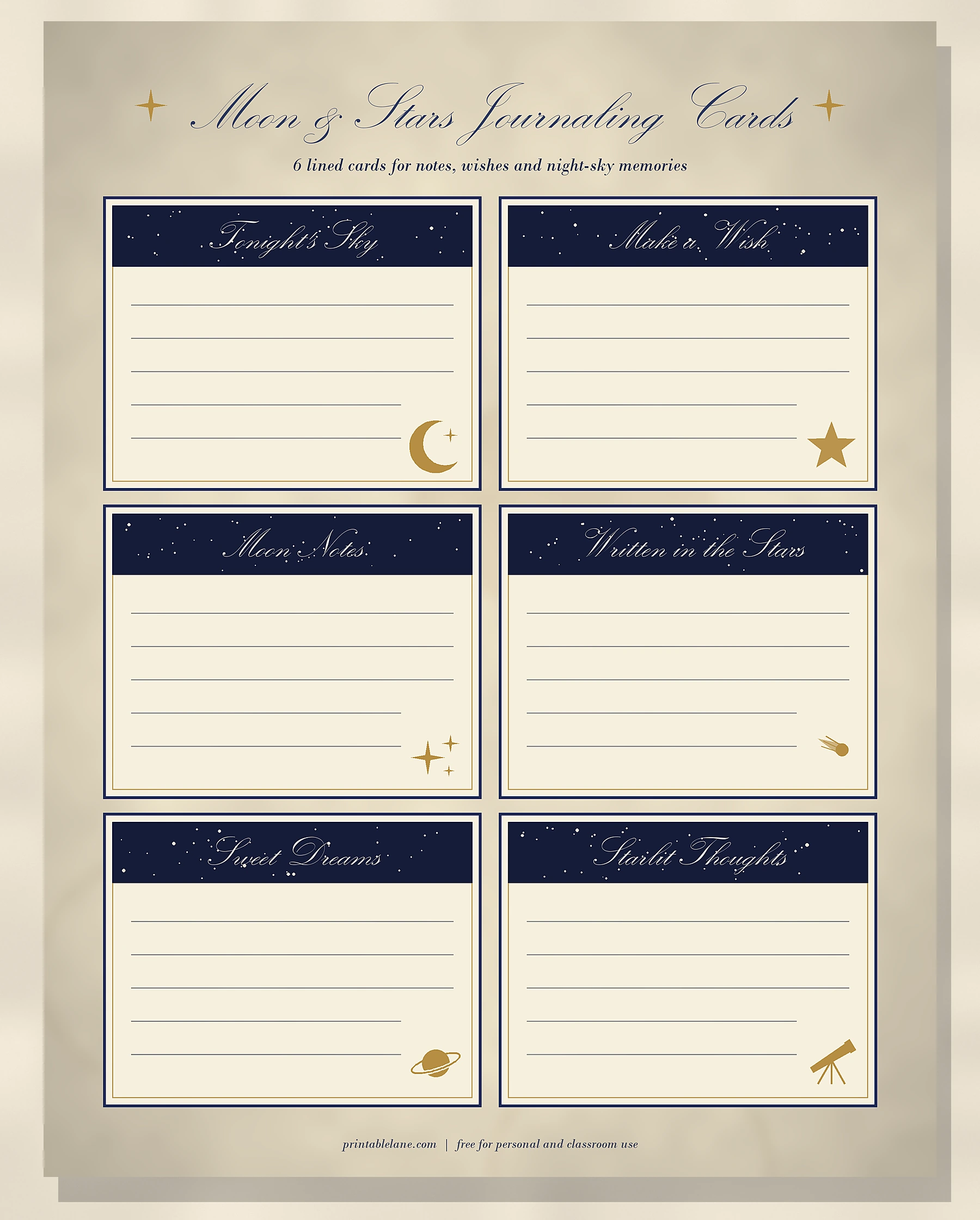
PDF page 8 has 6 lined cards (about 3.6 x 2.8 in) with starry navy headers: Tonight’s Sky, Make a Wish, Moon Notes, Written in the Stars, Sweet Dreams and Starlit Thoughts, each with a small gold motif in the corner.
Observatory Ephemera
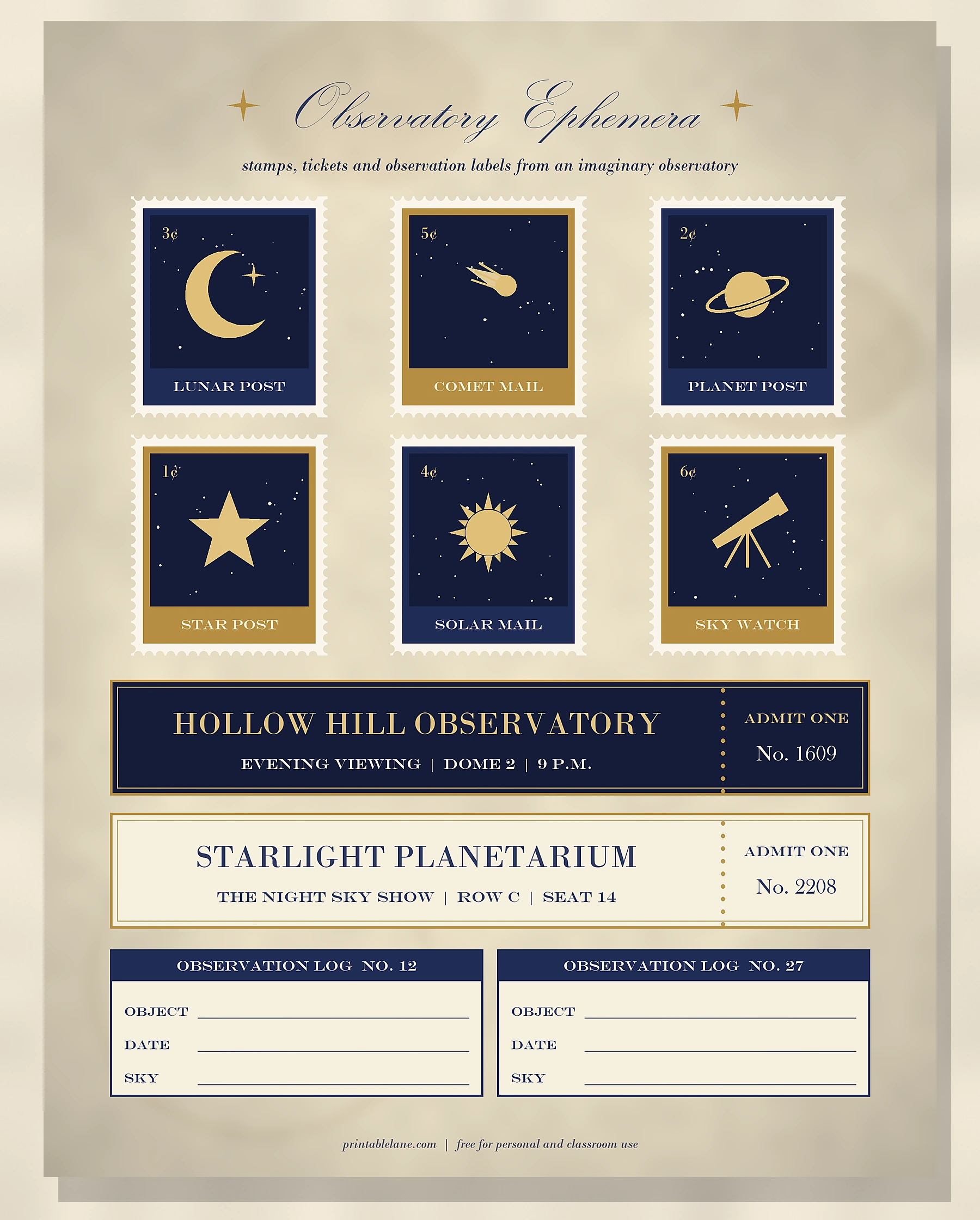
PDF page 9 holds paper scraps from an imaginary observatory: 6 stamps from 1¢ to 6¢ (Lunar Post, Comet Mail, Planet Post, Star Post, Solar Mail, Sky Watch), 2 admit-one tickets (Hollow Hill Observatory and Starlight Planetarium) and 2 Observation Log labels with Object, Date and Sky lines.
Star Pocket & Envelope
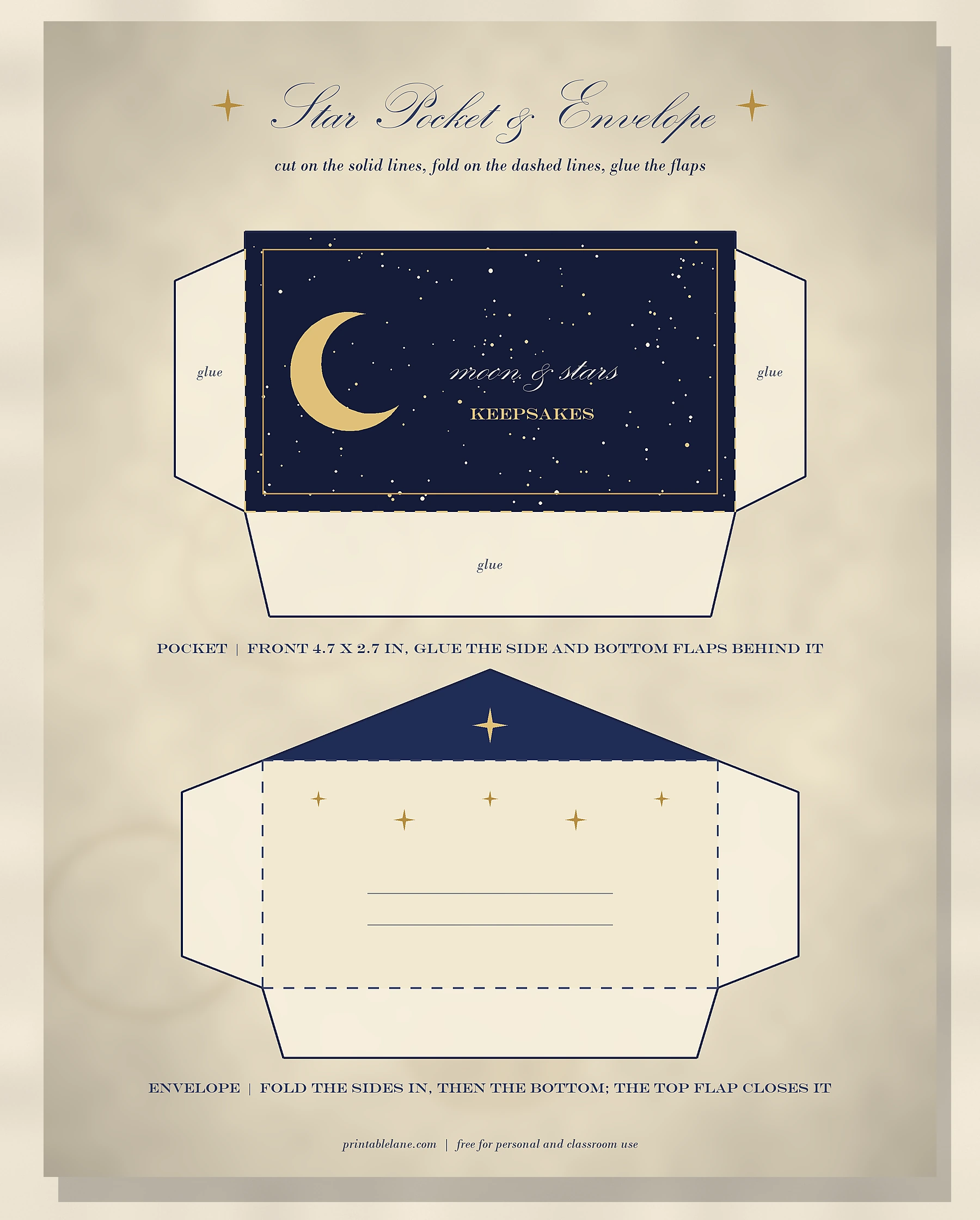
PDF page 10 has 2 templates. The pocket front (about 4.7 x 2.7 in) is starry navy with a gold crescent; its side and bottom flaps fold behind and glue to your page. The envelope has a navy top flap, a cream front (about 4.3 x 2.2 in) and 2 writing lines. The pocket fits the journaling cards.
Celestial Journal Cover
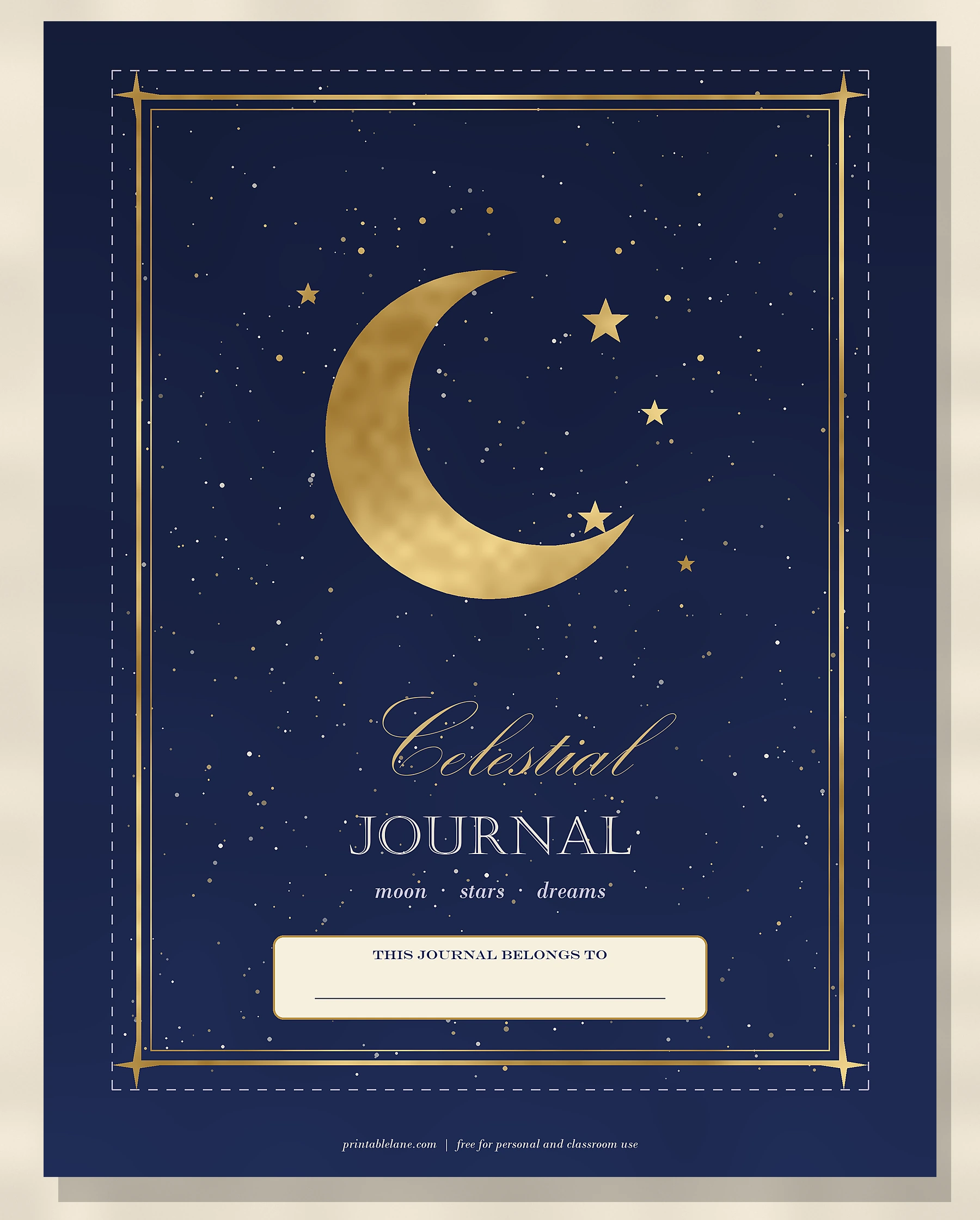
PDF page 11 is a front cover panel of about 7 x 9.5 in inside a dashed cutting line: a large gold crescent and 5 gold stars on a starry navy sky, a double gold frame, the words Celestial Journal and a This Journal Belongs To plate.
How to put the journal together
- Pick a size. Folded Letter sheets give 5.5 x 8.5 in pages; print the cover at about 75% to fit them.
- Make signatures. Fold 4 or 5 sheets in half together and nest them. 3 signatures make a good first journal.
- Mix dark and light. Pair a navy sheet with the cream gold pattern sheet on each spread.
- Sew the spine with a pamphlet stitch through 3 or 5 holes and waxed thread.
- Add extras last: the pocket, tags, cards and finally the cover.
Paper weight: 20 to 24 lb (75 to 90 gsm) printer paper for signature pages and background papers; 65 to 110 lb cardstock for tags, cards, the pocket, the envelope and the cover.
Tea staining: inkjet ink can run when wet, so stain blank paper with strong black tea, let it dry flat under books, then print. Easier: sponge brown ink around the edges, or print on ivory cardstock.
Spread ideas
- Moon month: the moon phase chart beside a filled-in moon log, with a Moon Notes card in the pocket.
- Constellation of the season: 1 constellation card on the map paper, an Observation Log label and the date you found it in the sky.
- Wish page: gold pattern paper, the Make a Wish tag and the Written in the Stars card with 3 hopes for the year.
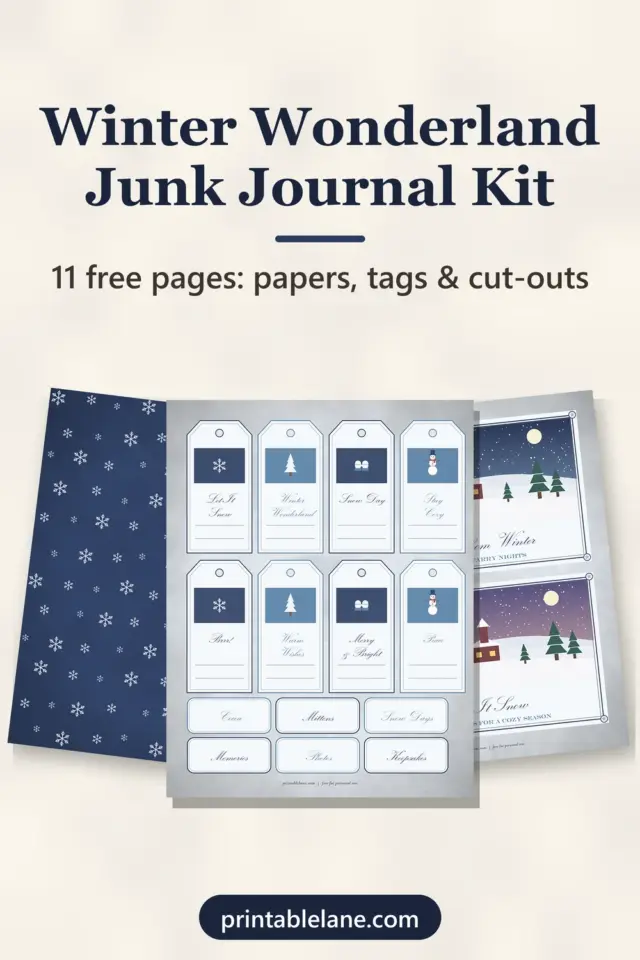
Want more scraps? Add pieces from the vintage junk journal ephemera printables, sheets from the free printable scrapbook paper set, or pages from the winter wonderland junk journal kit, which uses a similar blue.
Sky facts for your journaling
- A moon cycle takes about 29.5 days (29.53 from new moon to new moon), so the quarters fall near day 7 and day 22 and the full moon near day 15.
- The pointer stars find the North Star. Follow Merak through Dubhe and go about 5 times that gap to reach Polaris.
- Vega and Deneb belong to the Summer Triangle, together with Altair in Aquila.
- There are 88 official constellations, set by the International Astronomical Union to cover the whole sky.
- Albireo is a colorful double: a small telescope splits it into a gold star and a blue one.
The gratitude journal prompts fit nicely on the lined cards, and young stargazers can color the space coloring pages while you journal.
Printing tips
- US Letter: print at 100% (Actual size). A thin white printer margin on the pattern papers is normal.
- A4: print at 100% (Actual size) to keep the sizes of the pocket, envelope and cover. Kit page content stays at least 0.5 in from the side edges; the edge-to-edge papers lose only a thin sliver of pattern.
- Ink and shine: the 3 navy pages use the most ink. For real sparkle, trace a few stars with a gold gel pen after printing.
Download single pages
Need more star field paper or a second set of tags? Each sheet below opens as its own PNG; the PDF with all 11 pages, including the cover, is in the download box.
- Midnight Star Field Paper (PNG)
- Constellation Map Paper (PNG)
- Gold Celestial Pattern Paper (PNG)
- Moon Phase Chart (PNG)
- Constellation Cards (PNG)
- Celestial Tags & Labels (PNG)
- Moon & Stars Journaling Cards (PNG)
- Observatory Ephemera (PNG)
- Star Pocket & Envelope (PNG)
- Celestial Journal Cover (PNG)
Frequently asked questions
How many pages are in the PDF?
11 pages: the cover (page 1) plus 10 kit pages. When printing single pages from the PDF, remember that page 1 is the cover.
Can I print the kit on A4 paper?
Yes. Choose 100% (Actual size) so the pocket, envelope and cover keep their sizes.
Are the moon phases and constellations accurate?
Yes. The 8 phases are named and ordered correctly for the Northern Hemisphere, and the constellations are placed from real star coordinates, just without the fainter stars.
What paper should I use for the tags and cards?
65 to 110 lb cardstock. Regular printer paper is fine for the background papers inside signatures.
How many journaling cards fit in the pocket?
2 or 3, standing a little above the pocket edge so you can pull them out.
Can I use the kit in a classroom?
Yes, it is free for personal and classroom use, and the moon chart suits a night-sky lesson.