An acid free scrapbook is built from paper, card and glue that will not turn your pages yellow and brittle, or stain the photos sitting on them. The phrase is printed on almost every pack of patterned paper, yet it covers only one part of the story: the pH of the paper on the day it was made.
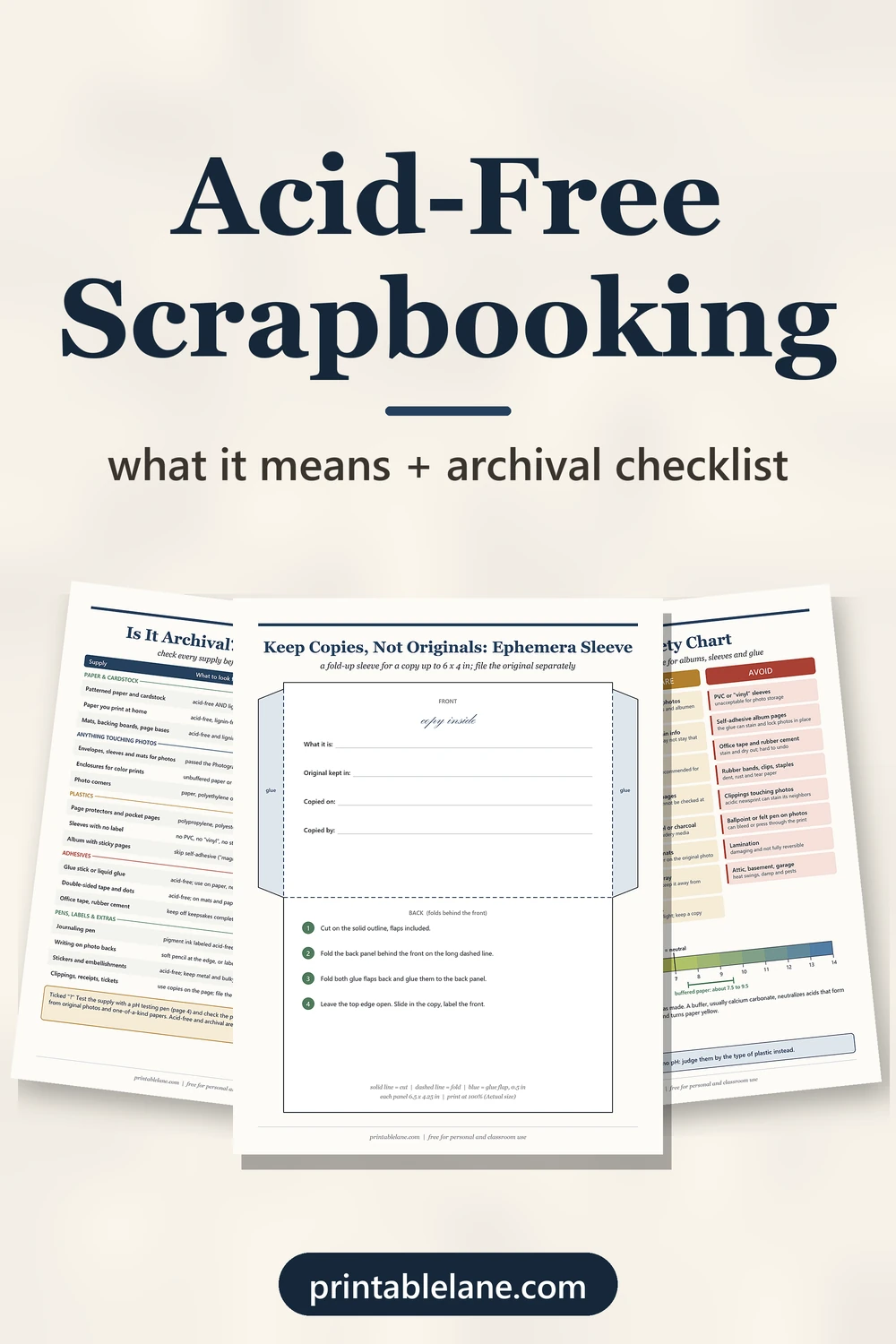
Below I explain what the label promises and what it leaves out, from lignin and buffering to the photo test, plastics and old clippings. The free 8-page PDF turns it into a checklist, a safety chart, a pH log, a storage guide, a planner, photo tags and a copy sleeve.
What does acid-free mean?
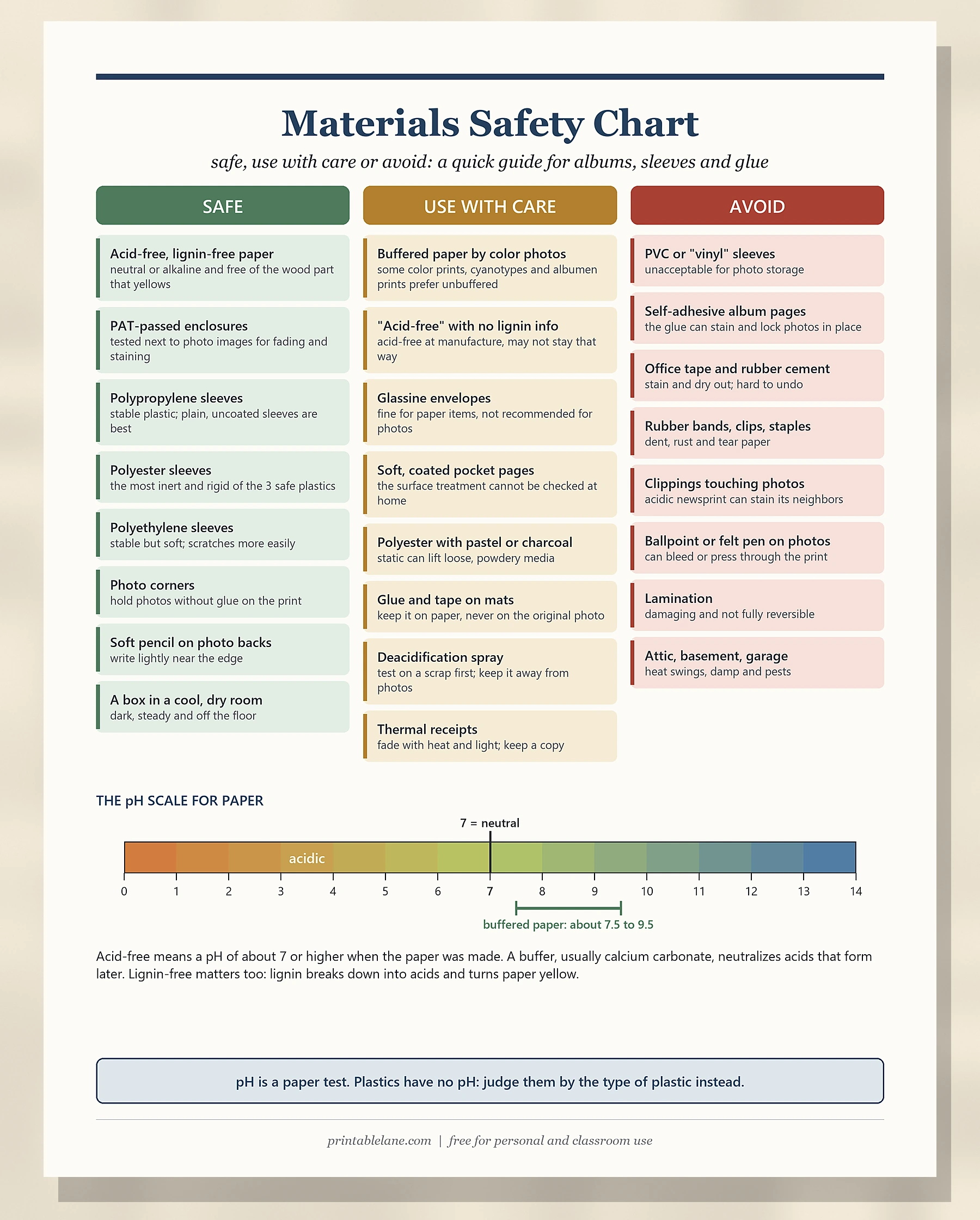
pH runs from 0 to 14: 7 is neutral, lower is acidic, higher is alkaline. Acid-free paper has a pH of about 7 or higher when it is made. Acid slowly breaks down paper fibers, so acidic paper yellows, turns brittle and passes acid to whatever touches it.
The catch is “when it is made”: the label says nothing about the pH in 20 years.
Lignin: the reason old paper yellows
Lignin is the natural glue that binds wood fibers. Paper made from ground wood keeps much of it, and as lignin ages and meets light it breaks down into acidic compounds and yellows the sheet; newsprint is the classic case. A paper can test acid-free today and still make acid later, so for keepsakes look for acid-free and lignin-free together.
Buffered vs. unbuffered paper
Buffered paper has an alkaline reserve added, usually calcium carbonate, which puts it at roughly pH 7.5 to 9.5. That reserve neutralizes acids as they form, which suits letters, certificates and most paper memorabilia.
Photos are the exception: conservators recommend unbuffered enclosures for color images, cyanotypes and albumen prints, which can react badly to alkaline paper.
“Photo-safe” and the Photographic Activity Test
When a package says photo-safe, ask whether it passed the Photographic Activity Test (PAT), the international standard ISO 18916. The test checks 2 things: whether chemicals in the material fade a photo image and whether it stains the gelatin layer. pH alone cannot tell you that. A pass still does not make a product archival on its own, and an unlabeled product may simply be untested.
Acid-free vs. archival: not the same promise
“Archival” has no legal or standard definition on craft packaging, so anyone can print it. Permanence standards for paper do exist (ANSI/NISO Z39.48 in the US, ISO 9706 internationally). Trust labels that list specifics: acid-free, lignin-free, buffered or unbuffered, PAT passed.
Plastics, adhesives and pens
- Safe plastics: uncoated polypropylene, polyester and polyethylene. Polyester is the most inert and rigid.
- Avoid PVC: polyvinyl chloride, often sold as vinyl, is unacceptable for photo storage.
- Adhesives: photo corners hold a print with no glue on it. Keep glue and tape on mats, never on an original photo; skip office tape, rubber cement and sticky album pages.
- Pens: use a soft pencil on photo backs near the edge, or label the sleeve.
How to check paper with a pH testing pen
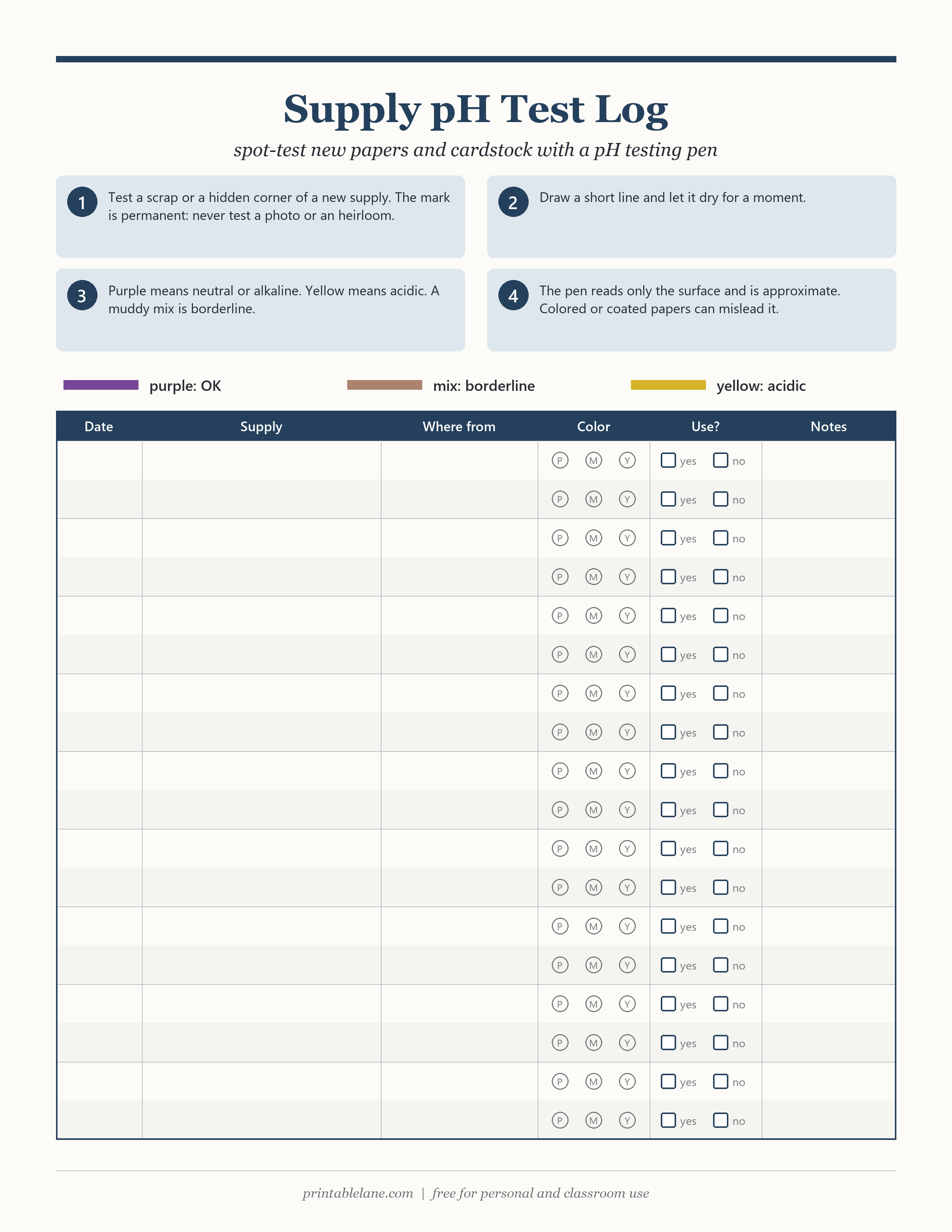
A pH testing pen draws a line of indicator ink: purple on neutral or alkaline paper, yellow on acidic paper. The mark is permanent, so test a scrap or hidden corner of a new supply, never a photo or an heirloom, and read it within minutes. It reads only the surface, approximately, and colored or coated papers can fool it.
What’s in the PDF (8 pages)
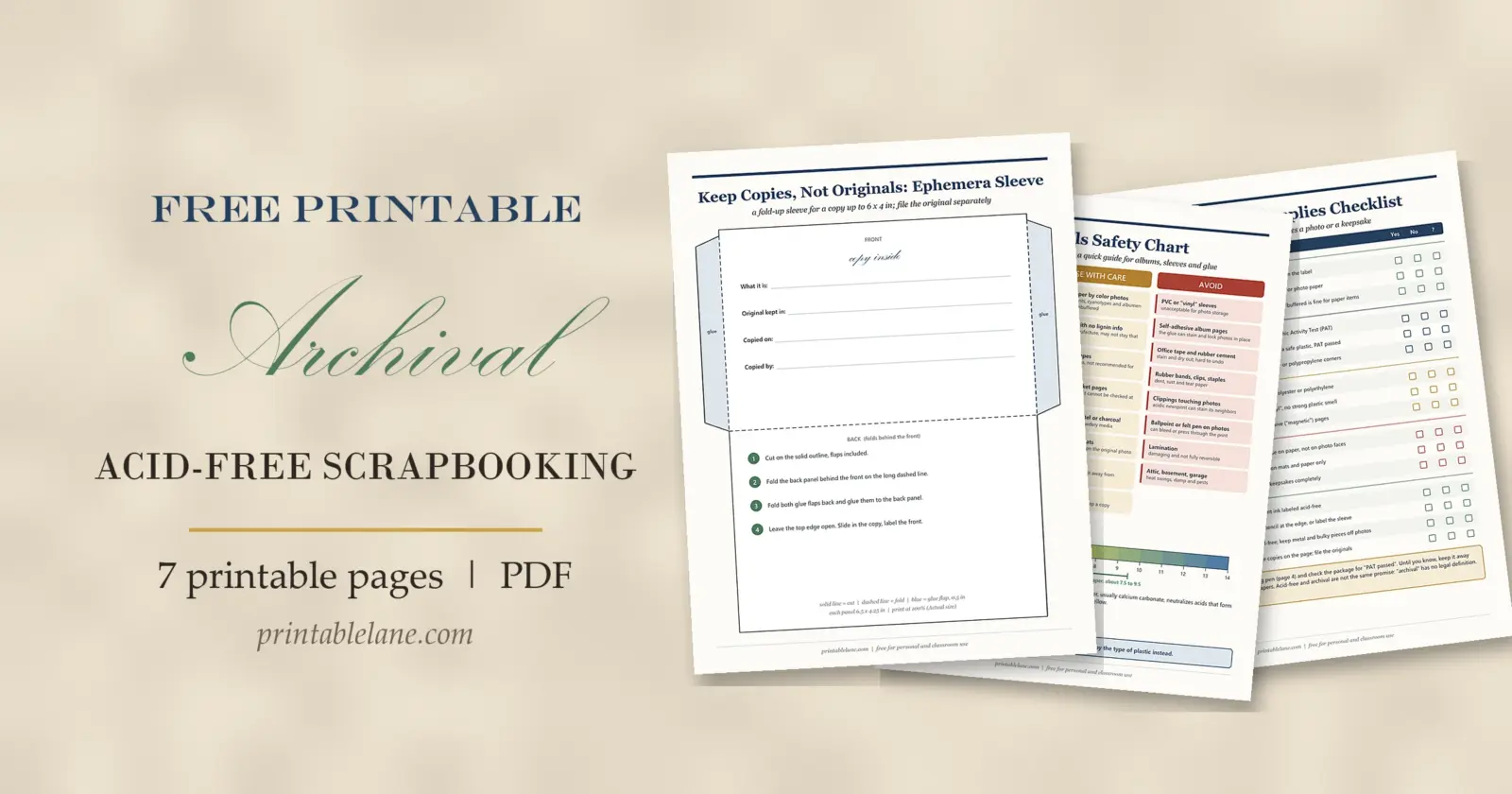
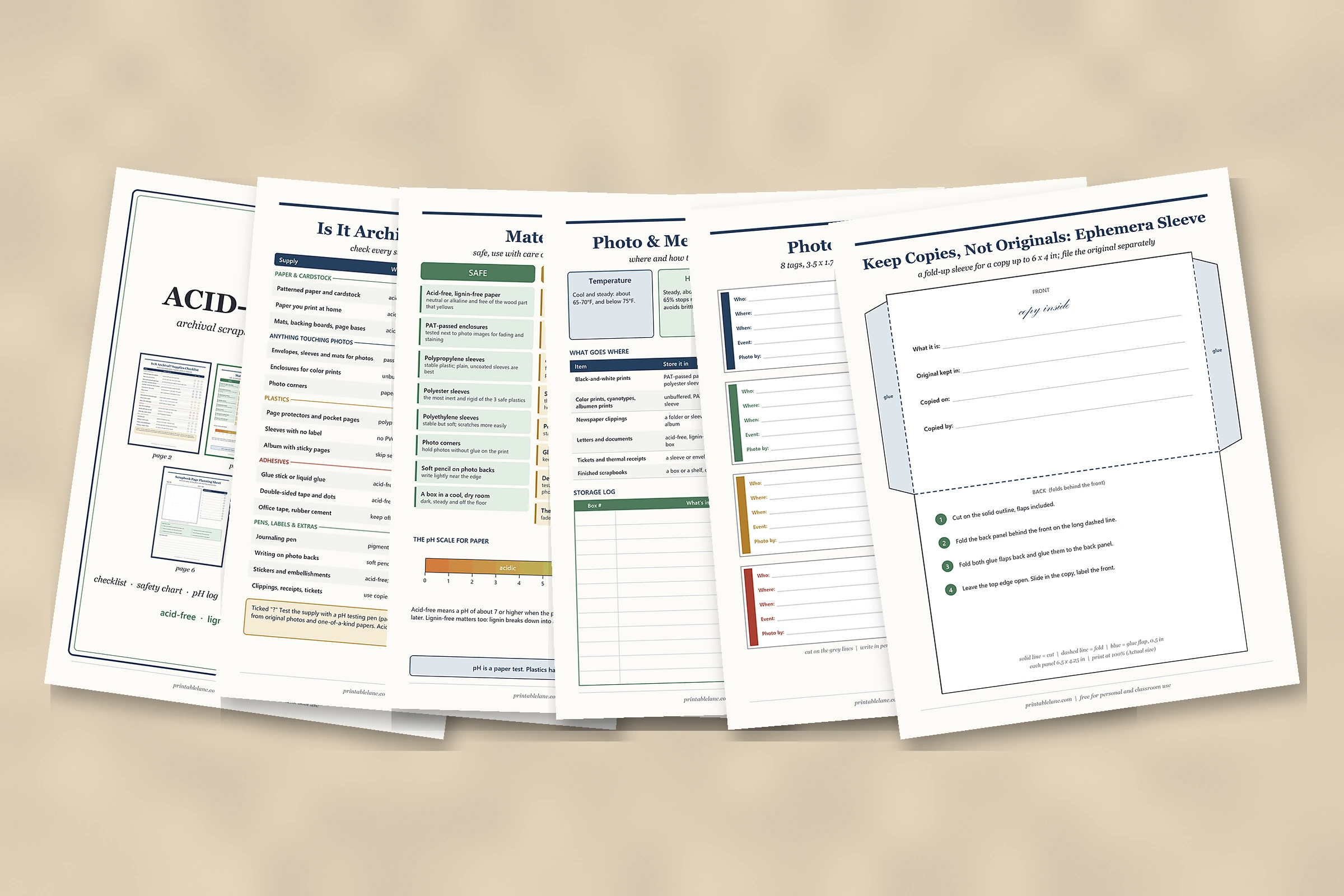
- Page 1: cover with thumbnails of the 7 printable pages.
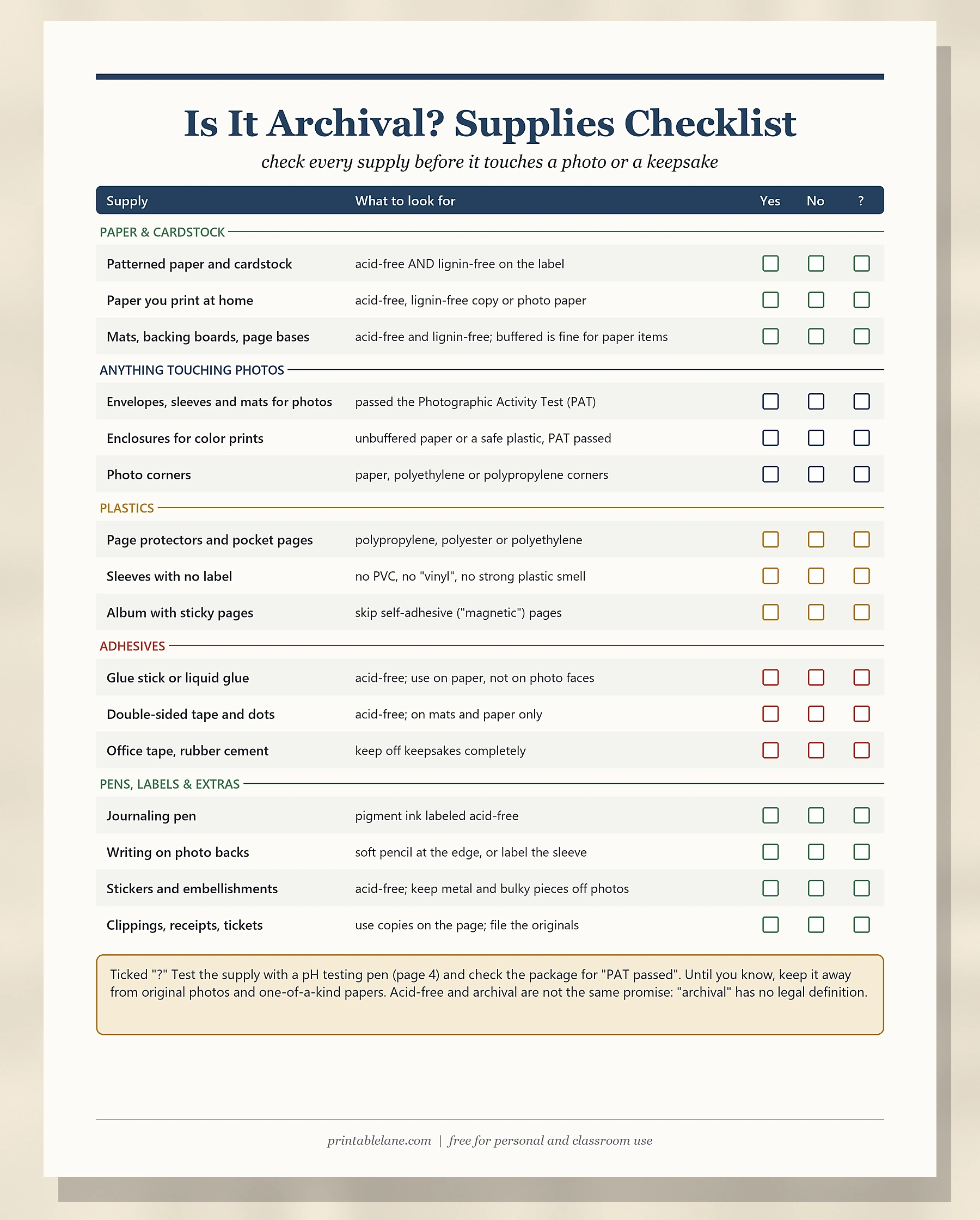
- Page 2: Is It Archival? Supplies Checklist (16 supplies).
- Page 3: Materials Safety Chart (24 entries).
- Page 4: Supply pH Test Log (18 rows).
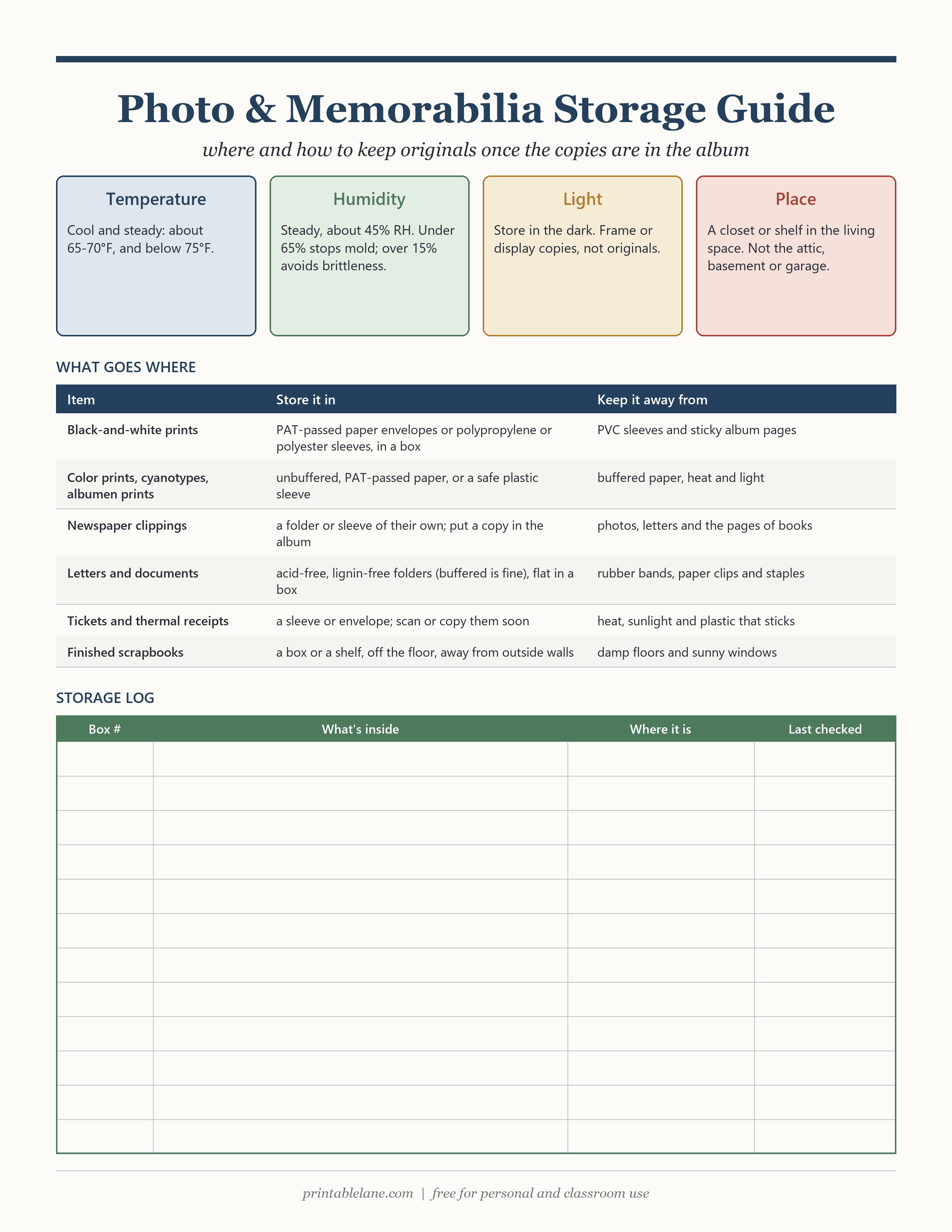
- Page 5: Photo & Memorabilia Storage Guide.
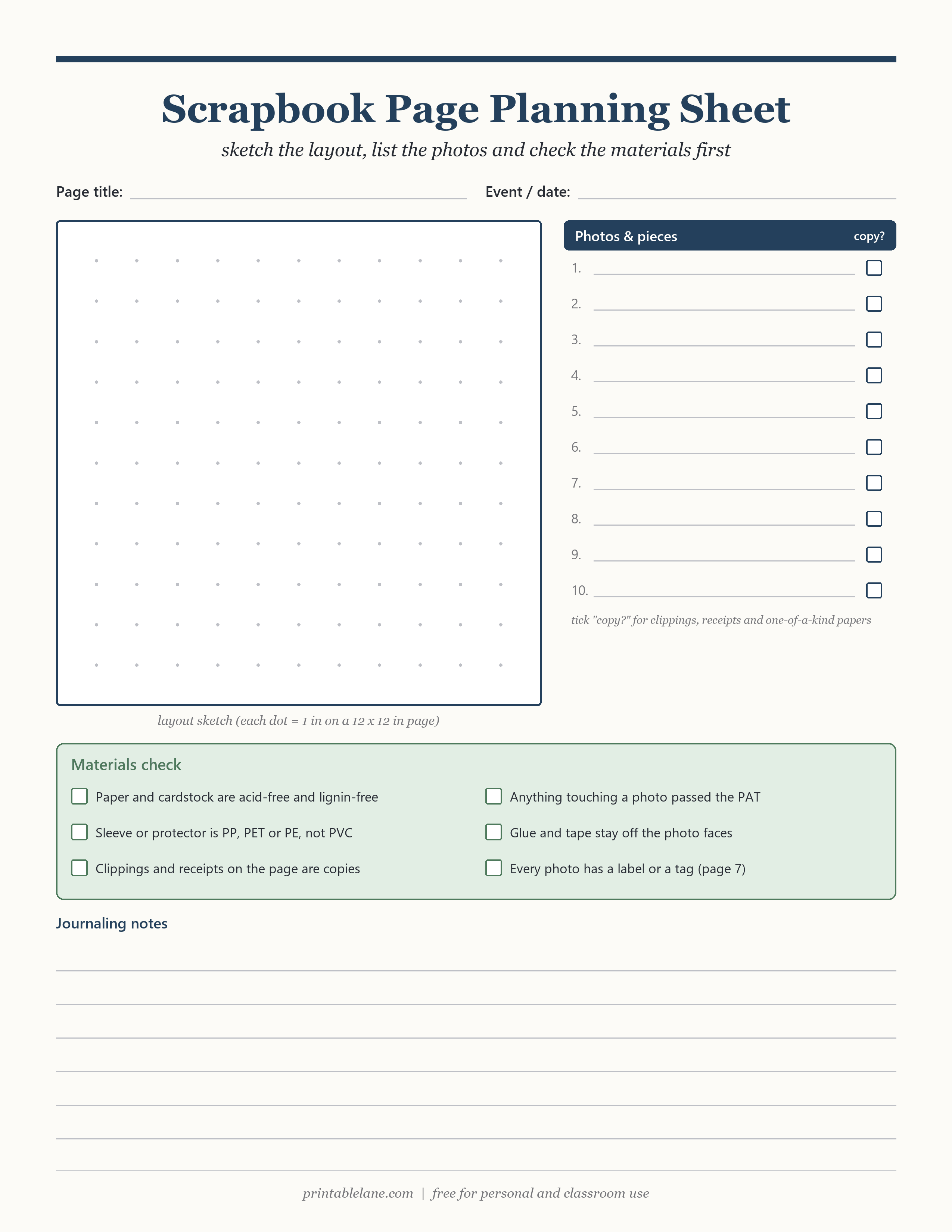
- Page 6: Scrapbook Page Planning Sheet.
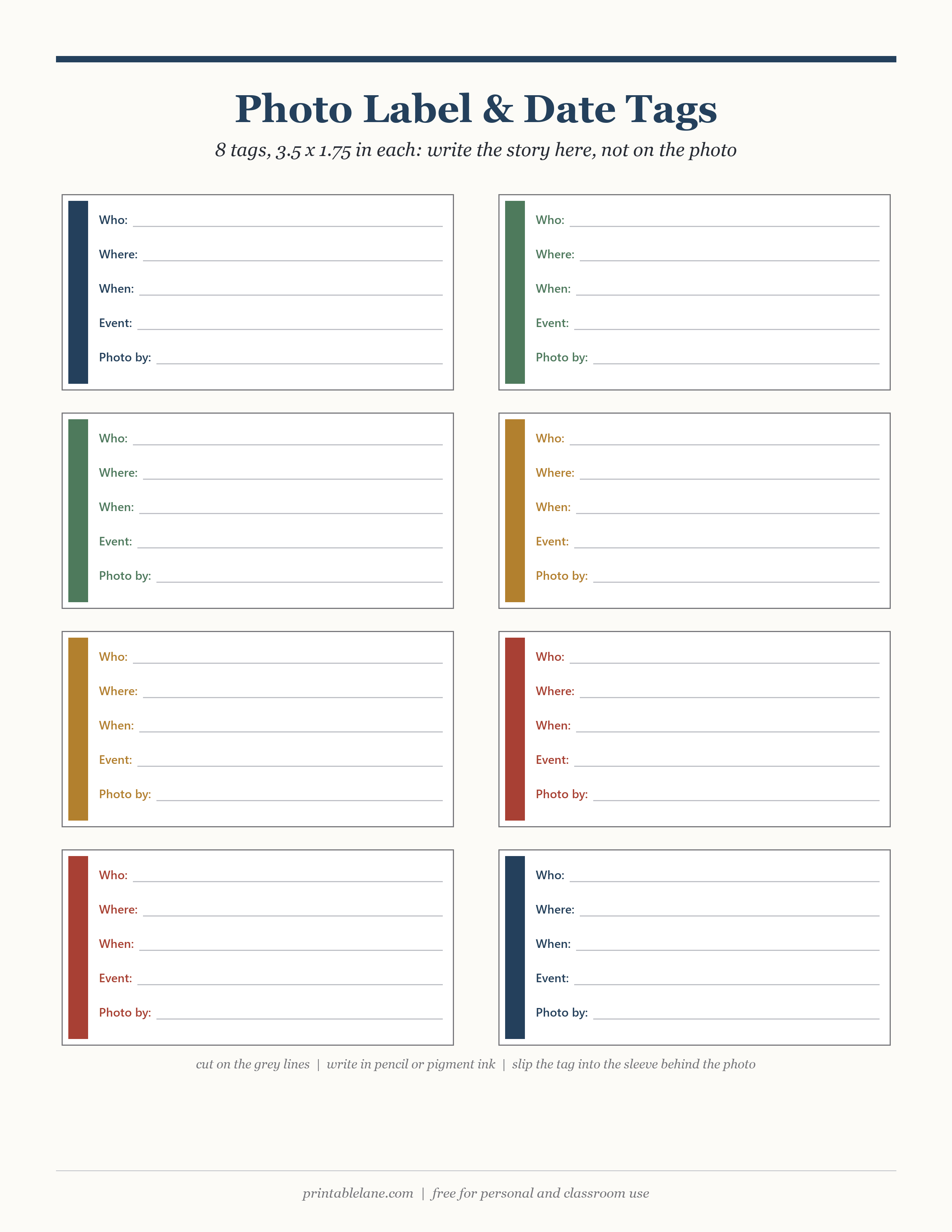
- Page 7: Photo Label & Date Tags (8 tags).
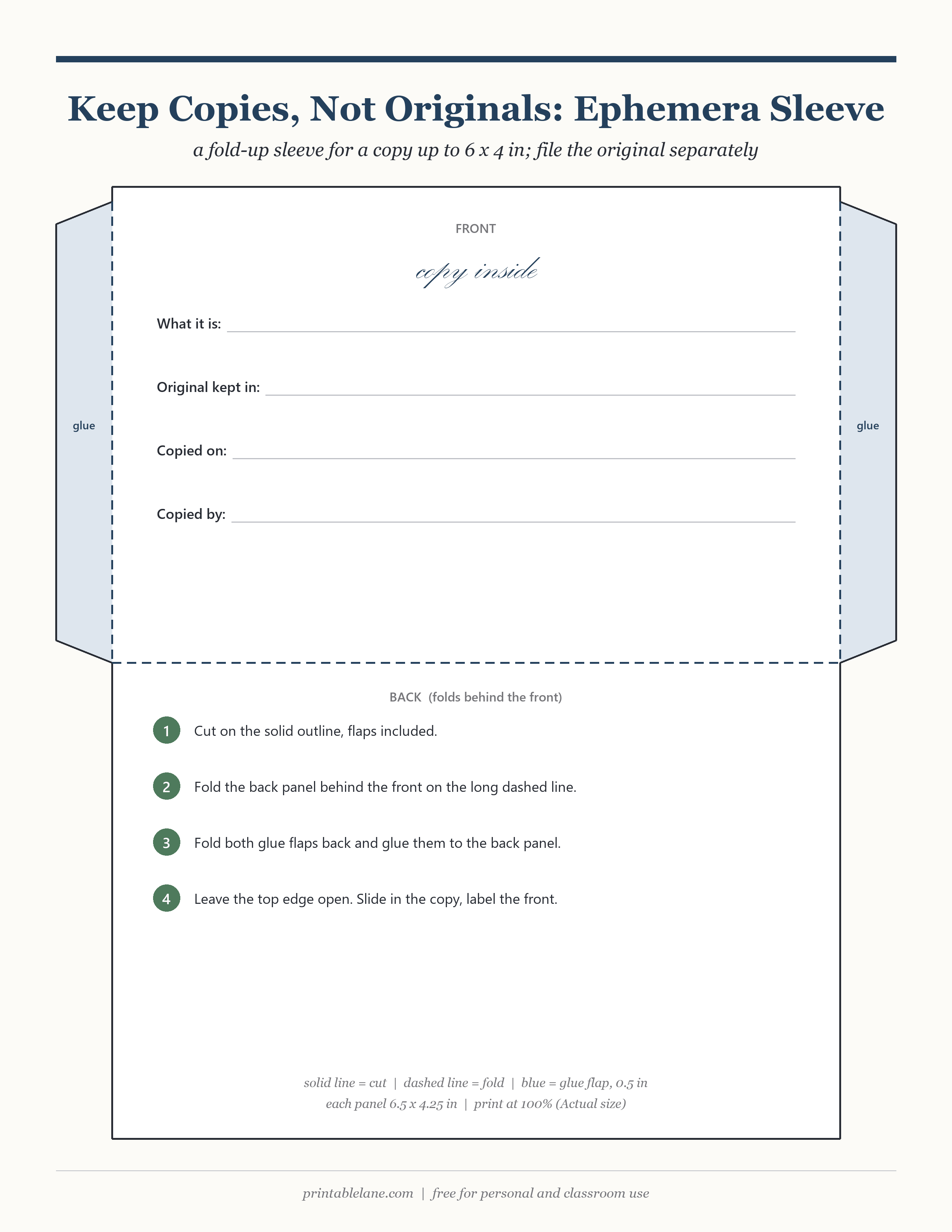
- Page 8: Keep Copies, Not Originals: Ephemera Sleeve.
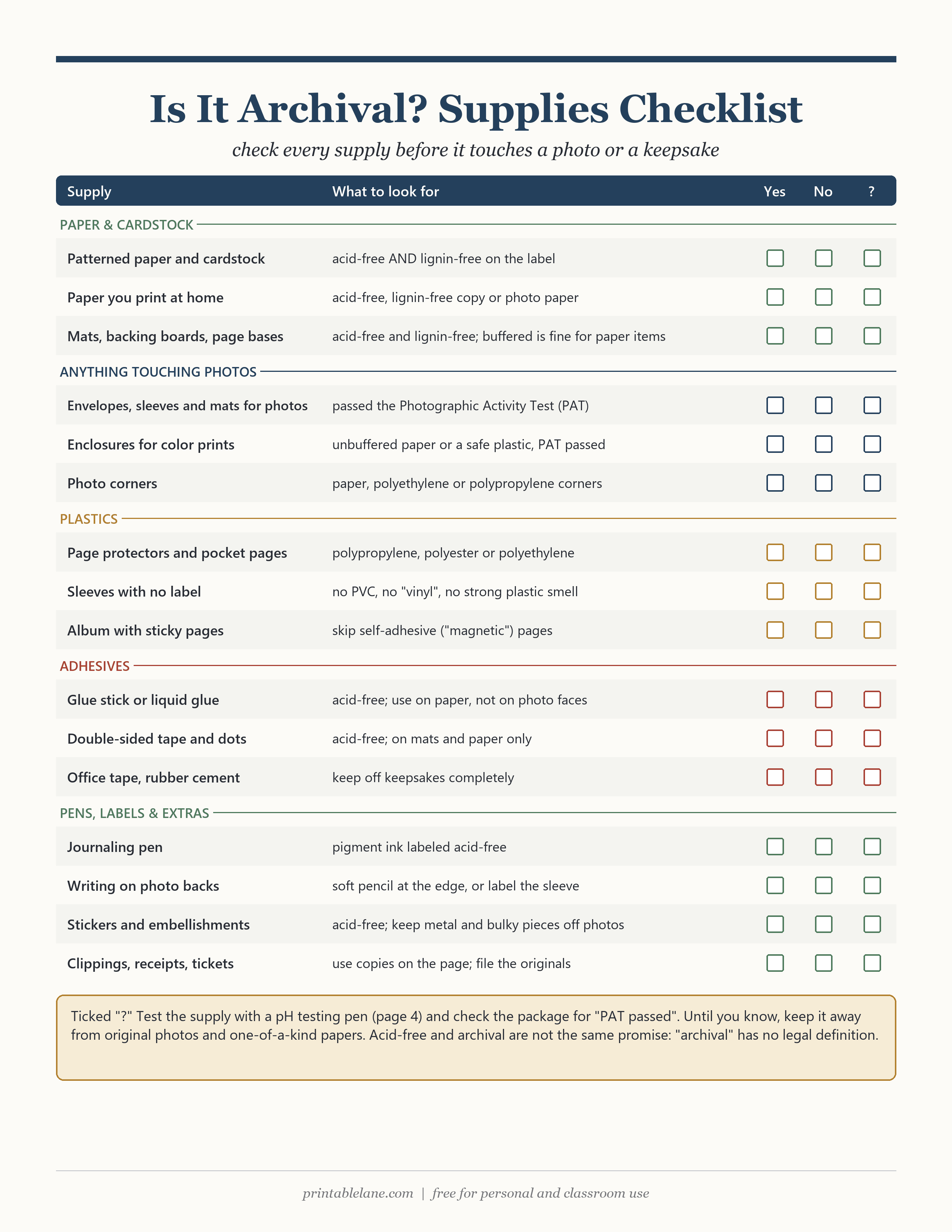
Is It Archival? Supplies Checklist
PDF page 2 lists 16 supplies in 5 groups, from Paper & Cardstock to Pens, Labels & Extras. Each row says what to look for and has Yes, No and ? boxes.
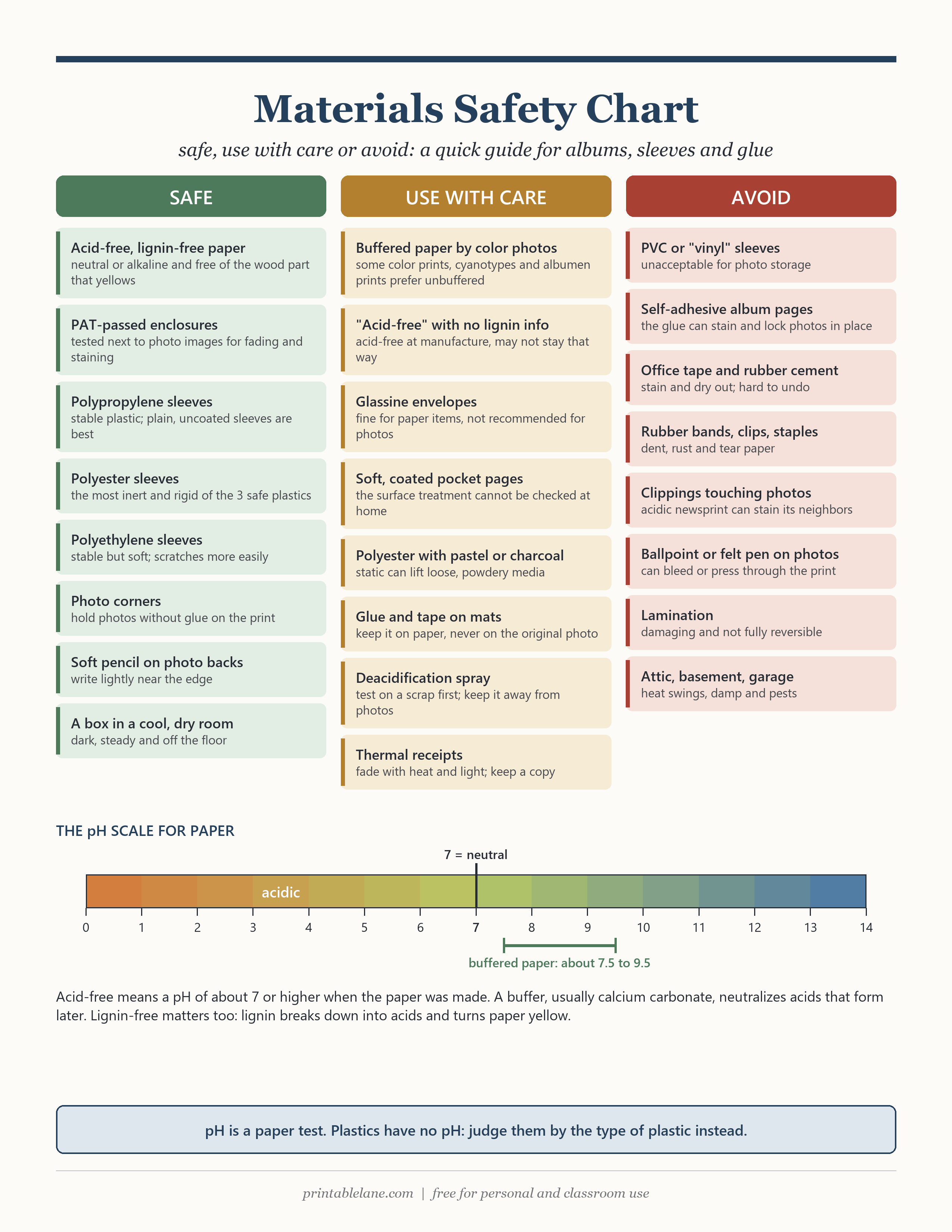
Materials Safety Chart
PDF page 3 sorts 24 entries into 3 columns of 8: Safe, Use With Care and Avoid, each with a reason. A 0 to 14 pH scale sits below.
Supply pH Test Log
PDF page 4 gives 4 testing steps, a color key and 18 rows for Date, Supply, Where from, Color, Use? and Notes.
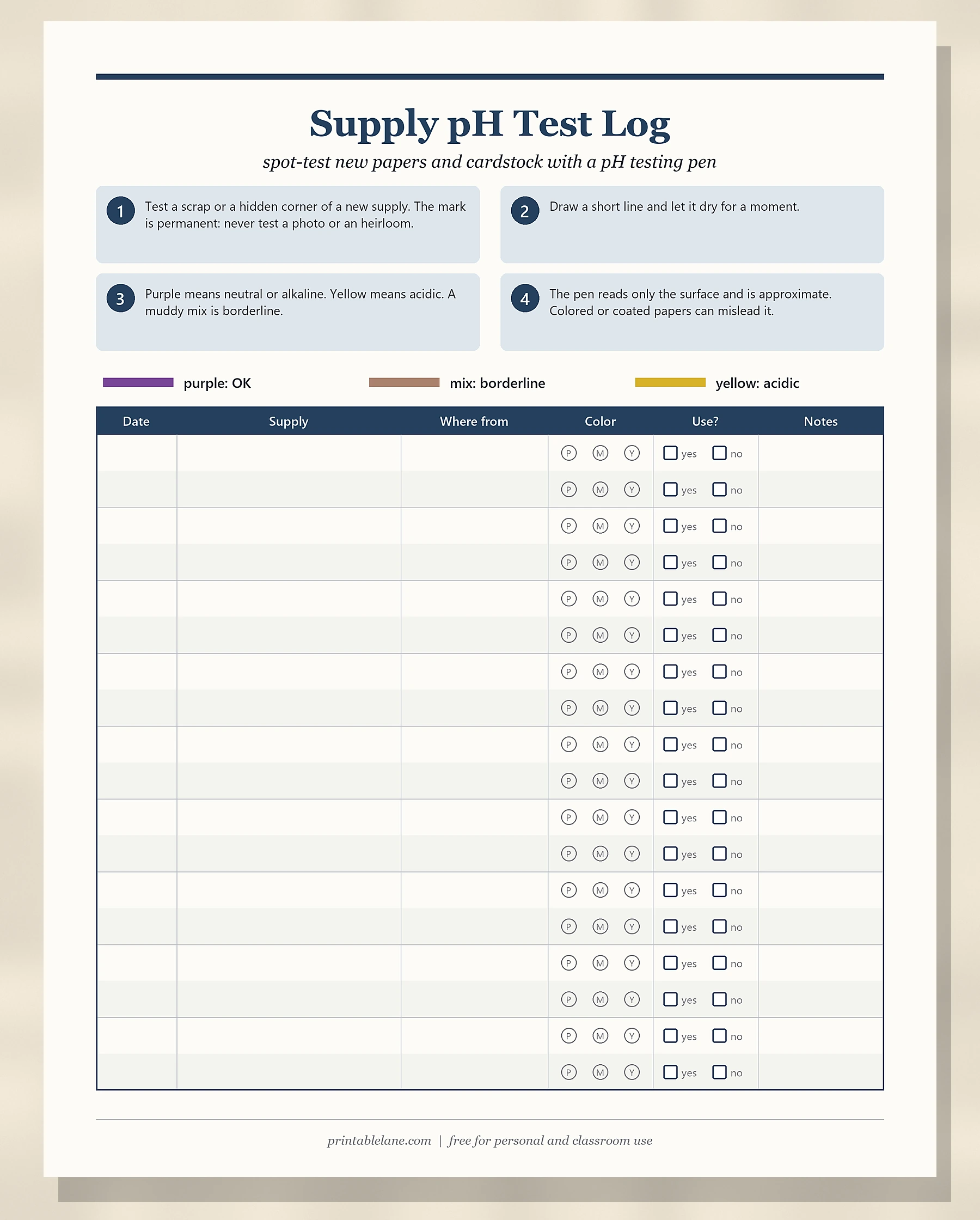
Photo & Memorabilia Storage Guide
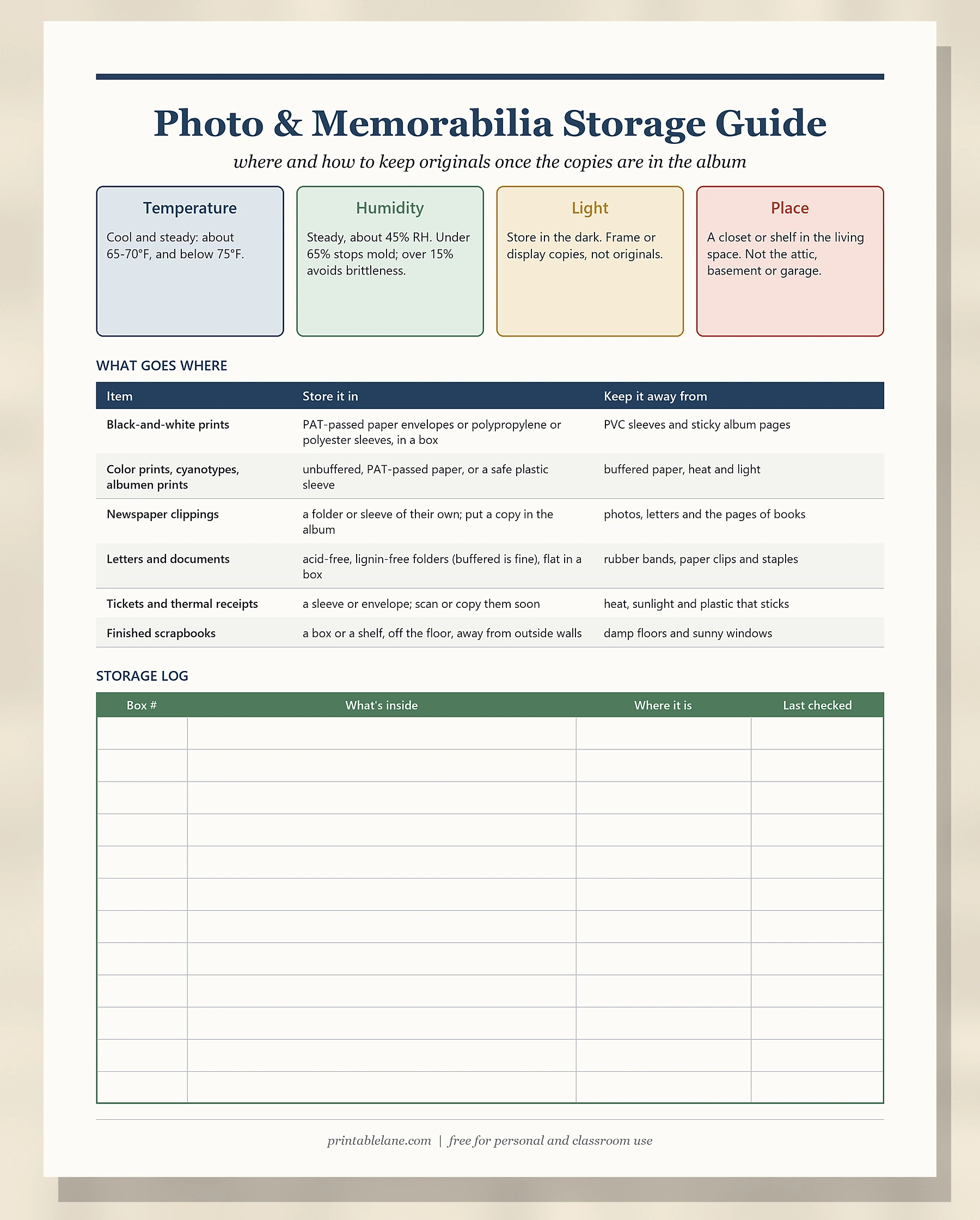
PDF page 5 has 4 tiles (Temperature, Humidity, Light, Place), a What Goes Where table for 6 item types and a 12-row Storage Log.
Scrapbook Page Planning Sheet
PDF page 6 has a dotted layout square (each dot = 1 in on a 12 x 12 in page), a Photos & Pieces list of 10 with “copy?” boxes, a 6-point Materials Check and journaling lines.
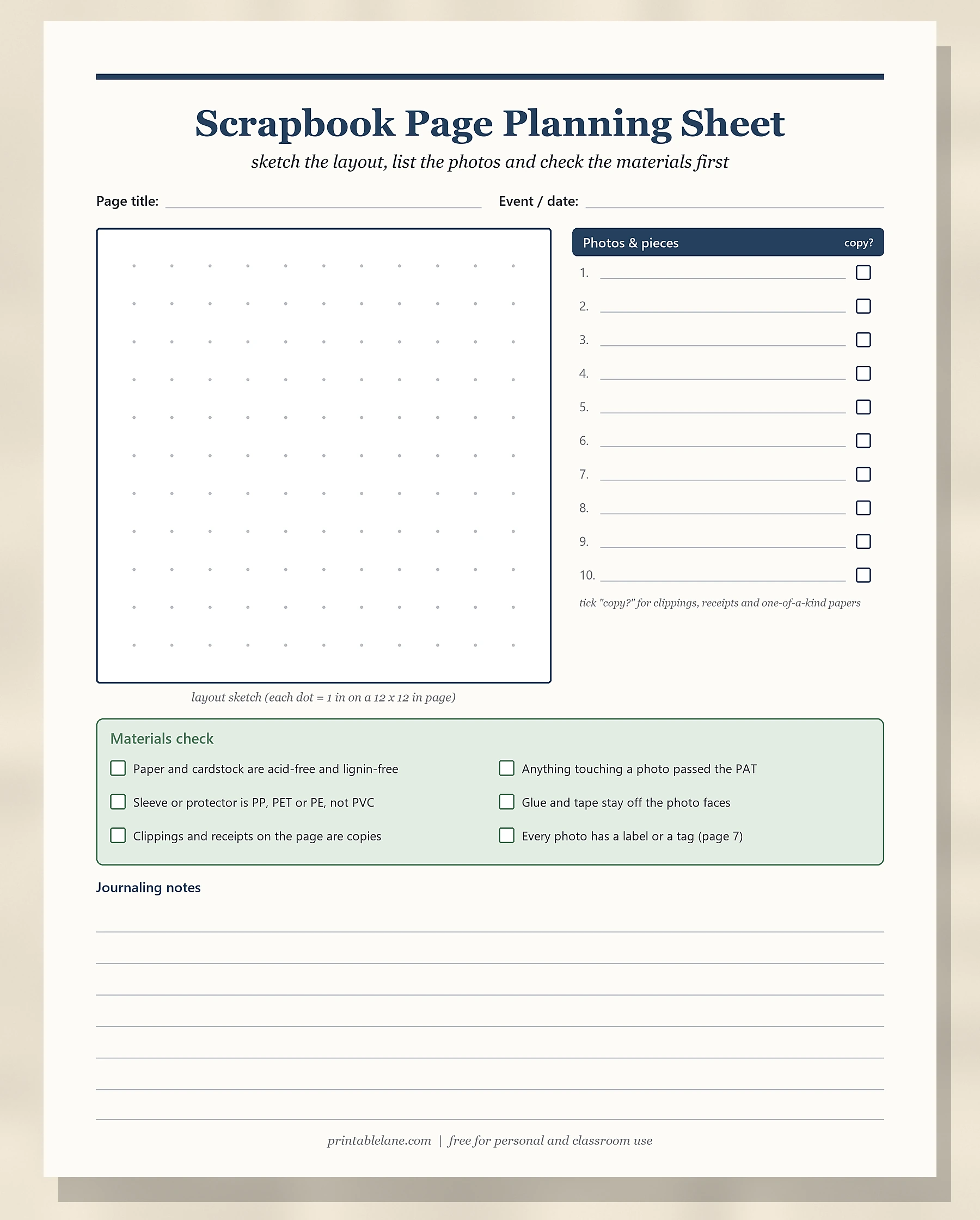
Photo Label & Date Tags
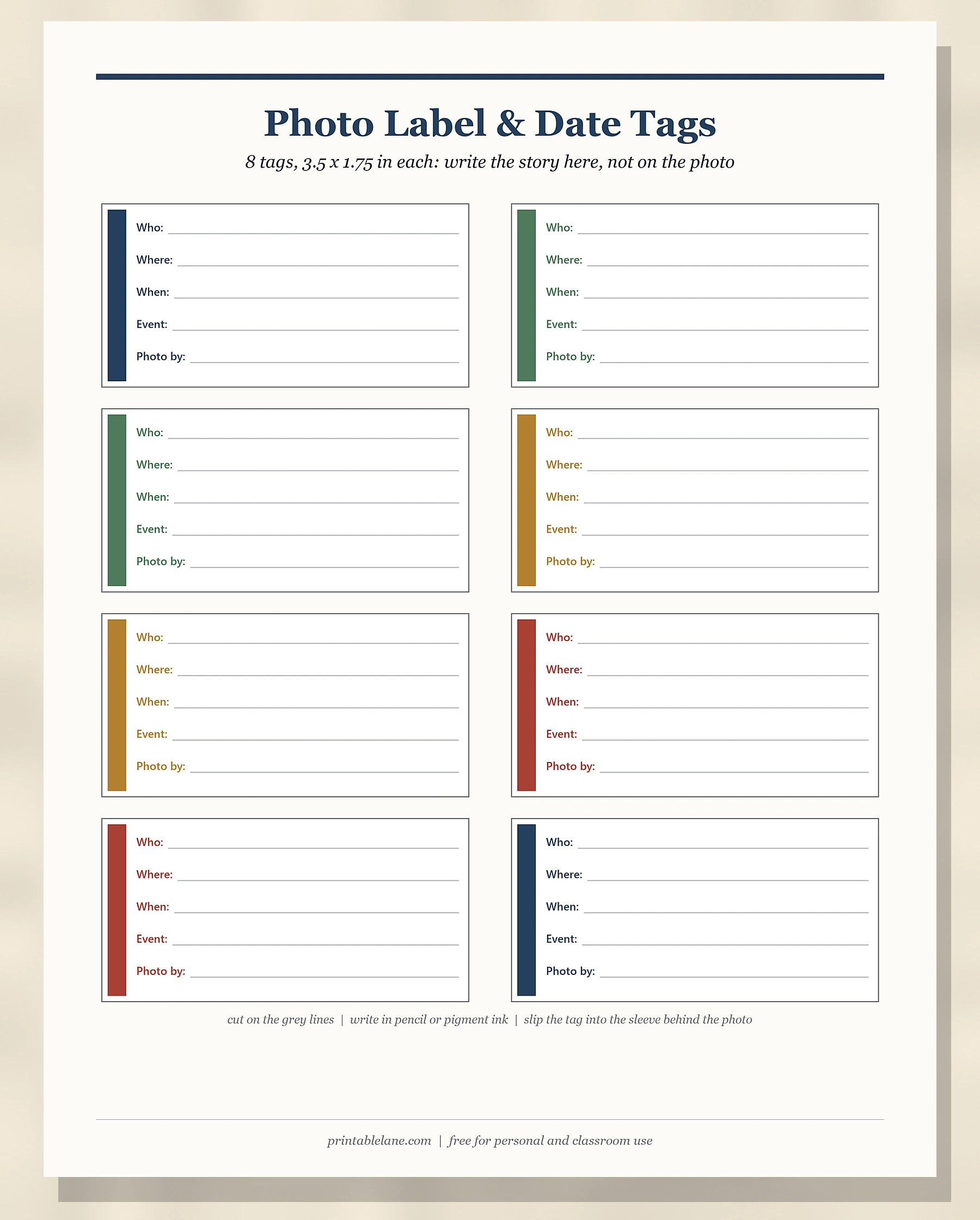
PDF page 7 holds 8 tags, 3.5 x 1.75 in each, with a colored side stripe and 5 lines: Who, Where, When, Event and Photo by.
Keep Copies, Not Originals: Ephemera Sleeve
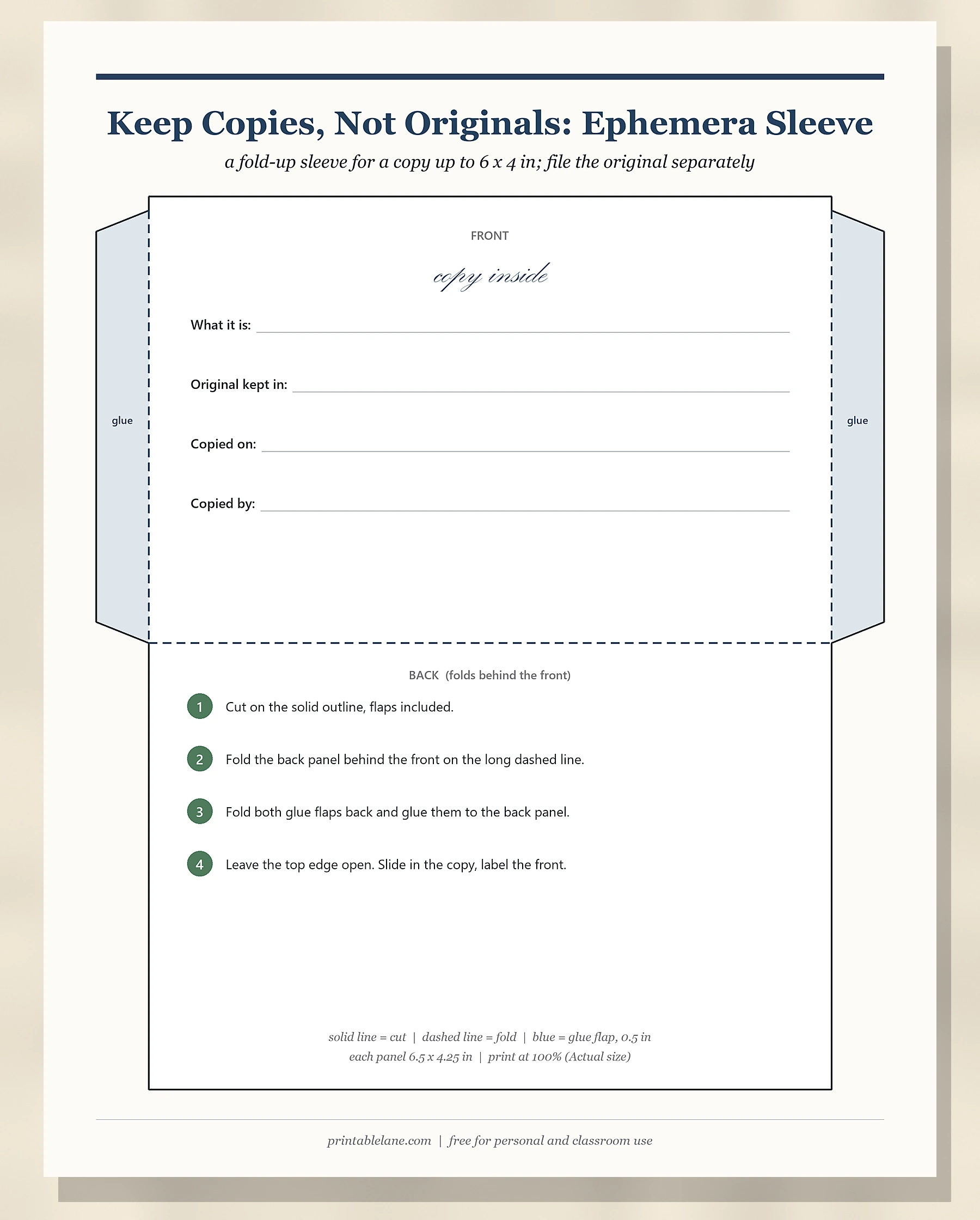
PDF page 8 is a fold-up sleeve: 2 panels of 6.5 x 4.25 in, 2 glue flaps of 0.5 in, label lines on the front and 4 steps on the back. It holds a copy up to 6 x 4 in.
Protecting old newspaper clippings
Newsprint is acidic ground wood pulp with no buffer, and it stains what it touches. Scan or photocopy the clipping onto acid-free, lignin-free paper and put the copy in the album. Store the original flat in its own folder or polyester sleeve, away from photos, letters and books. Deacidification sprays add an alkaline reserve, but results vary, so test one on a scrap and keep it away from photographs. Skip lamination; it is not fully reversible.
Storage conditions that make the biggest difference
- Temperature: about 65 to 70°F, and below 75°F.
- Humidity: about 45%; above 65% invites mold, below 15% makes paper brittle.
- Light: keep albums boxed and display copies.
- Place: the living space, not the attic, basement or garage.
Printing tips
- US Letter: print at 100% (Actual size) so the tags stay 3.5 x 1.75 in and the sleeve panels 6.5 x 4.25 in.
- A4: choose 100% (Actual size), not Fit to page; content sits 0.5 in inside the side edges.
- Paper: plain paper for the charts and logs; acid-free cardstock for the tags and sleeve, since they go in the album.
Download single pages
Need only the tags for a box of loose photos, or a fresh pH log? Grab that page alone.
- Is It Archival? Supplies Checklist (PNG)
- Materials Safety Chart (PNG)
- Supply pH Test Log (PNG)
- Photo & Memorabilia Storage Guide (PNG)
- Scrapbook Page Planning Sheet (PNG)
- Photo Label & Date Tags (PNG)
- Keep Copies, Not Originals: Ephemera Sleeve (PNG)
Pages to fill next
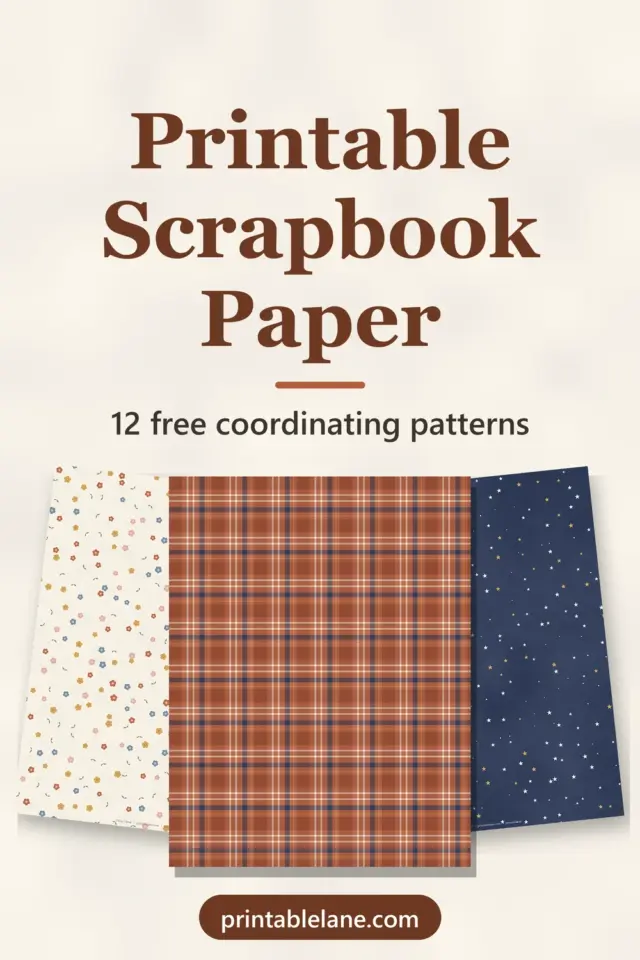
Print our free printable scrapbook paper on acid-free cardstock as a backing for copied photos. If loose tickets appeal more than tidy albums, read what a junk journal is and try the junk journal ephemera printables, which are copies by design. For holiday albums, use the Christmas scrapbook paper.
Frequently asked questions
How many pages are in the PDF?
8 pages: a cover and 7 printable pages. The checklist is page 2 and the copy sleeve is page 8, so you can print either one alone.
Can I print these on A4 paper?
Yes. Choose 100% (Actual size) so the photo tags and the sleeve keep their measured size; Fit to page would shrink them slightly.
Is acid-free paper the same as archival paper?
No. Acid-free describes pH at manufacture. “Archival” has no fixed definition, so look for lignin-free and, for photos, a PAT pass as well.
Is buffered paper safe for photos?
Usually for black-and-white prints. Color prints, cyanotypes and albumen prints are better in unbuffered, PAT-passed paper.
Are page protectors safe for scrapbooks?
Ones made of polypropylene, polyester or polyethylene are. Avoid PVC or anything sold as vinyl, which can damage photos over time.