A plain header in your own handwriting works fine, but a few bullet journal fonts you can letter from memory make each spread easier to scan. Below are 10 hand lettering styles, each drawn as a complete alphabet, with notes on how to copy it using the pen you already own.
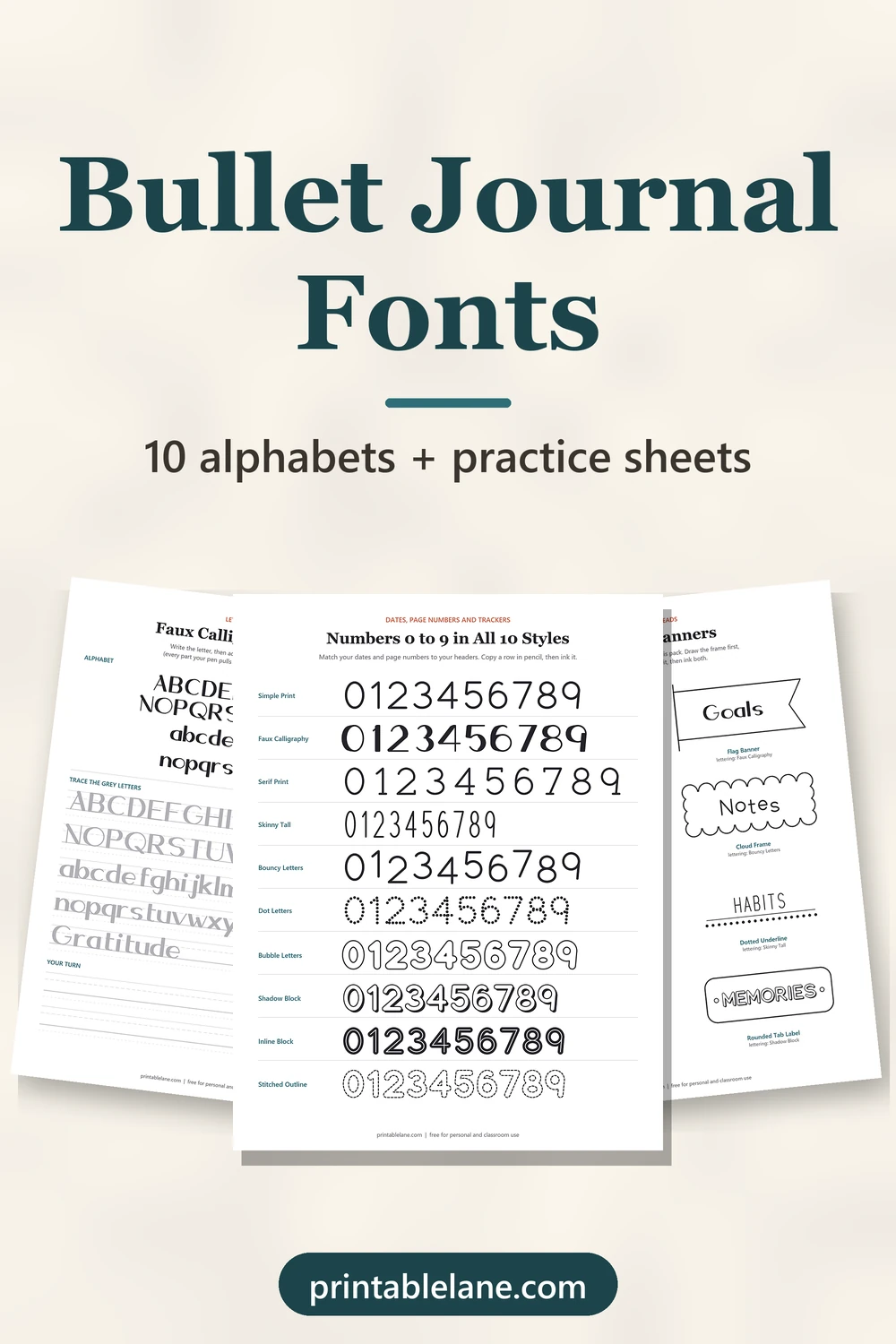
Every style has its own practice sheet in the free 13-page PDF: a dark reference alphabet, grey letters to trace on guide lines and blank rows to try it alone. There is also a page of headers and banners and a page of numbers for dates and page numbers.
What’s in the PDF (13 pages)
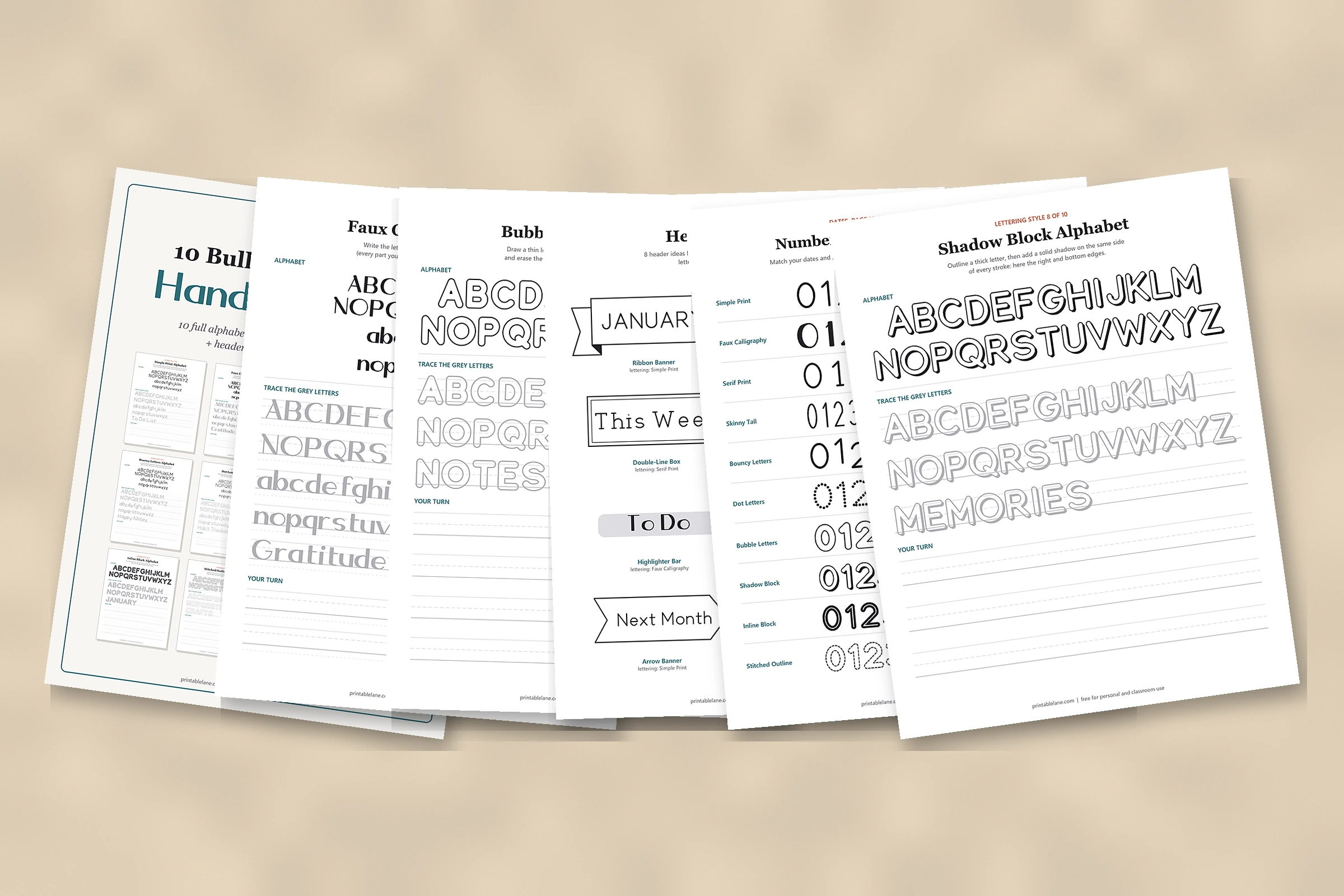
- Page 1: cover
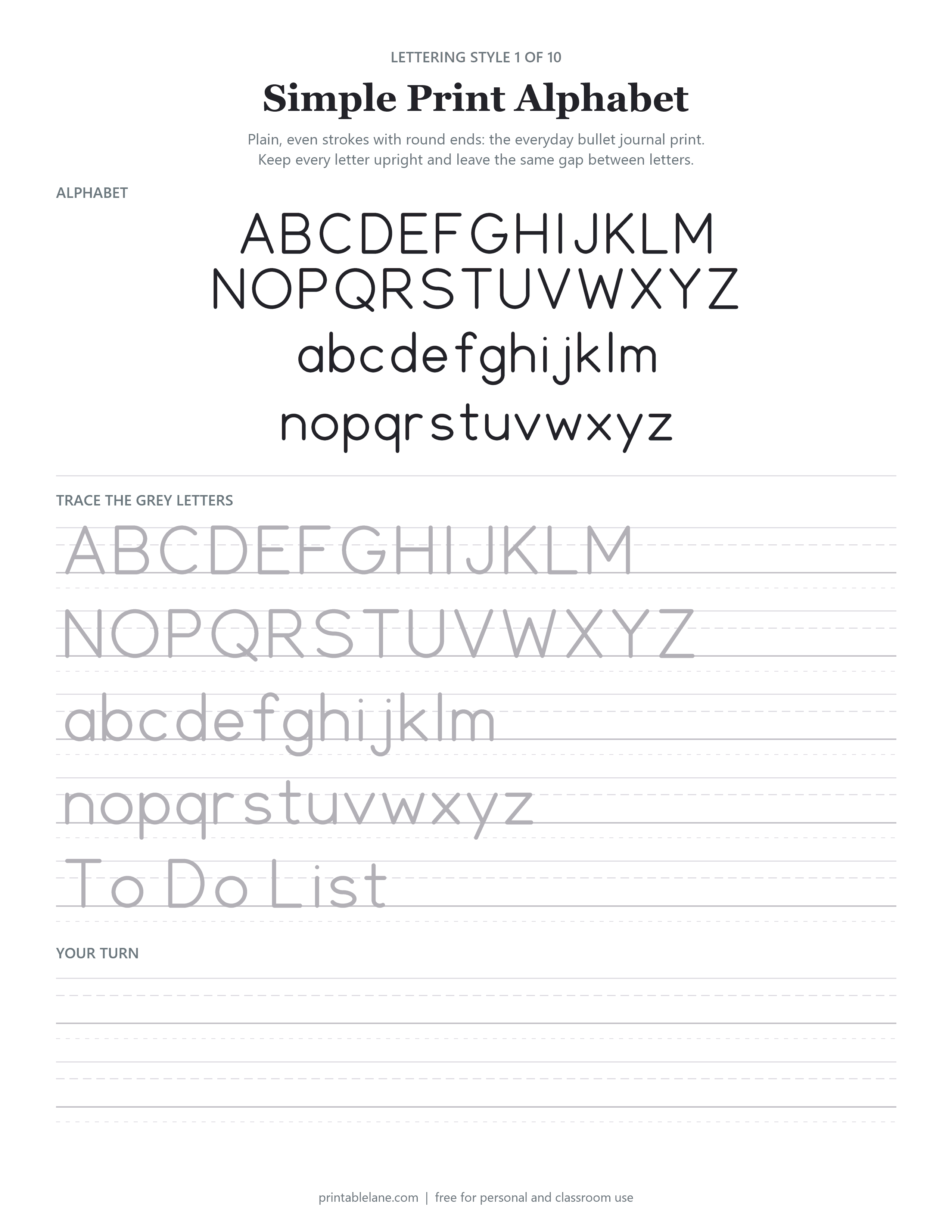
- Page 2: Simple Print Alphabet
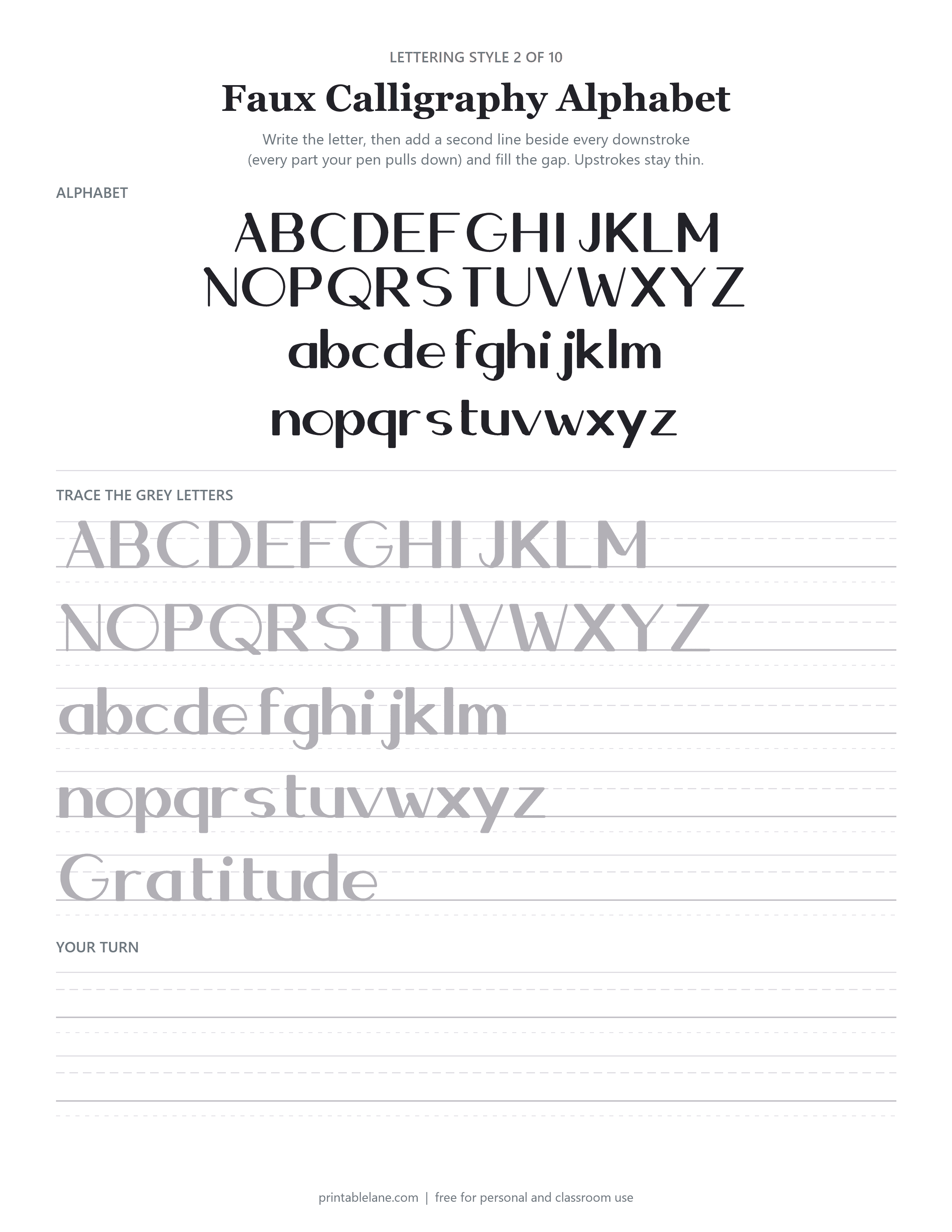
- Page 3: Faux Calligraphy Alphabet
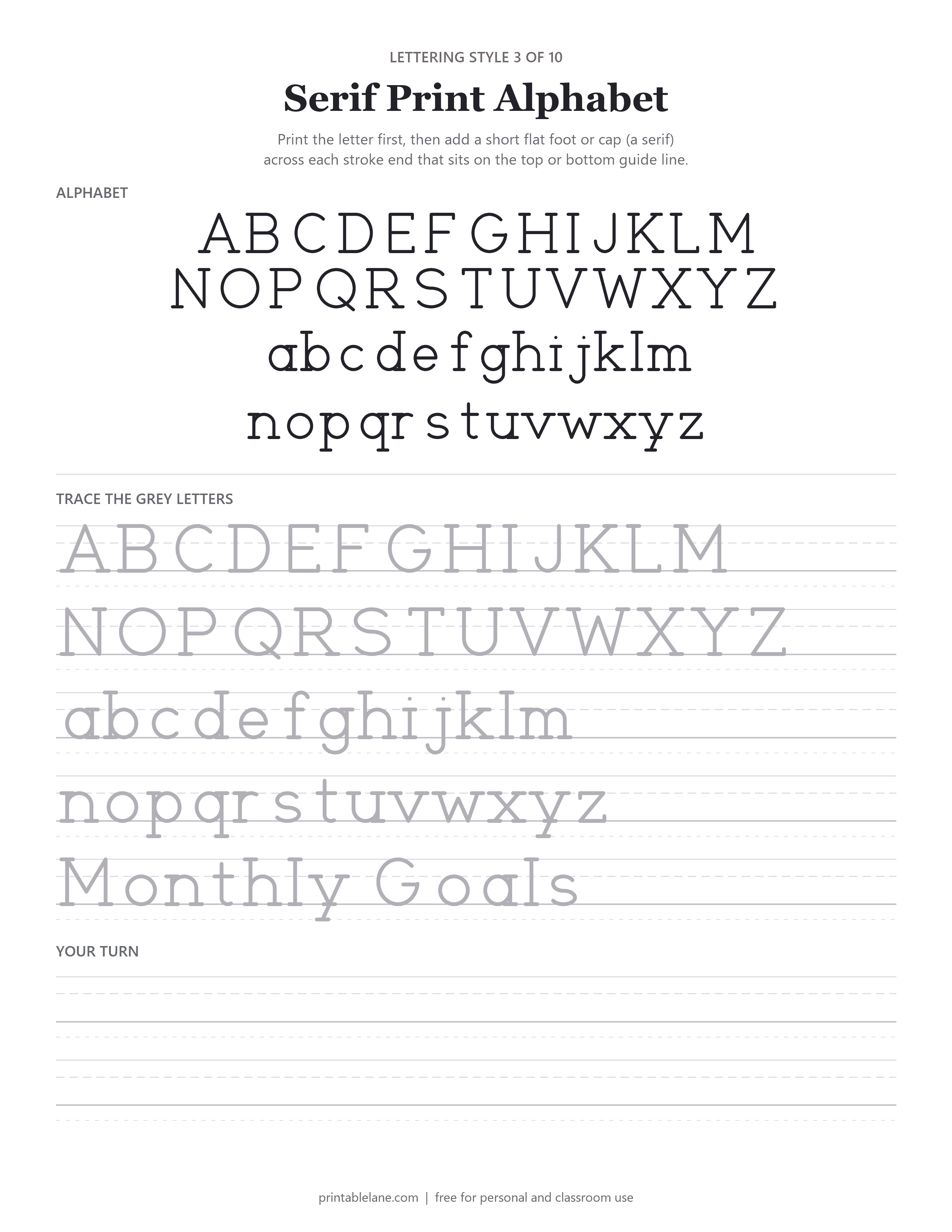
- Page 4: Serif Print Alphabet
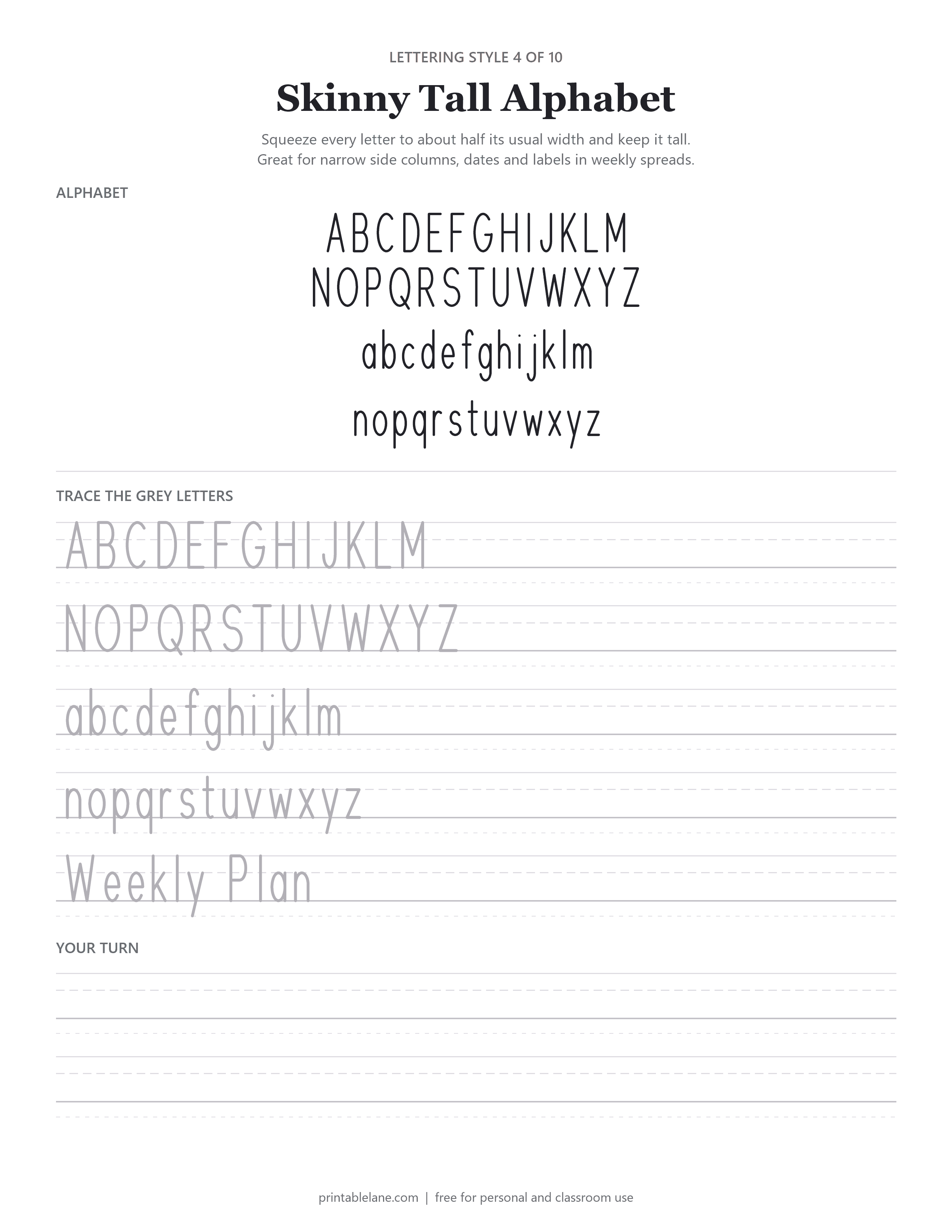
- Page 5: Skinny Tall Alphabet
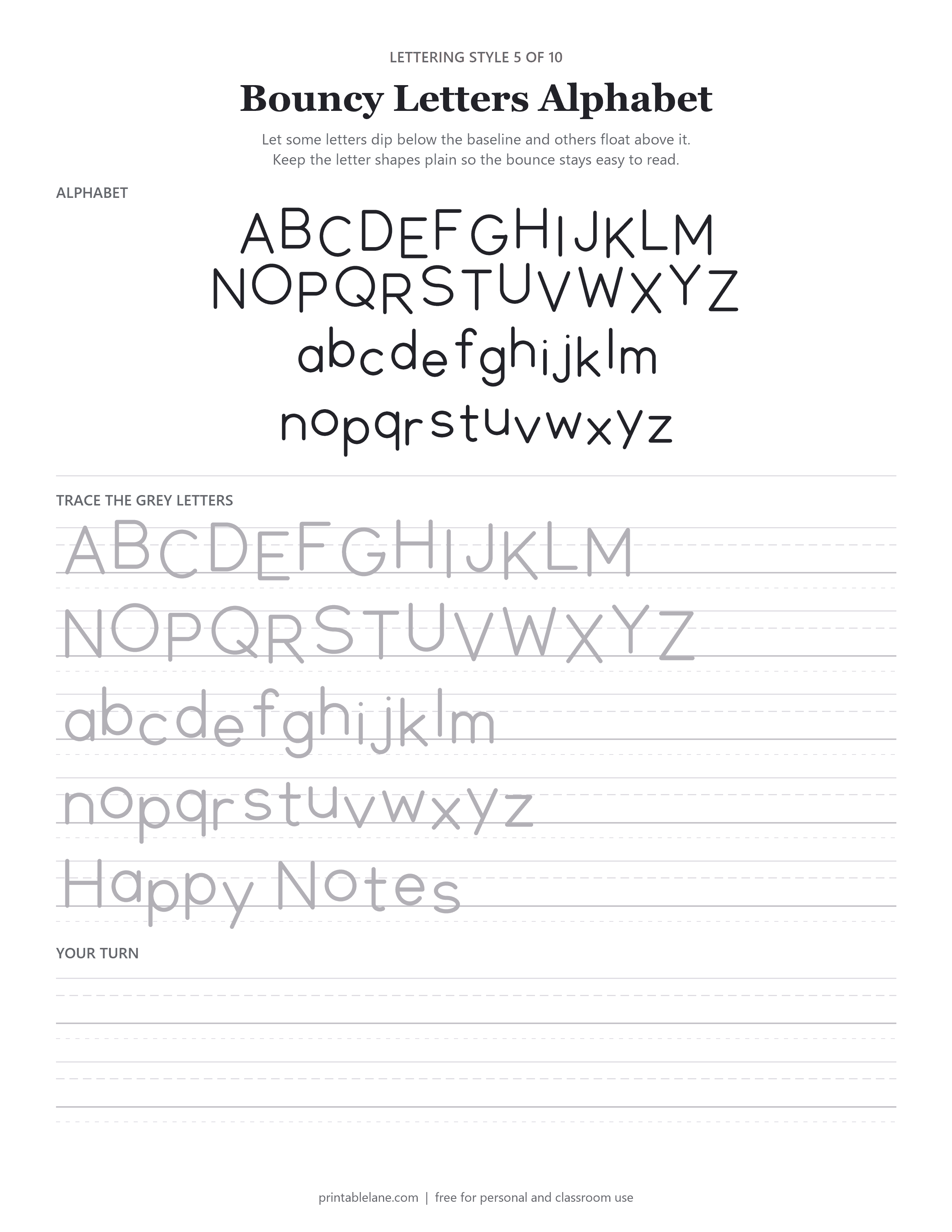
- Page 6: Bouncy Letters Alphabet
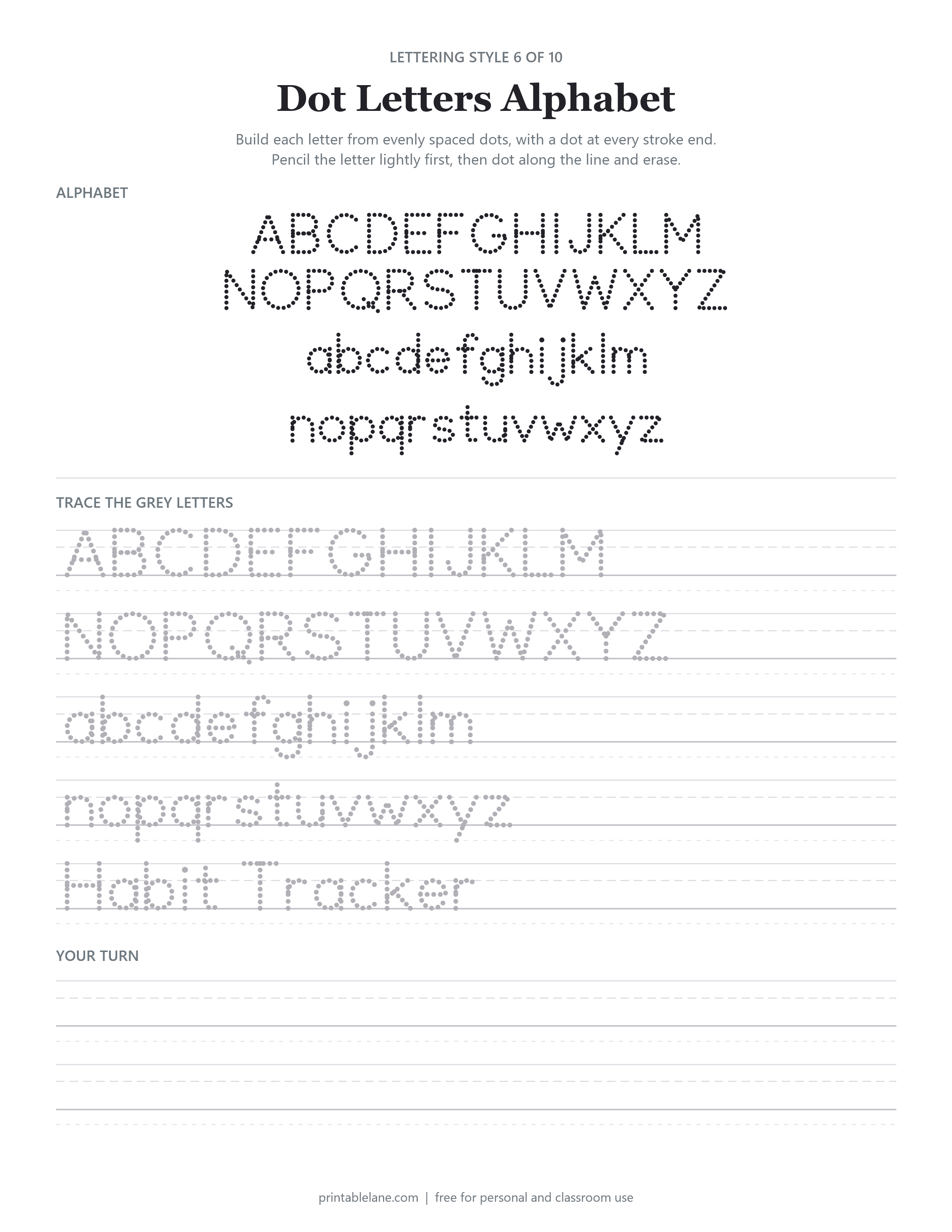
- Page 7: Dot Letters Alphabet
- Page 8: Bubble Letters Alphabet
- Page 9: Shadow Block Alphabet
- Page 10: Inline Block Alphabet
- Page 11: Stitched Outline Alphabet
- Page 12: Headers & Banners
- Page 13: Numbers 0 to 9 in All 10 Styles
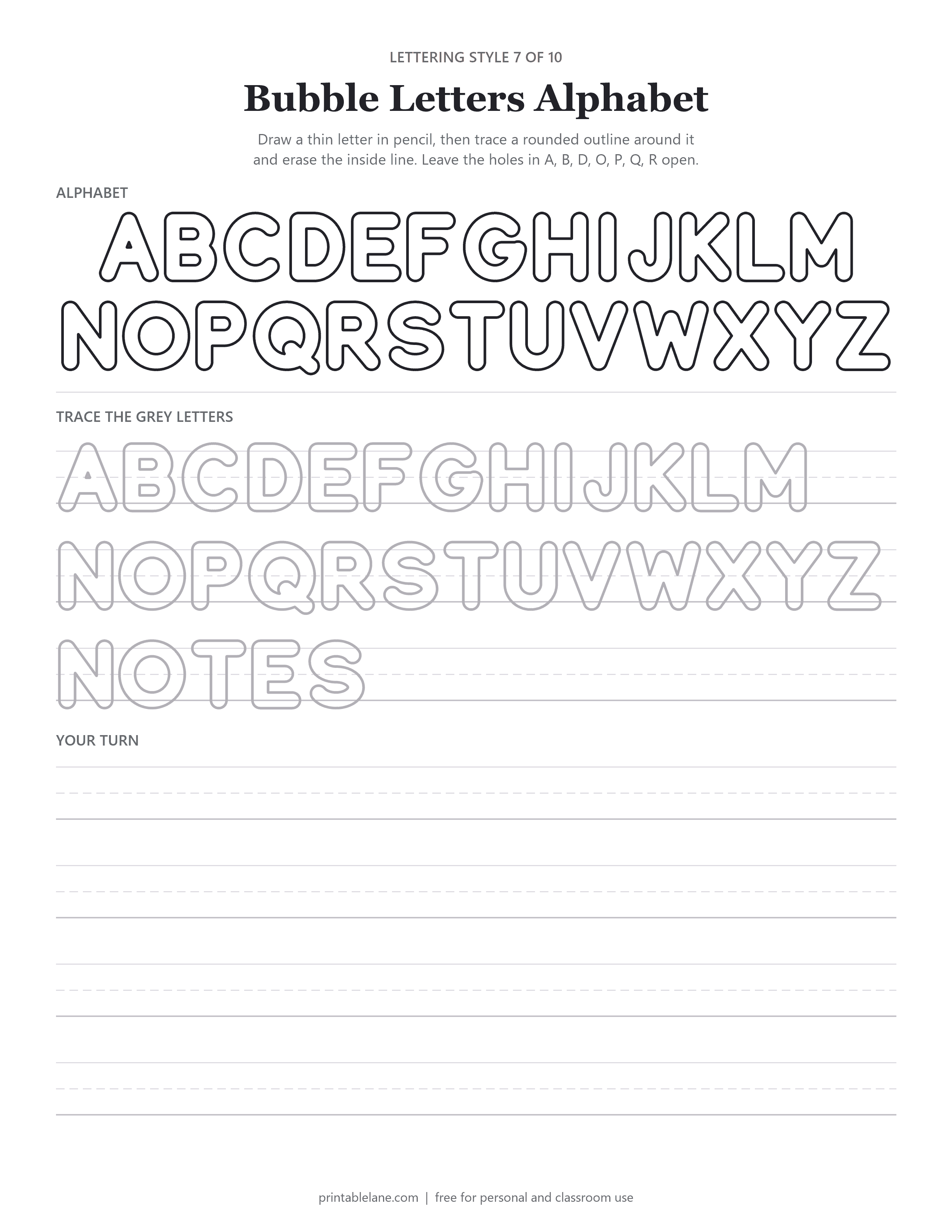
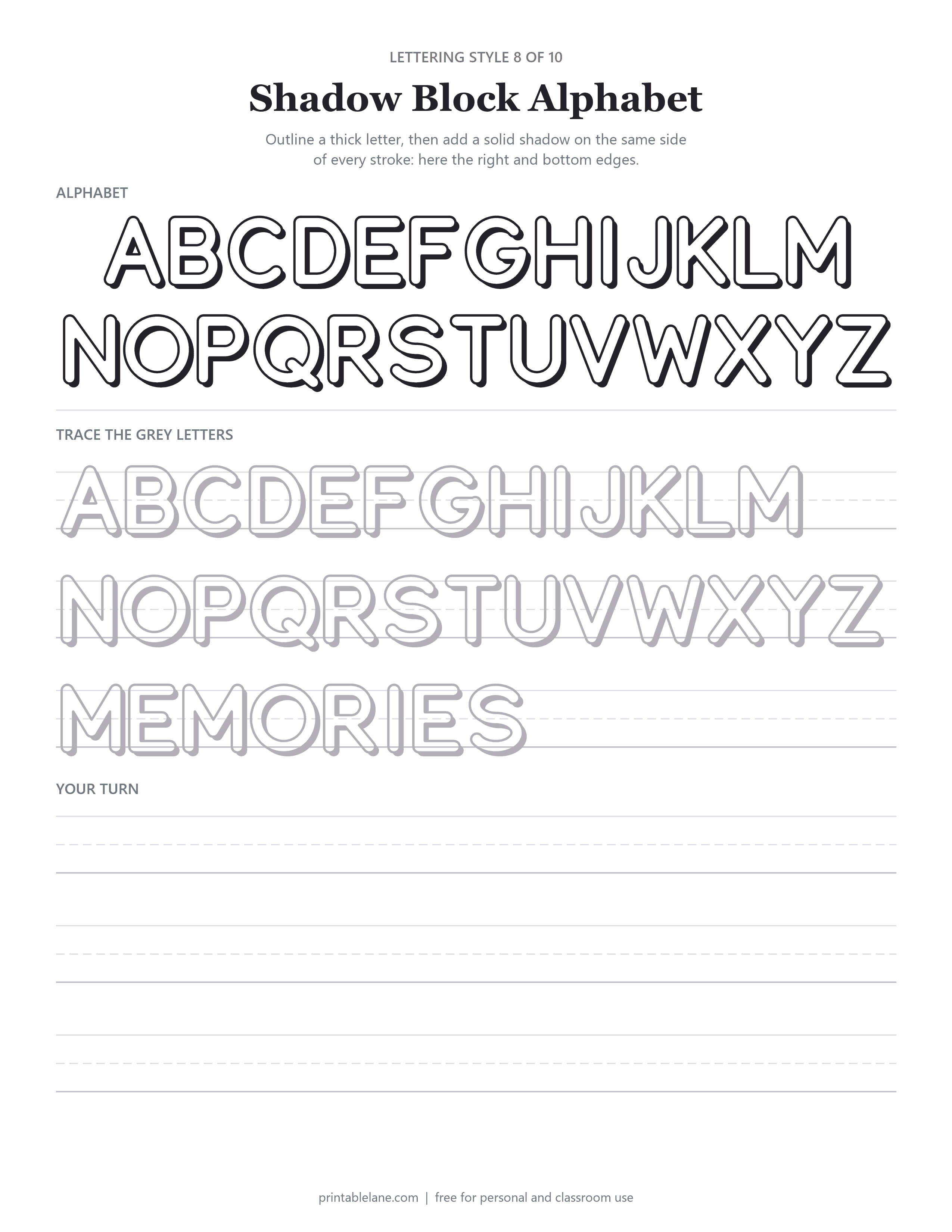
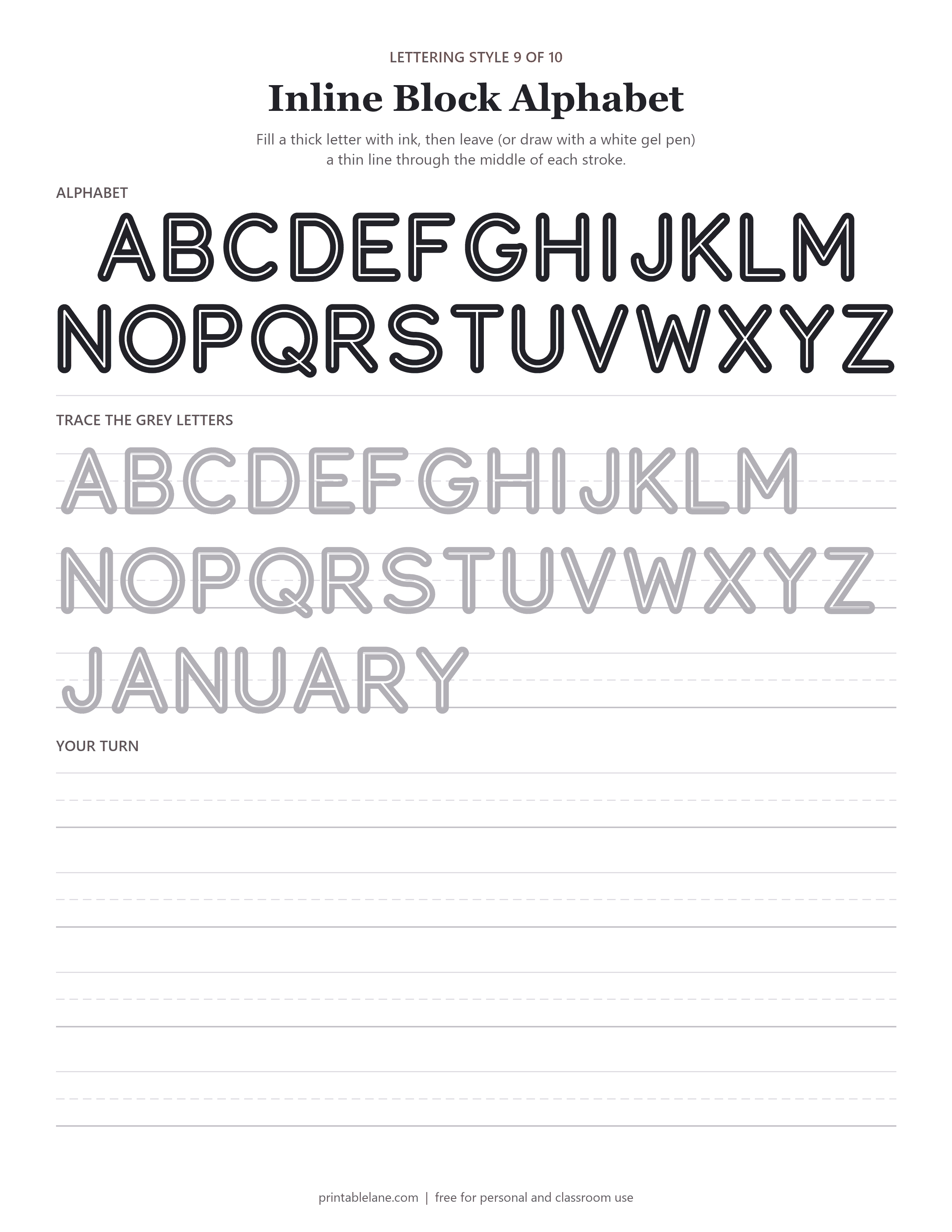
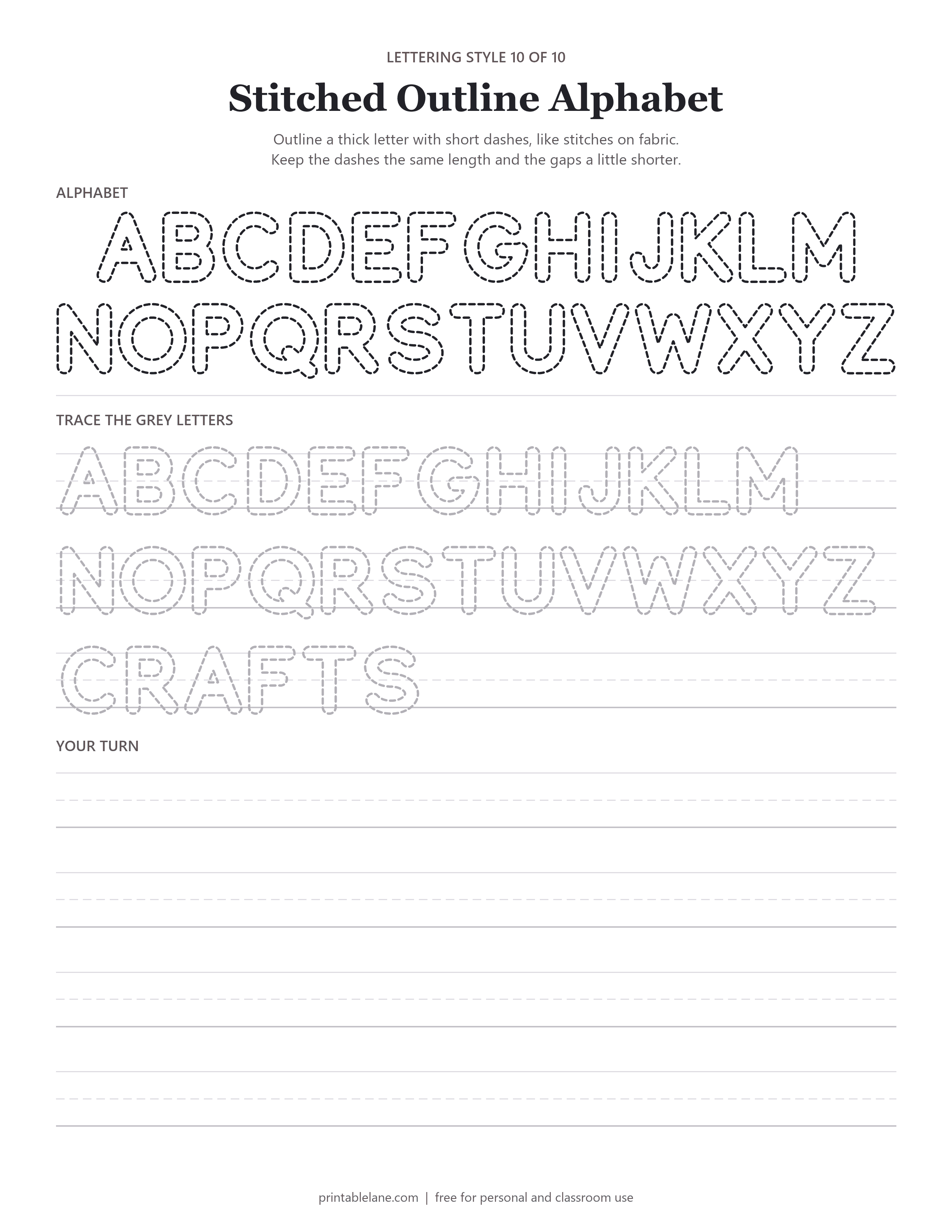
Pages 2 to 7 show uppercase and lowercase: 4 alphabet rows, 5 trace rows with a sample word and 2 blank rows. Pages 8 to 11 are thick display styles in capitals only, with 2 alphabet rows, 3 trace rows and 3 or 4 blank rows.
The 10 lettering styles
Simple Print Alphabet
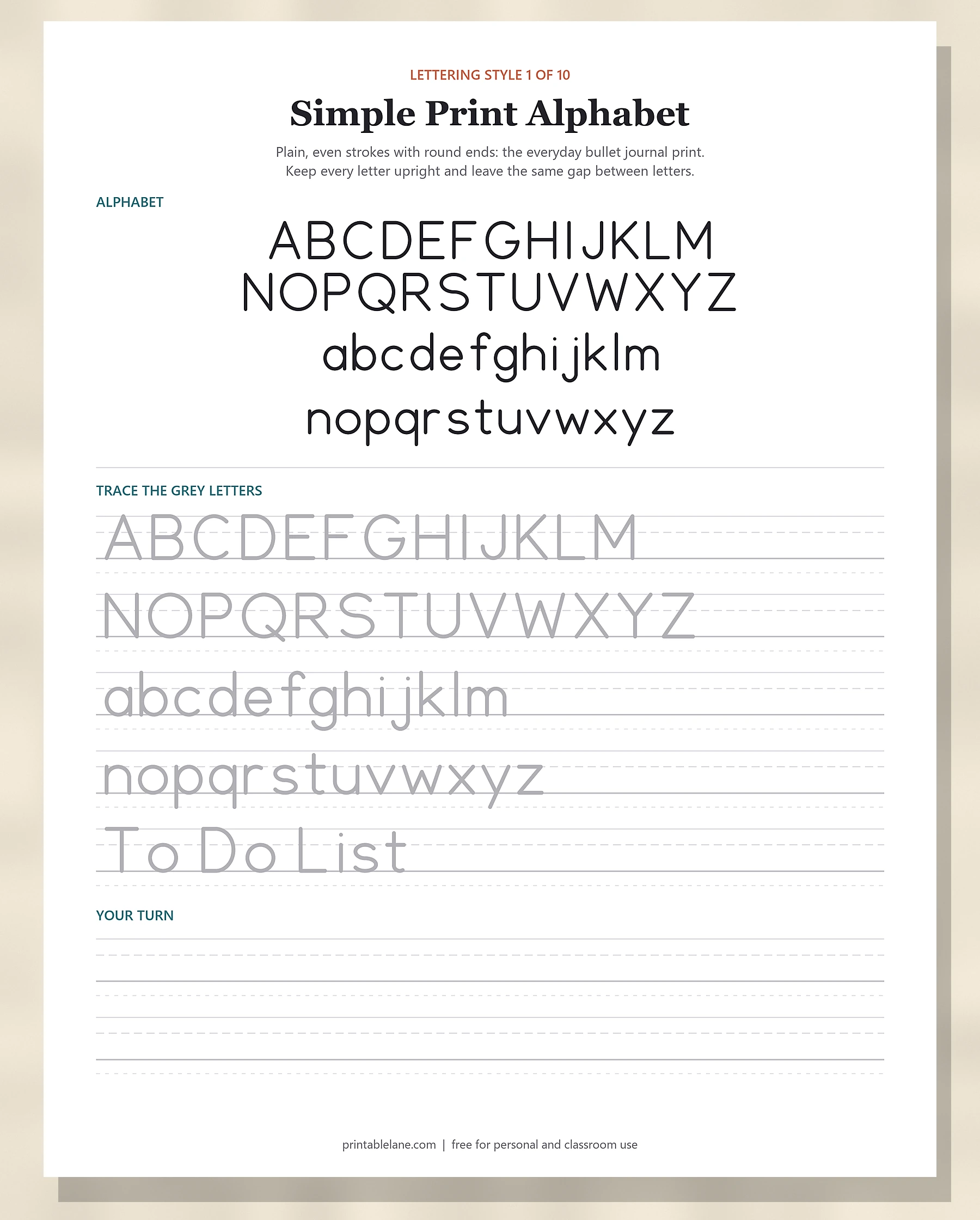
PDF page 2. Even strokes with round ends, the base for every other style here. Keep letters upright and leave the same small gap after each one. The trace word is “To Do List”.
Faux Calligraphy Alphabet
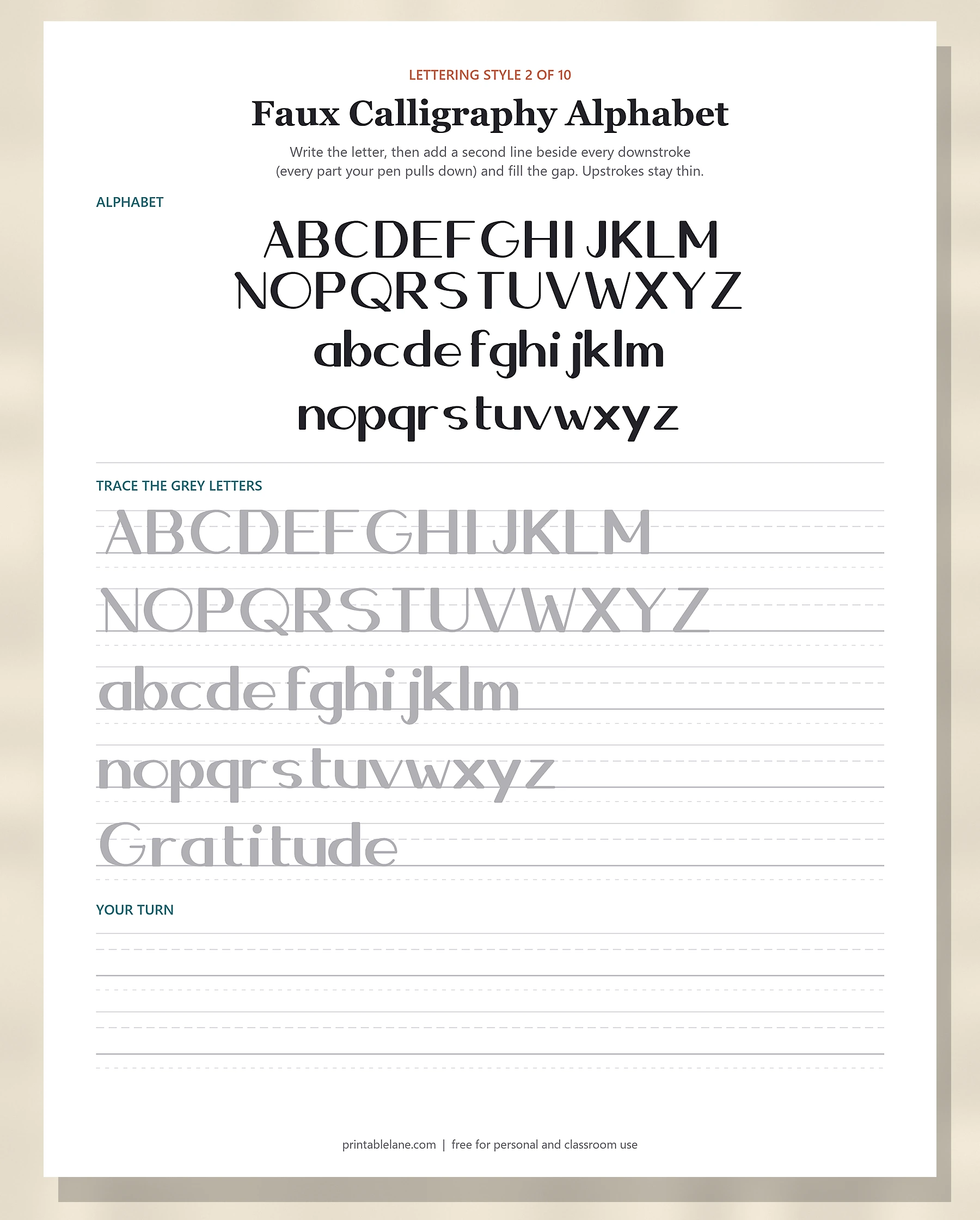
PDF page 3. The thick and thin look of a brush pen, made with any fine pen: every part where the pen moves down gets a second line and is filled in. On the sheet, the right leg of the A is thick and the left leg thin. The trace word is “Gratitude”.
Serif Print Alphabet
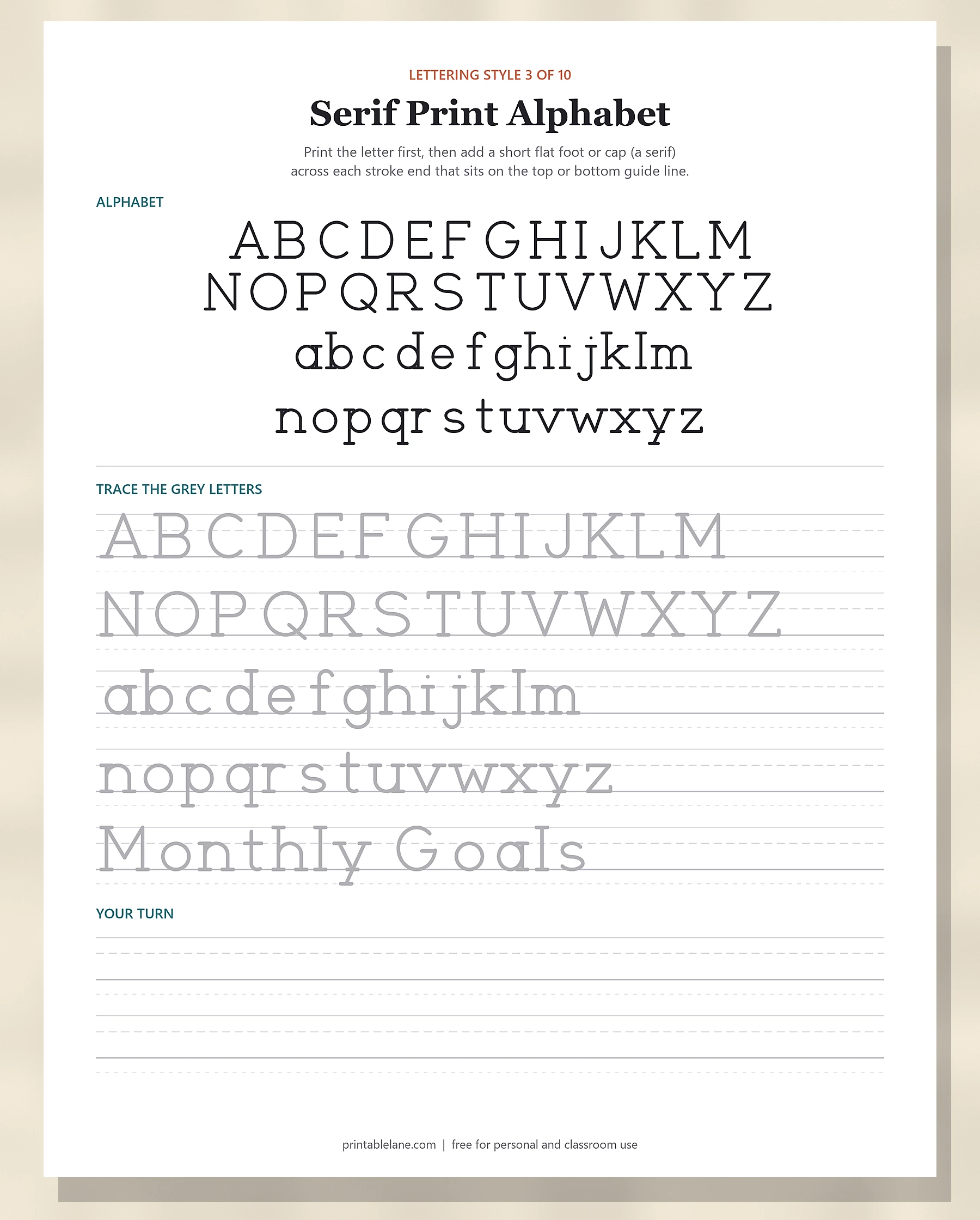
PDF page 4. Simple print with small serifs: a short flat foot or cap across each stroke end that sits on the top or bottom line, and a small tick at the ends of flat arms such as E, F, T and Z. Trace word: “Monthly Goals”.
Skinny Tall Alphabet
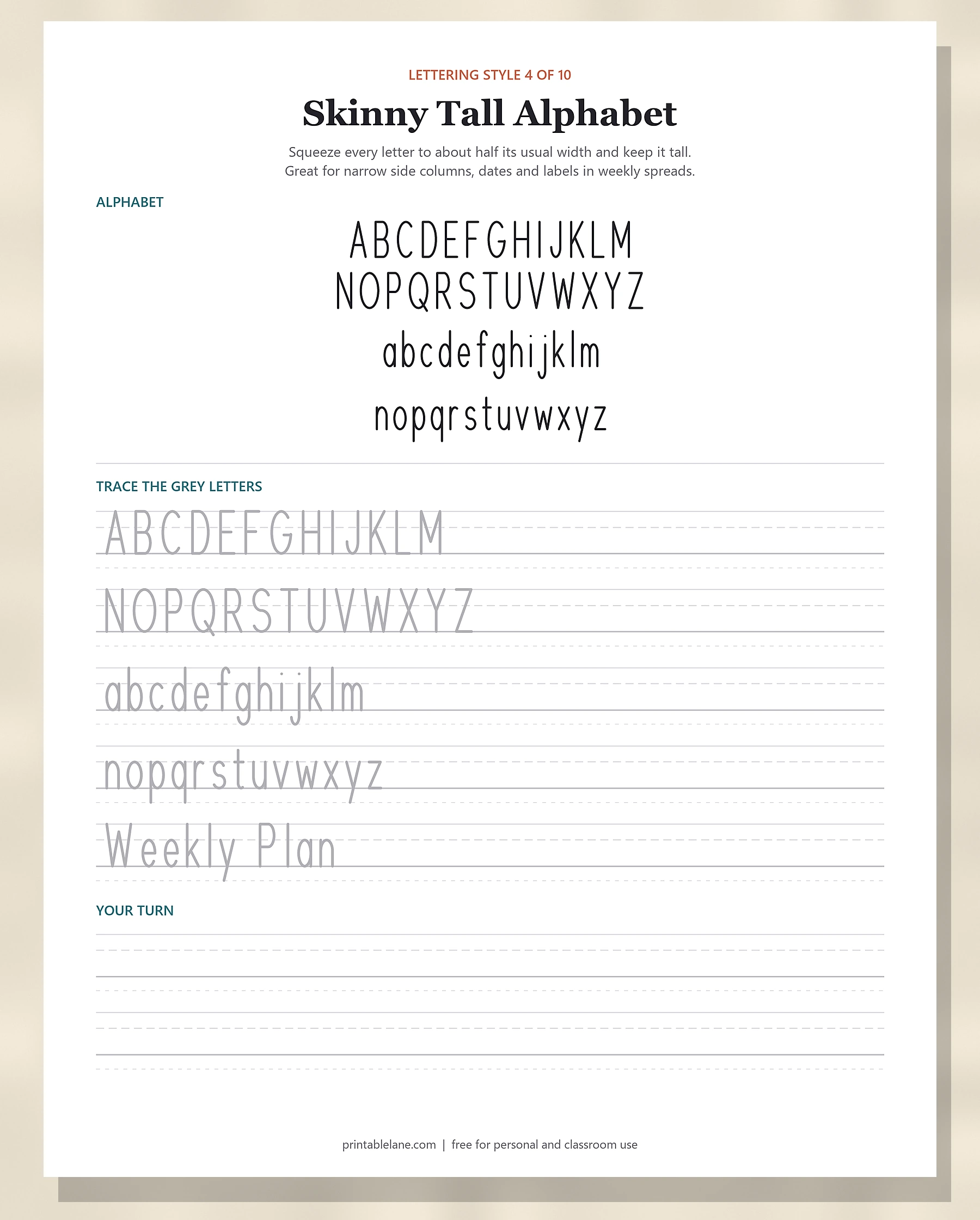
PDF page 5. The same shapes squeezed to about half their width. It fits narrow places: day names in a weekly column or tracker labels. Trace word: “Weekly Plan”.
Bouncy Letters Alphabet
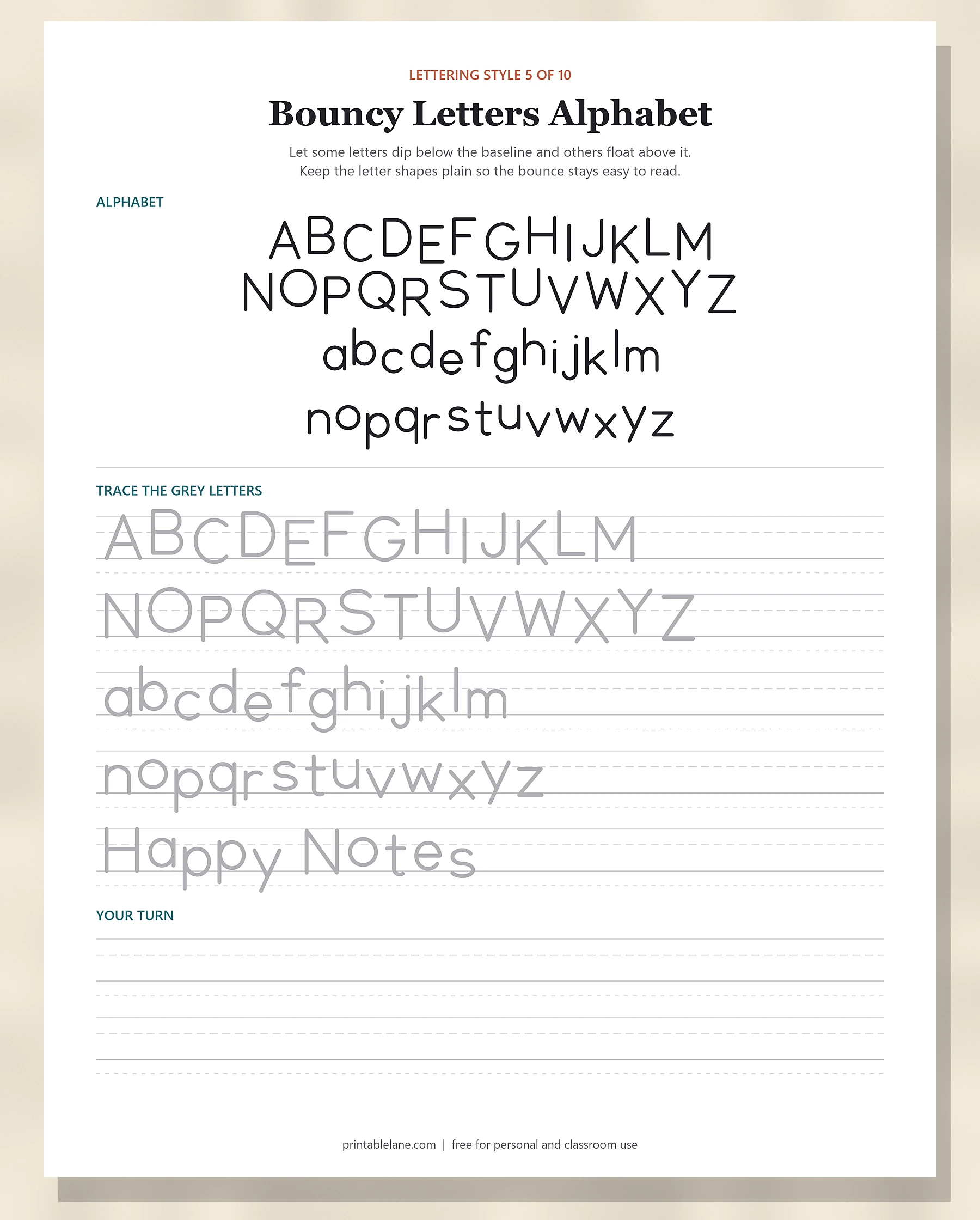
PDF page 6. Plain print where some letters sit a little above the baseline and others dip below it. Keep the shapes simple and vary only the height. Trace word: “Happy Notes”.
Dot Letters Alphabet
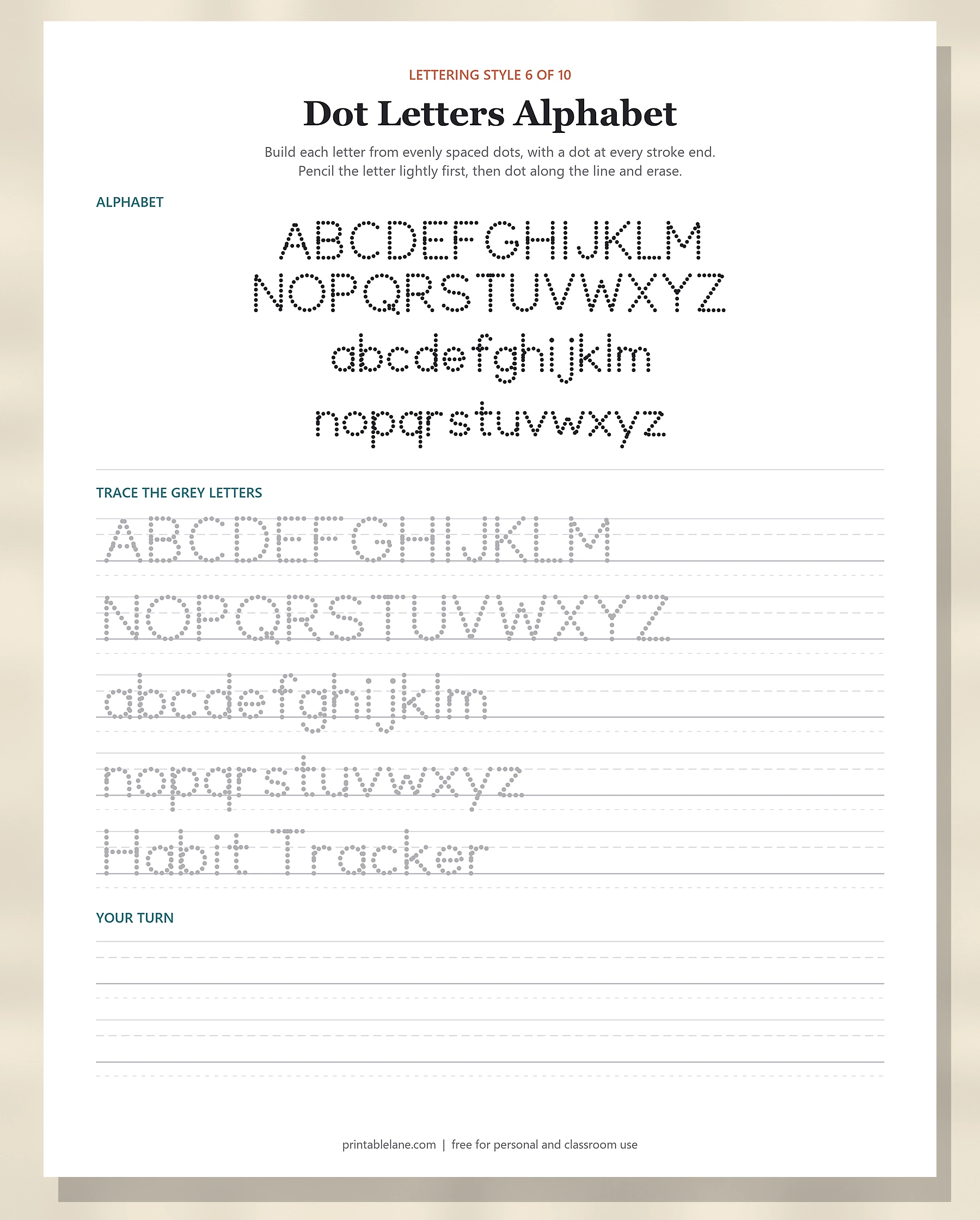
PDF page 7. Each letter is built from evenly spaced dots, with a dot at every stroke end. Pencil the letter first, dot along the line, then erase. Trace word: “Habit Tracker”.
Bubble Letters Alphabet
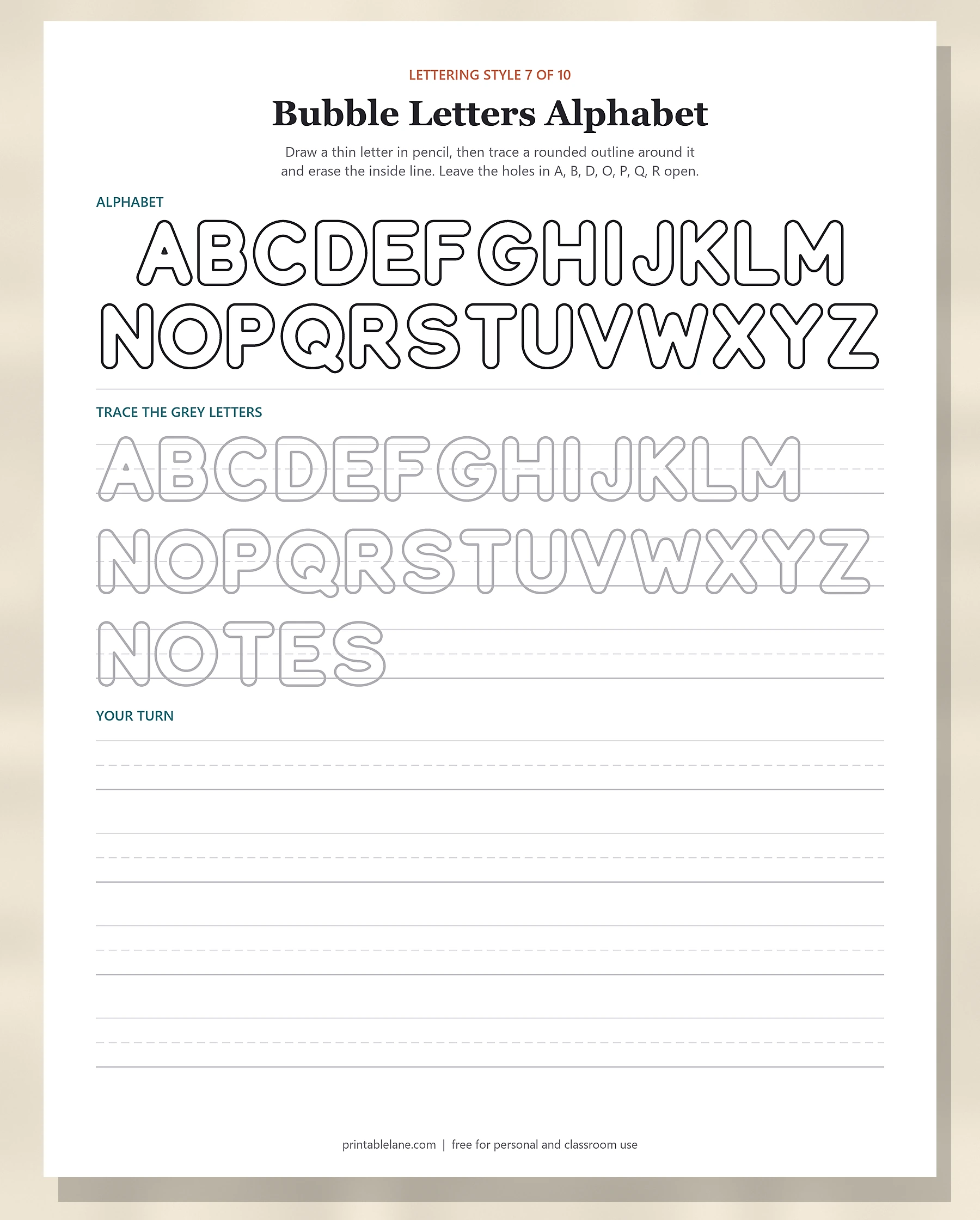
PDF page 8. Round, puffy capitals drawn as outlines, with the holes in A, B, D, O, P, Q and R left open. Draw a thin skeleton letter in pencil, trace a rounded outline around it at an even distance and erase the middle. For full uppercase and lowercase sets, see the free printable bubble letters. Trace word: “NOTES”.
Shadow Block Alphabet
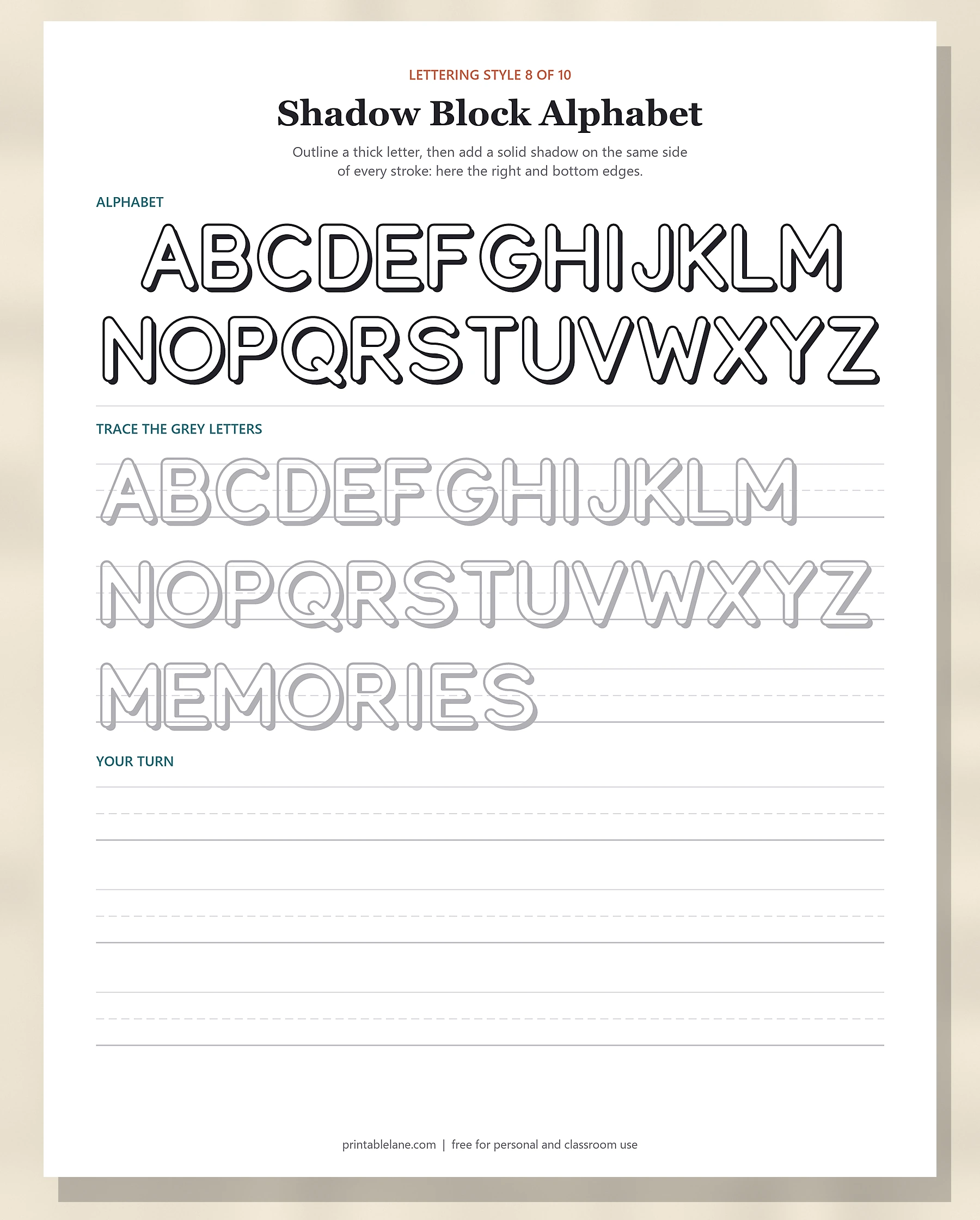
PDF page 9. A thick outlined letter with a solid shadow along the right and bottom edges. Keep the shadow on the same side of every stroke, curves included. Trace word: “MEMORIES”.
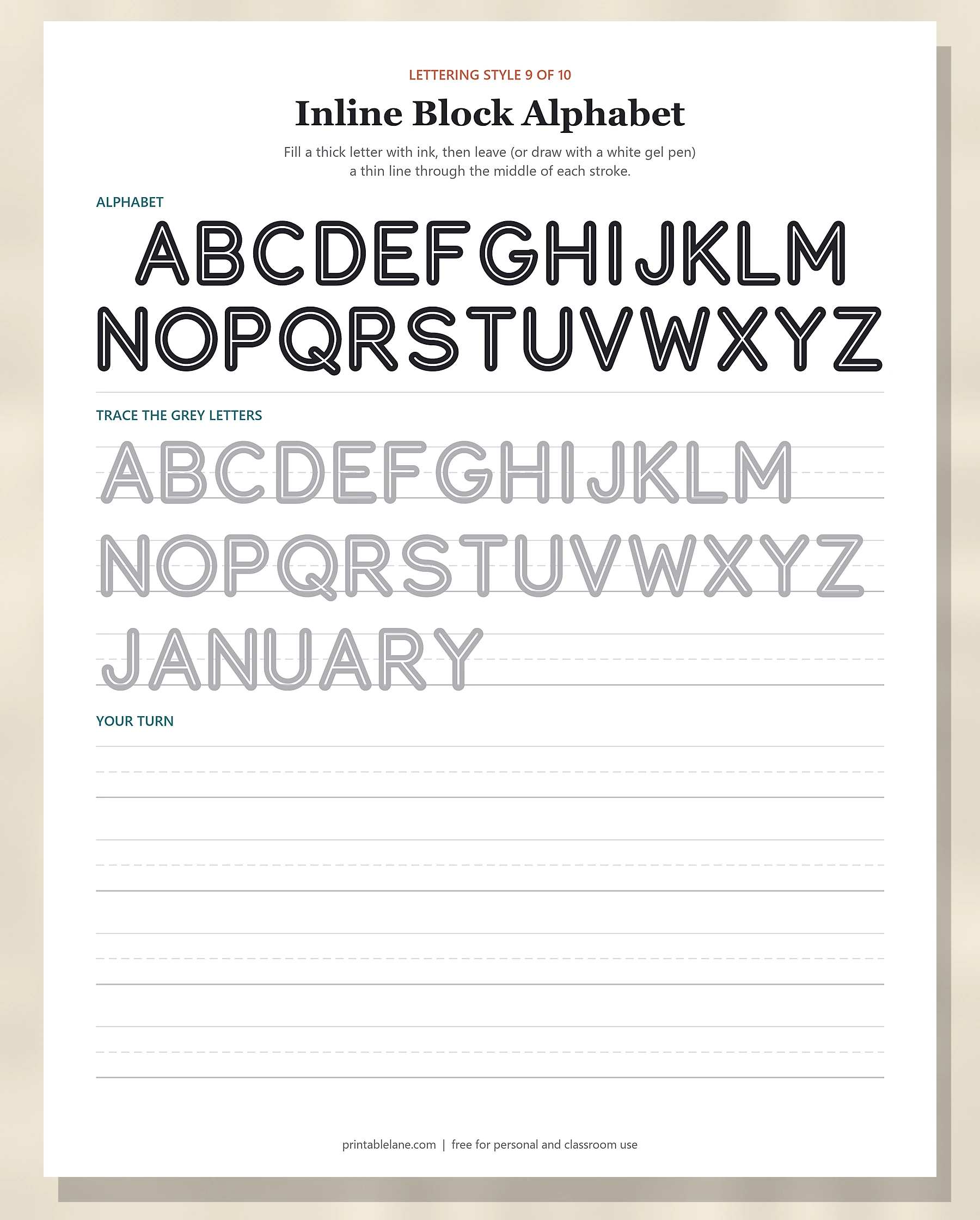
Inline Block Alphabet
PDF page 10. A thick filled letter with a thin white line running through the middle of each stroke. By hand, pencil a line down the middle of each stroke, fill around it and erase, or add the line with a white gel pen. Trace word: “JANUARY”.
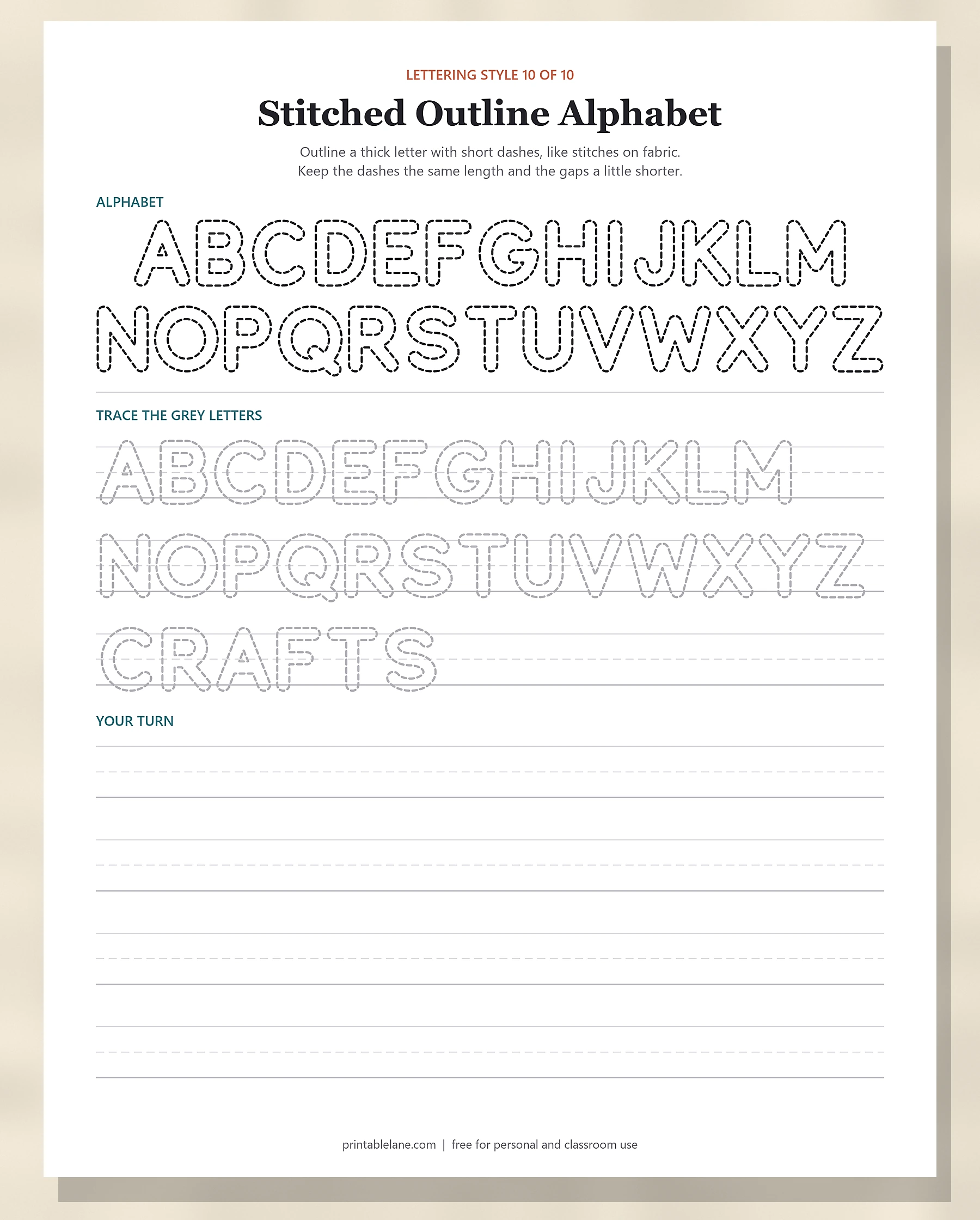
Stitched Outline Alphabet
PDF page 11. A thick letter outlined with short dashes, like stitches on fabric. Keep every dash the same length and the gaps a little shorter. Trace word: “CRAFTS”.
Headers, banners and numbers
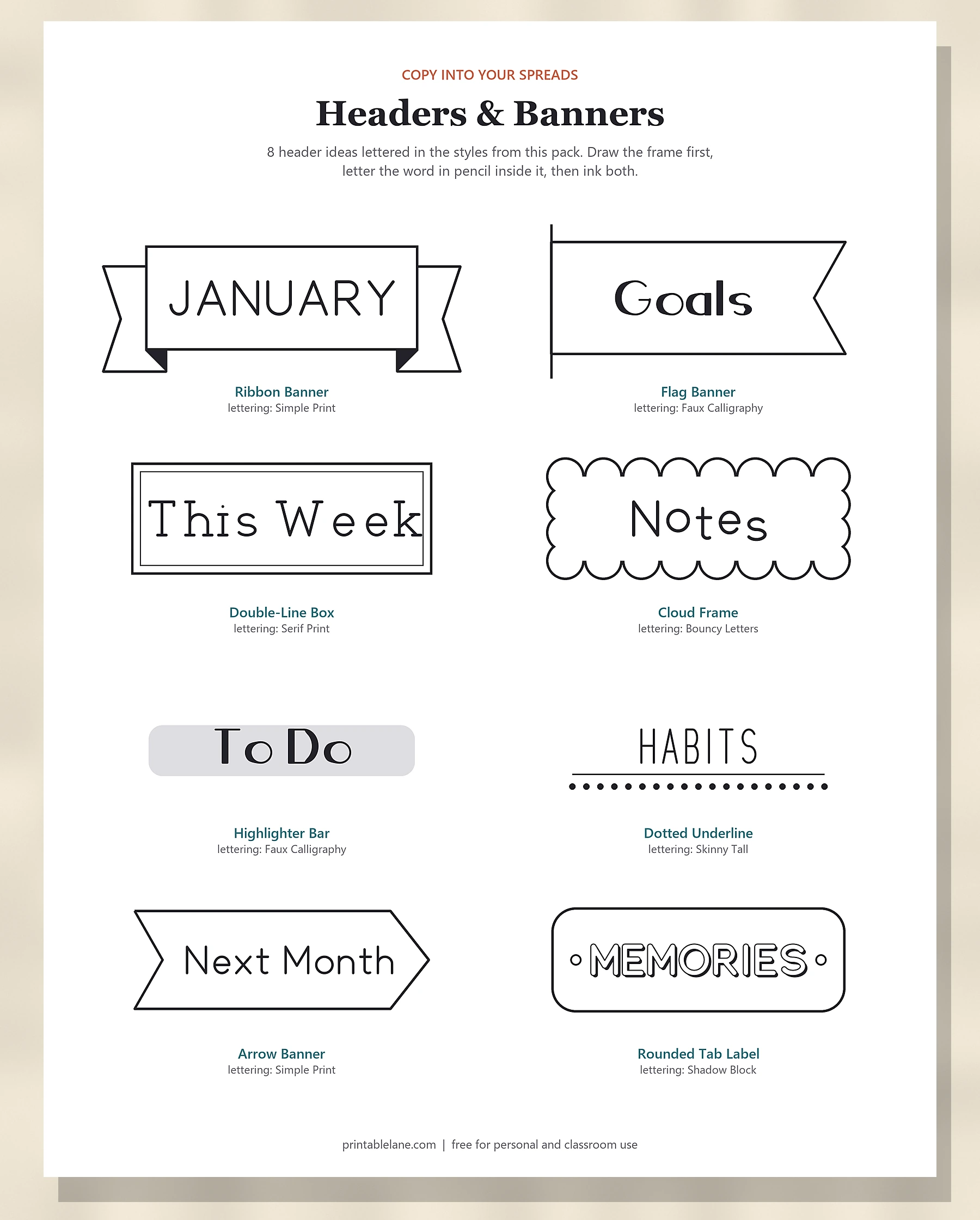
Headers & Banners
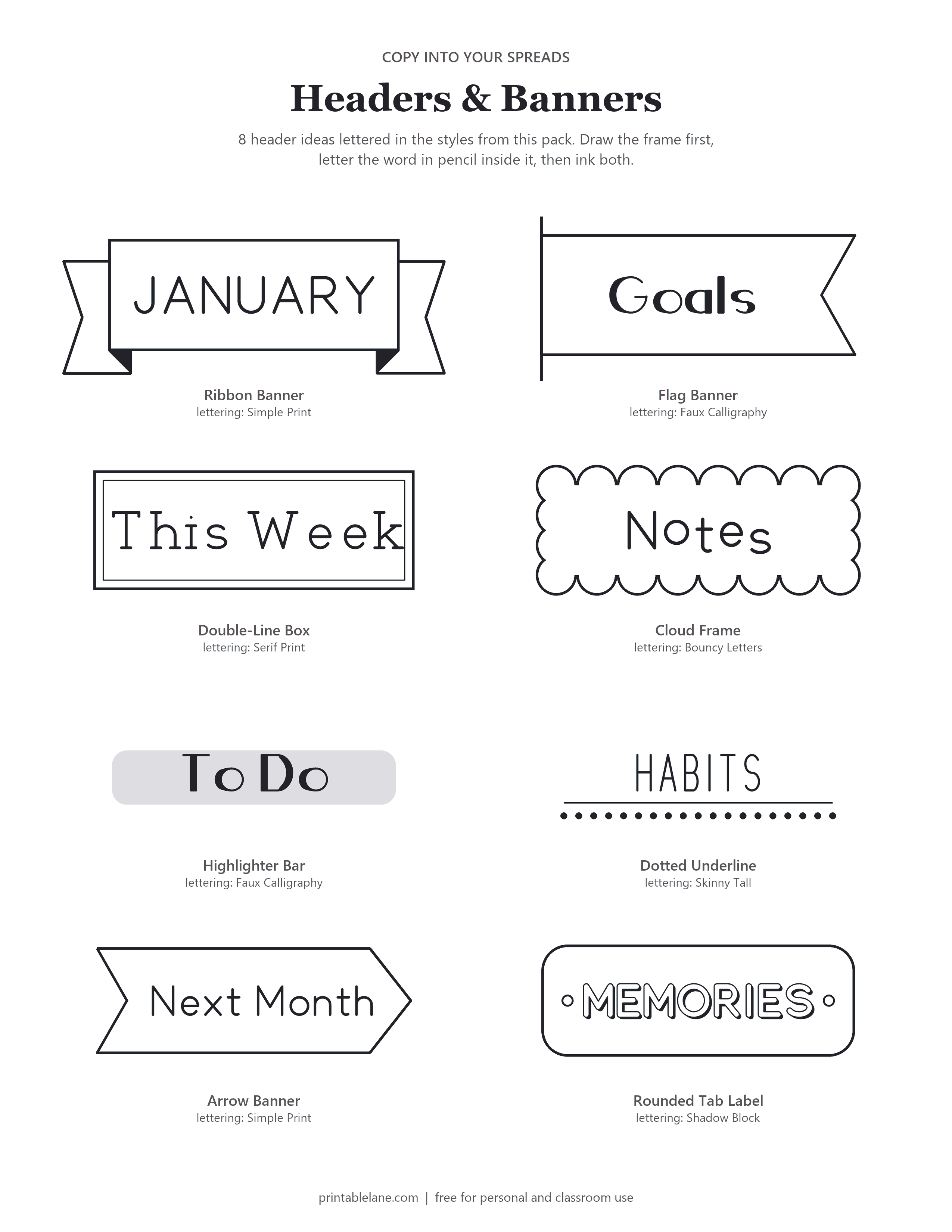
PDF page 12 has 8 ideas, each lettered in a style from the pack: a Ribbon Banner (JANUARY, Simple Print), a Flag Banner (Goals, Faux Calligraphy), a Double-Line Box (This Week, Serif Print), a Cloud Frame (Notes, Bouncy Letters), a grey Highlighter Bar (To Do, Faux Calligraphy), a Dotted Underline (HABITS, Skinny Tall), an Arrow Banner (Next Month, Simple Print) and a Rounded Tab Label (MEMORIES, Shadow Block).
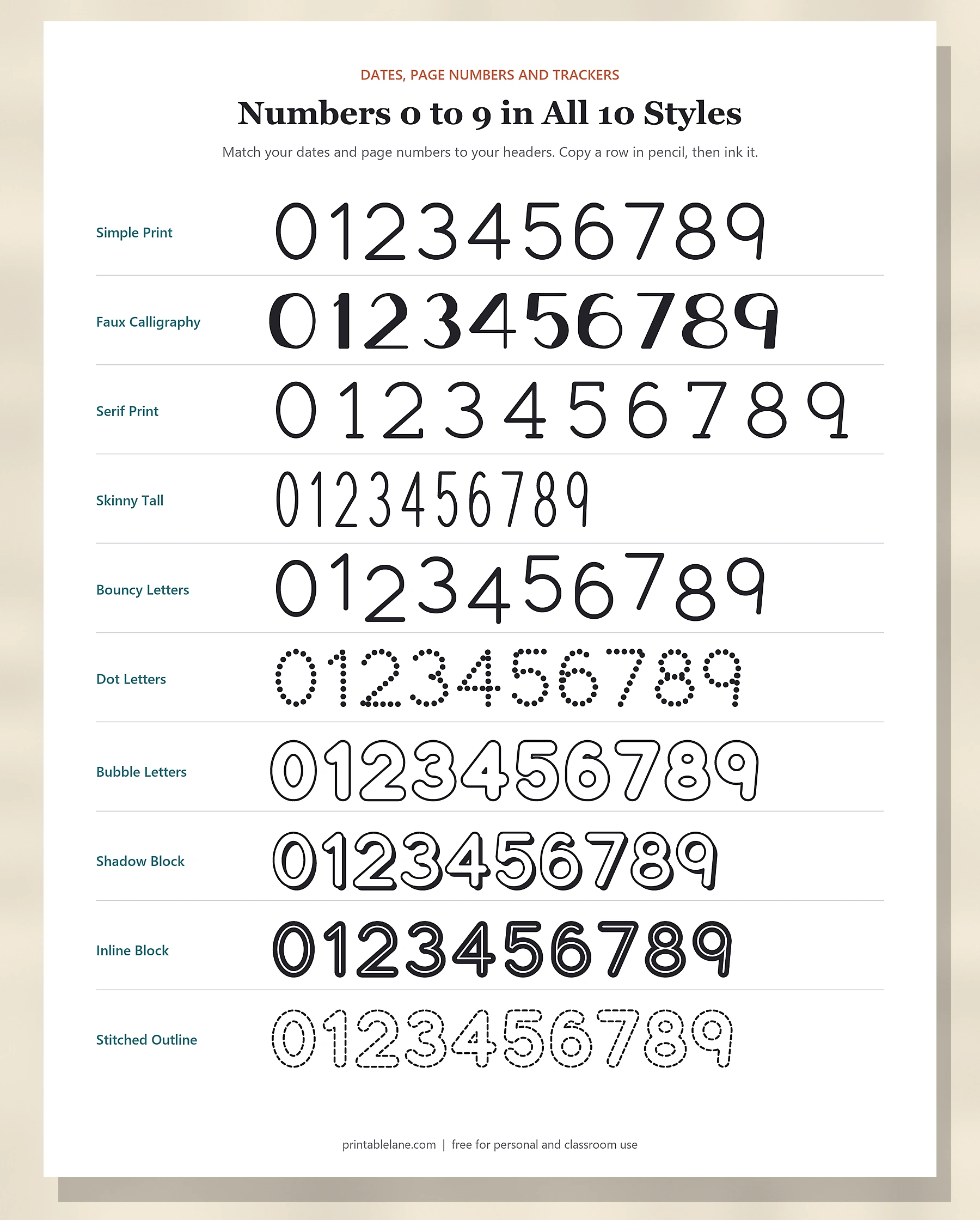
Numbers 0 to 9 in All 10 Styles
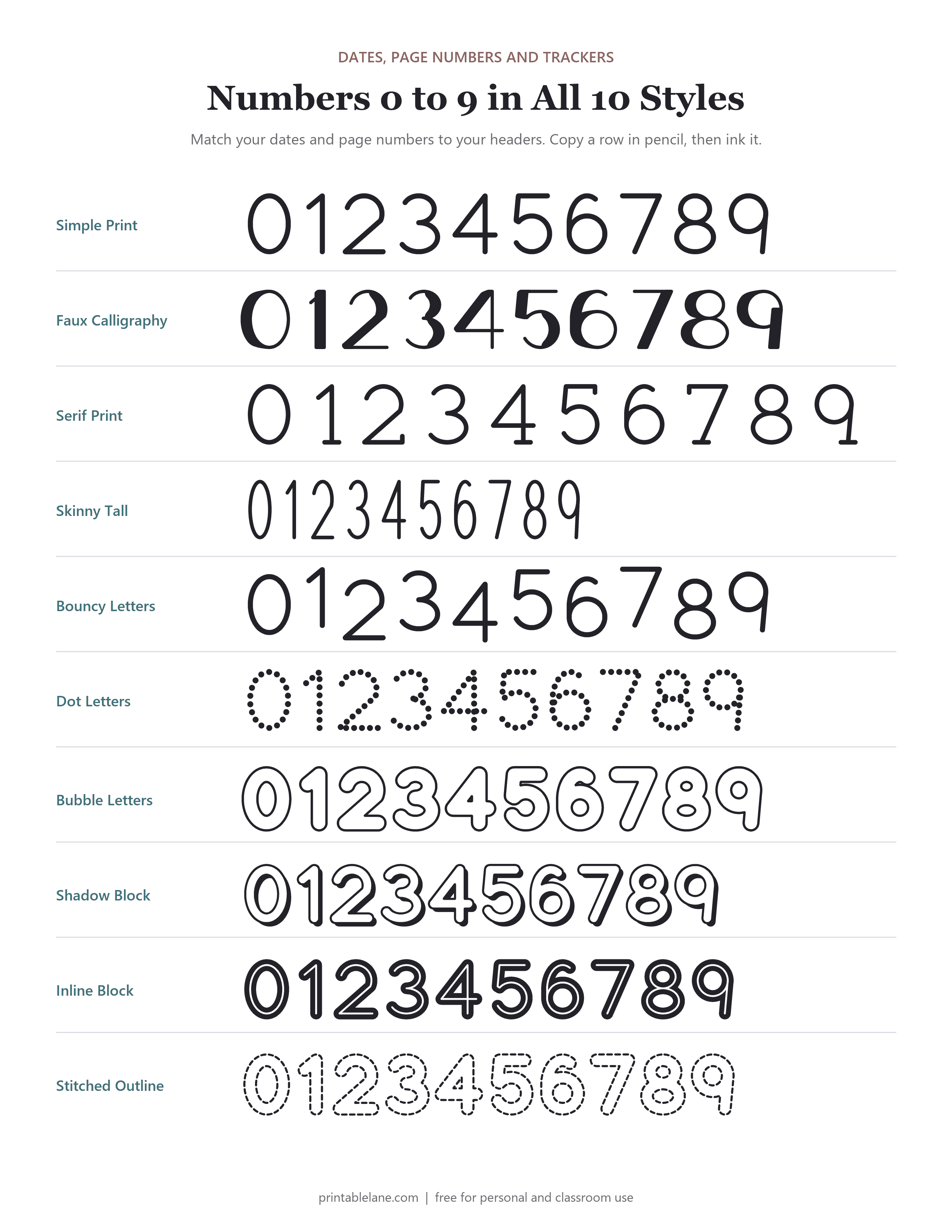
PDF page 13 lists the digits 0 to 9 once in each style, labeled by name, so dates, page numbers and tracker days can match your header lettering.
Faux calligraphy with a normal pen, step by step
- Write the word with a fine pen, spaced a little wider than usual.
- Find the downstrokes: every part where your hand moves down.
- Add a second line on the same side of each downstroke, meeting the first line at both ends.
- Fill the gap with the same pen; upstrokes stay thin.
Using the styles in your spreads
- Pick 2 styles per spread: 1 display style for the title, Simple Print for the rest.
- Size by grid: most dotted notebooks have a 5 mm grid. Capitals 2 squares tall (about 1 cm) suit headers; 1 square works for task text. The trace capitals on pages 2 to 7 print about 0.4 in (1 cm) tall on US Letter.
- Monthly cover: a month name in Shadow Block or Inline Block on the title page, as in the beginner guide to starting a bullet journal.
- Weekly spread: day names in Skinny Tall down the side and a Faux Calligraphy “This Week” header; these weekly spread ideas show layouts to letter them into.
- Spacing: pencil the middle letter of a header at the center of the page, then work outward.
Printing tips
- US Letter: print at 100%.
- A4: 100% or Fit to page; the letters only get slightly smaller, which is fine for practice.
- Paper: regular copy paper is fine with gel pens and fine liners. For brush pens or markers use smooth paper or 65 lb (176 gsm) cardstock, which bleeds less.
- Reuse: put a sheet in a sheet protector and trace with a dry-erase marker.
Download single pages
Want only the faux calligraphy page, or the numbers sheet to keep beside your planner? Each of the 12 inside pages is a separate PNG below.
- Simple Print Alphabet (PNG)
- Faux Calligraphy Alphabet (PNG)
- Serif Print Alphabet (PNG)
- Skinny Tall Alphabet (PNG)
- Bouncy Letters Alphabet (PNG)
- Dot Letters Alphabet (PNG)
- Bubble Letters Alphabet (PNG)
- Shadow Block Alphabet (PNG)
- Inline Block Alphabet (PNG)
- Stitched Outline Alphabet (PNG)
- Headers & Banners (PNG)
- Numbers 0 to 9 in All 10 Styles (PNG)
Frequently asked questions
How many pages are in the PDF?
13: a cover, 10 alphabet practice sheets (pages 2 to 11), the headers and banners page and the numbers page.
Can I print the practice sheets on A4?
Yes. Pick 100% or Fit to page; none of the sheets needs an exact size, and the margins keep the footer clear.
Are these real fonts I can install on my computer?
No. They are hand lettering styles drawn as pictures for you to copy with a pen, not font files to type with.
Which style should a beginner start with?
Simple Print, then Faux Calligraphy. Both use the letter shapes you already know, and faux calligraphy only adds a filled line to the downstrokes.
Why do the bubble and block pages have capitals only?
Thick outlines need room inside each letter; small lowercase e and a would close up.
What pen works best for faux calligraphy?
Any fine pen that does not smear: a fine liner or gel pen between 0.3 and 0.5 mm. Let the outline dry before you fill the downstrokes.