 By
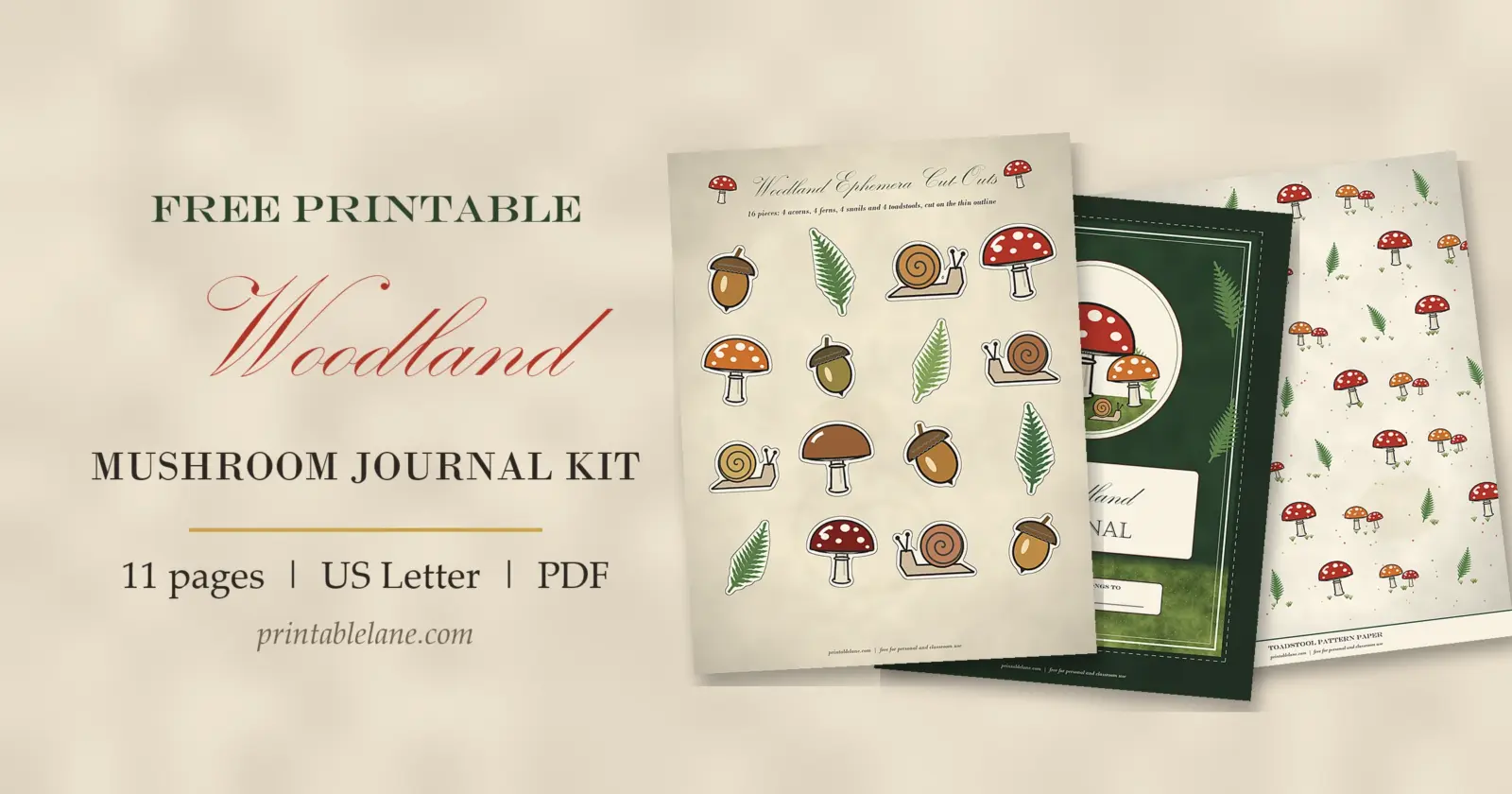
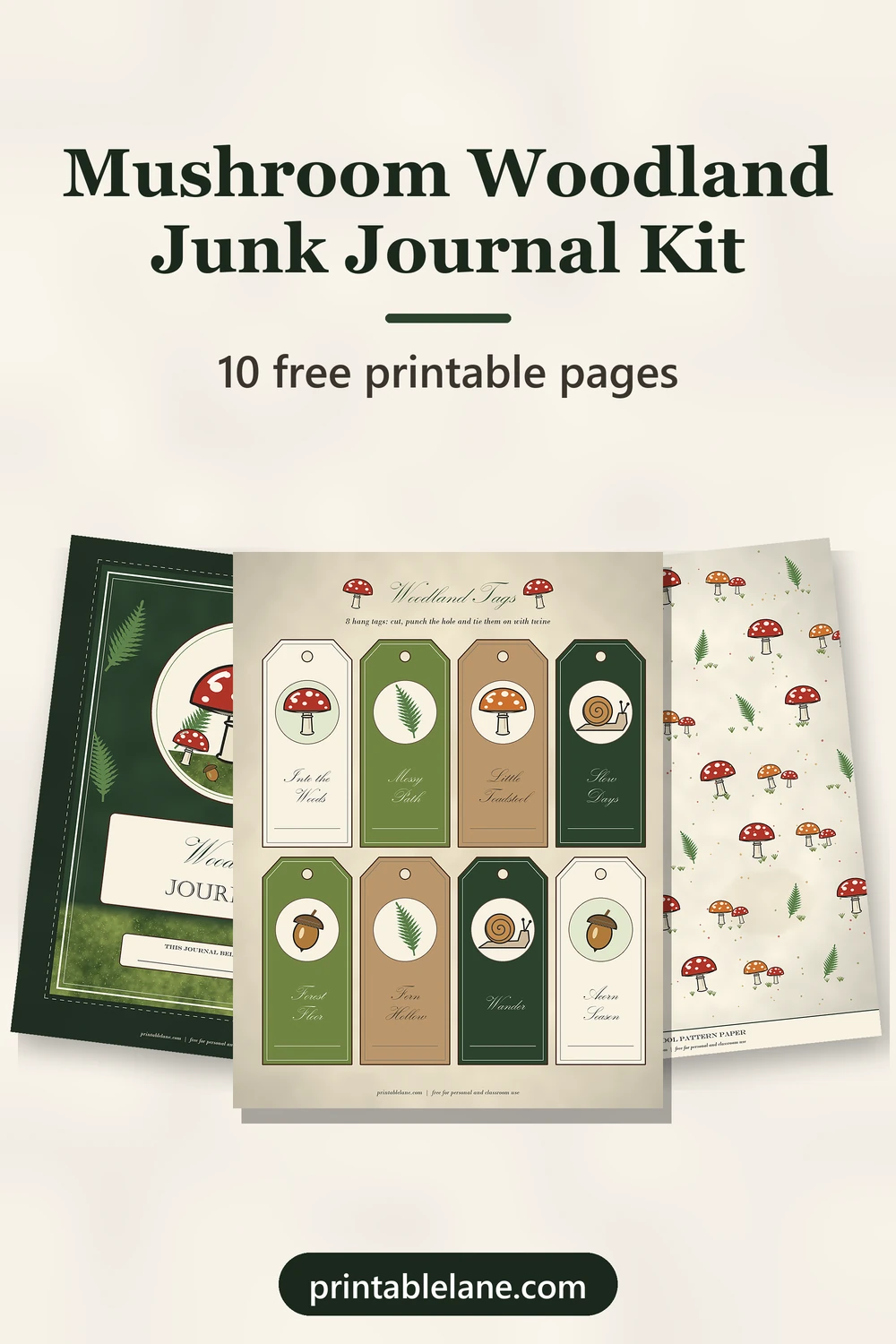
Moss, toadstools and peeling birch bark make a quiet theme for autumn pages, and this mushroom junk journal kit gives you all three as full-page papers. You also get a field page for recording real finds, cap shape cards, tags, envelopes and a woodland cover.
The 3 background papers come first, right below. Everything is drawn in moss green, forest green, toadstool red and bark brown, so any page sits well next to any other.
Moss, toadstool and birch bark papers
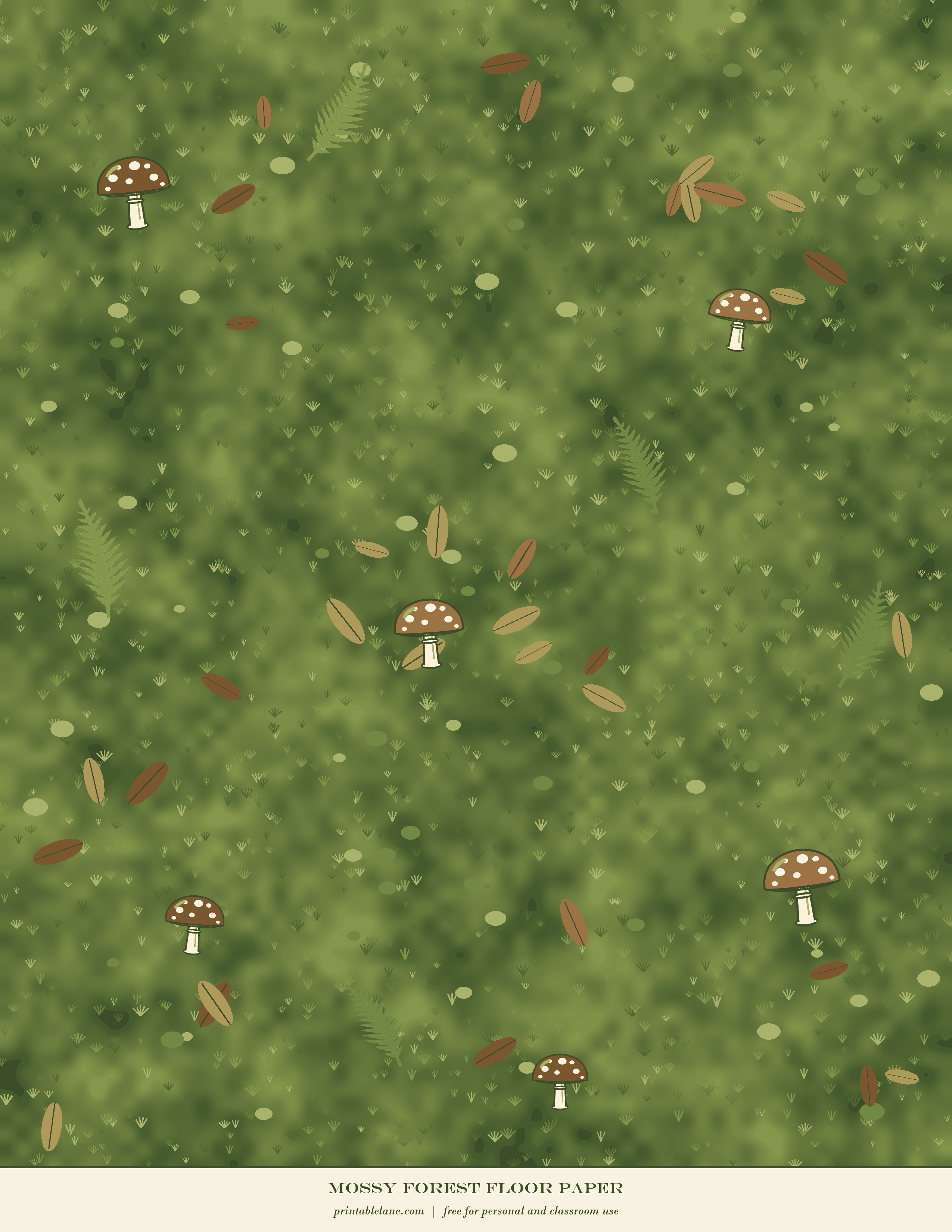
Mossy Forest Floor Paper
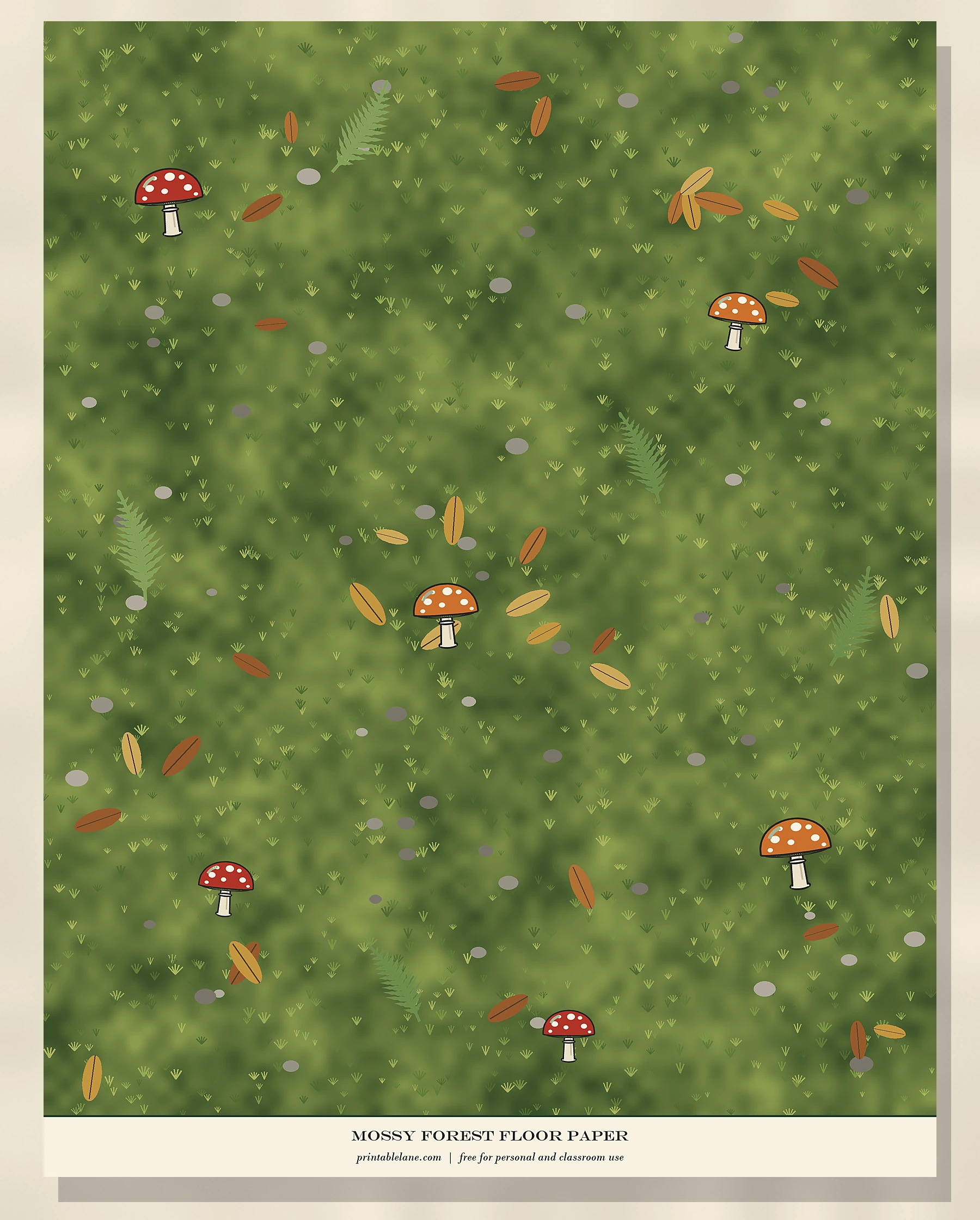
PDF page 2 is a deep green moss texture covered in small grass tufts, grey pebbles, fallen ochre and rust leaves, 5 faint ferns and 6 little red and orange toadstools. It works as a full background or torn into strips for a ground line.
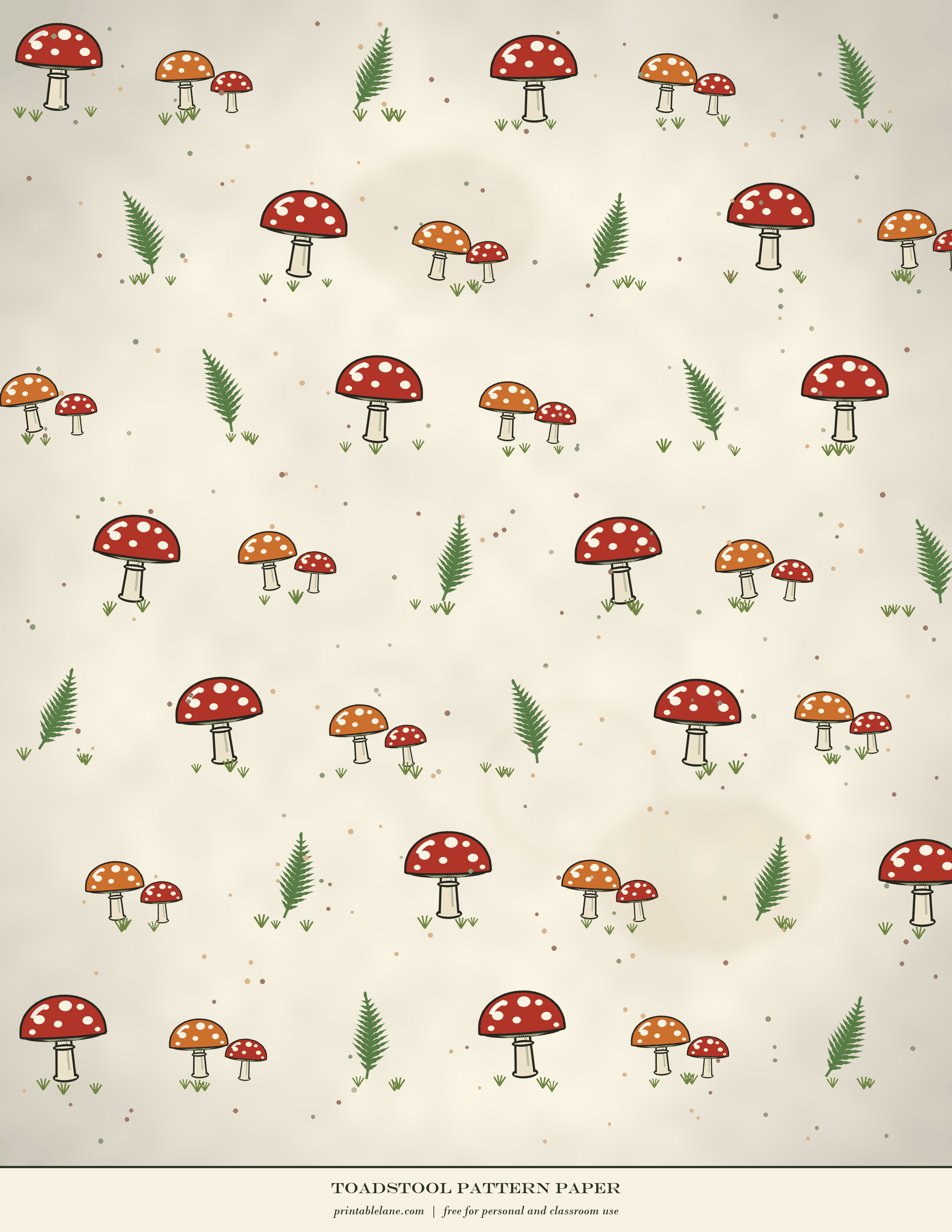
Toadstool Pattern Paper
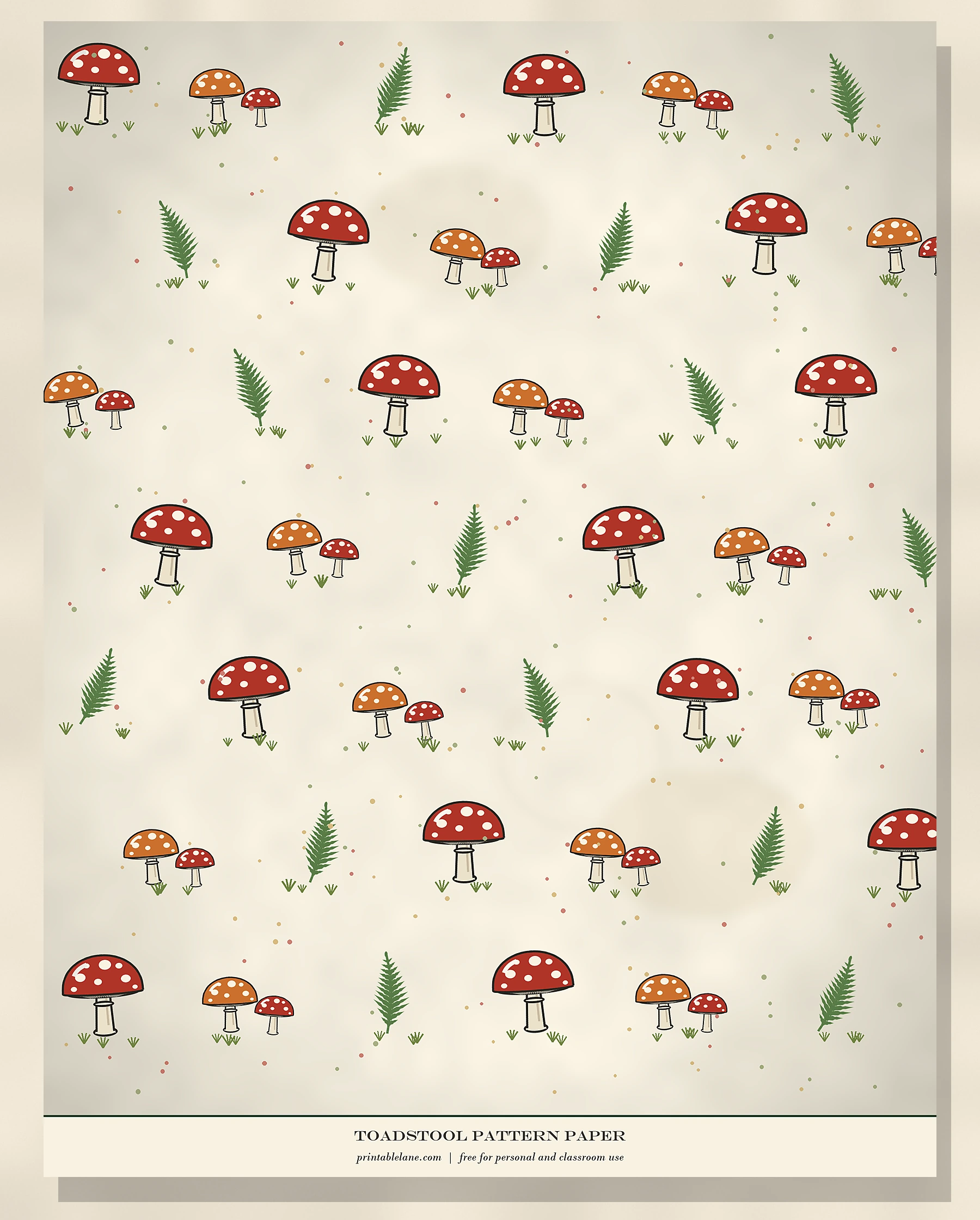
PDF page 3 repeats red toadstools, orange pairs and small fern fronds on a cream ground with grass tufts under each one. The light background leaves room to write straight on the paper.
Birch Bark Paper
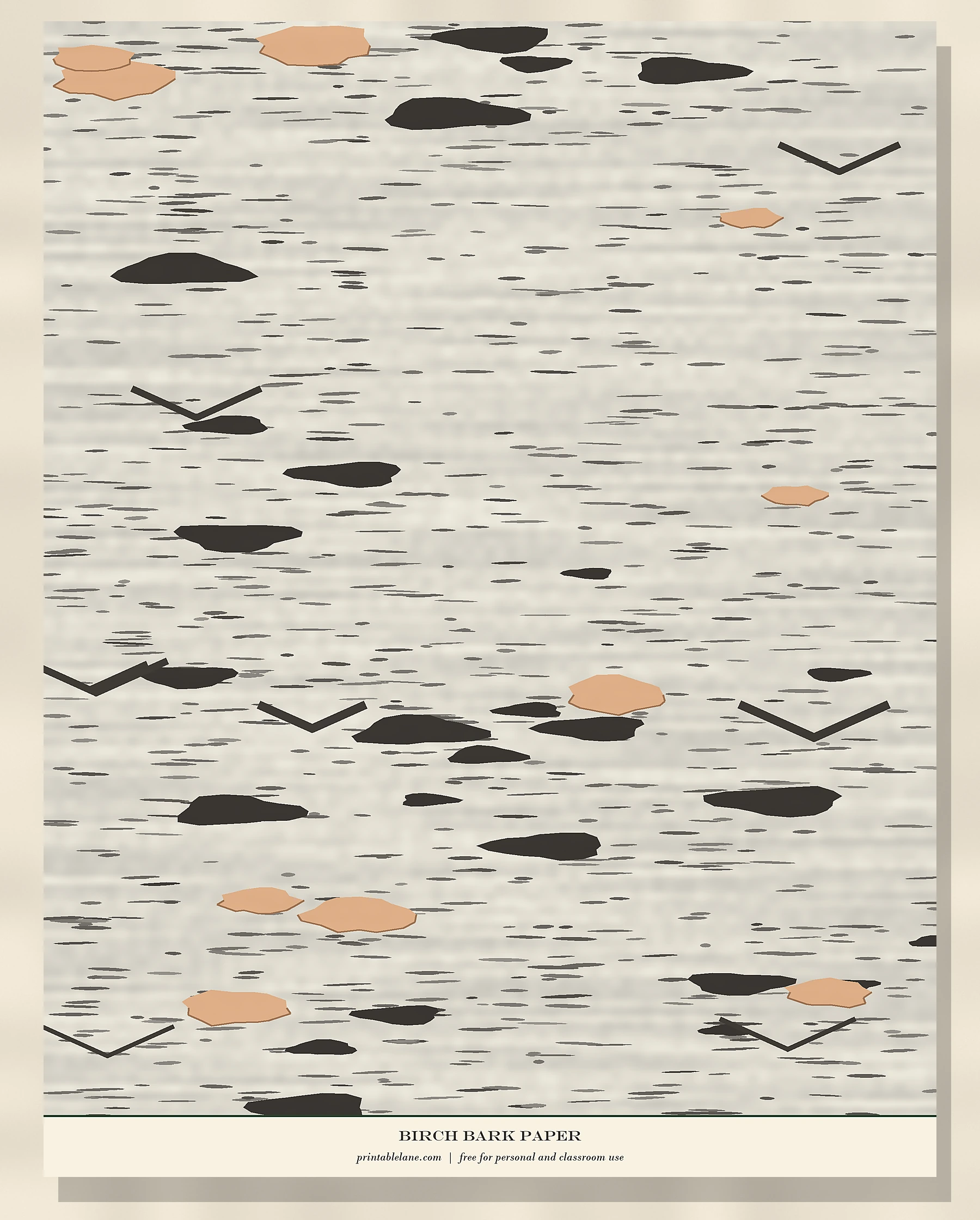
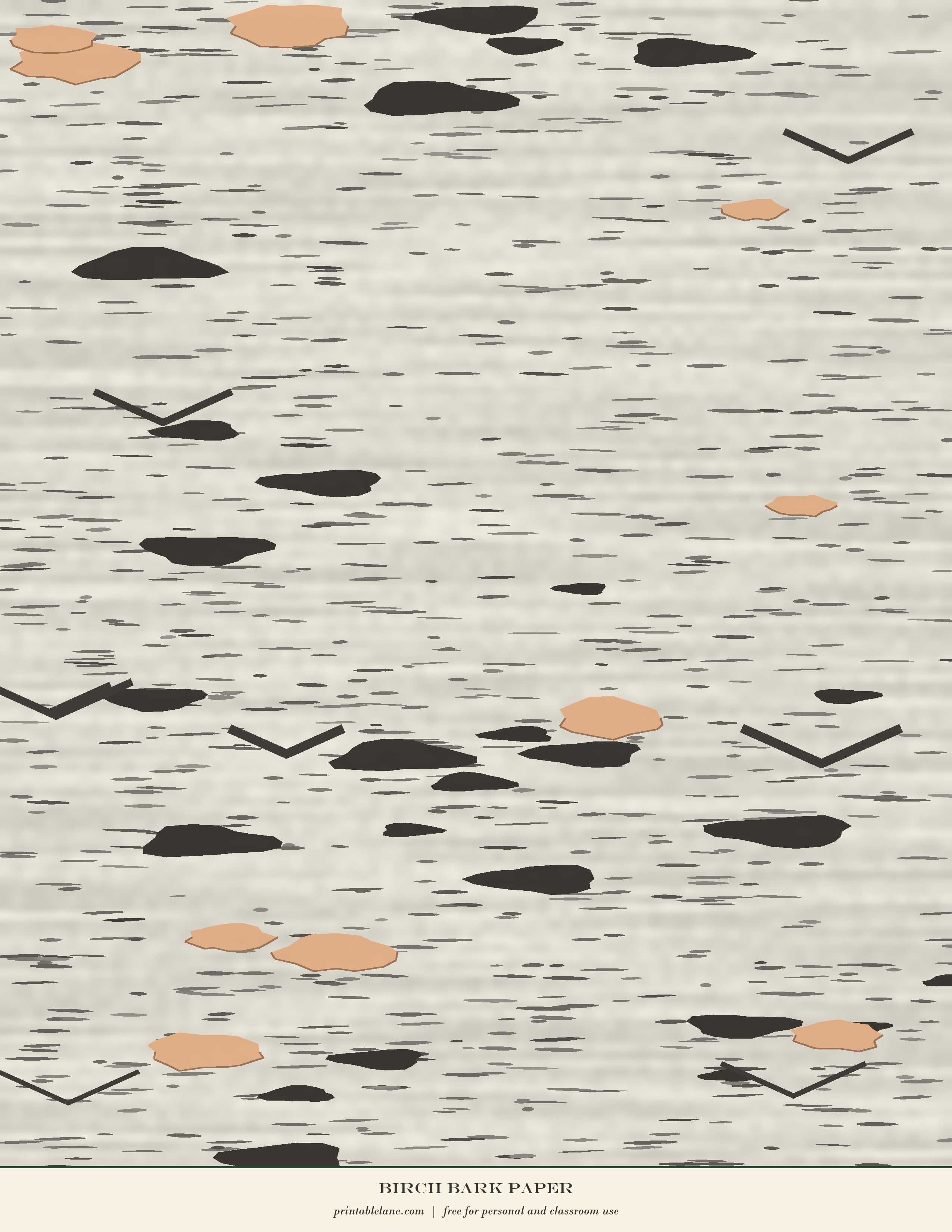
PDF page 4 copies the look of a white birch trunk: thin dark horizontal marks, black knots, V-shaped scars where branches once grew and a few peach patches where the outer layer has peeled away. Those short horizontal marks on real birch are lenticels, small pores that let the bark exchange air.
Recording a mushroom where it grows
The next 2 pages turn a woodland walk into notes. Both are made for looking and sketching. Never eat a wild mushroom based on a picture, an app or a page like this one, because several deadly species look very close to edible ones.
Mushroom Foraging Journal
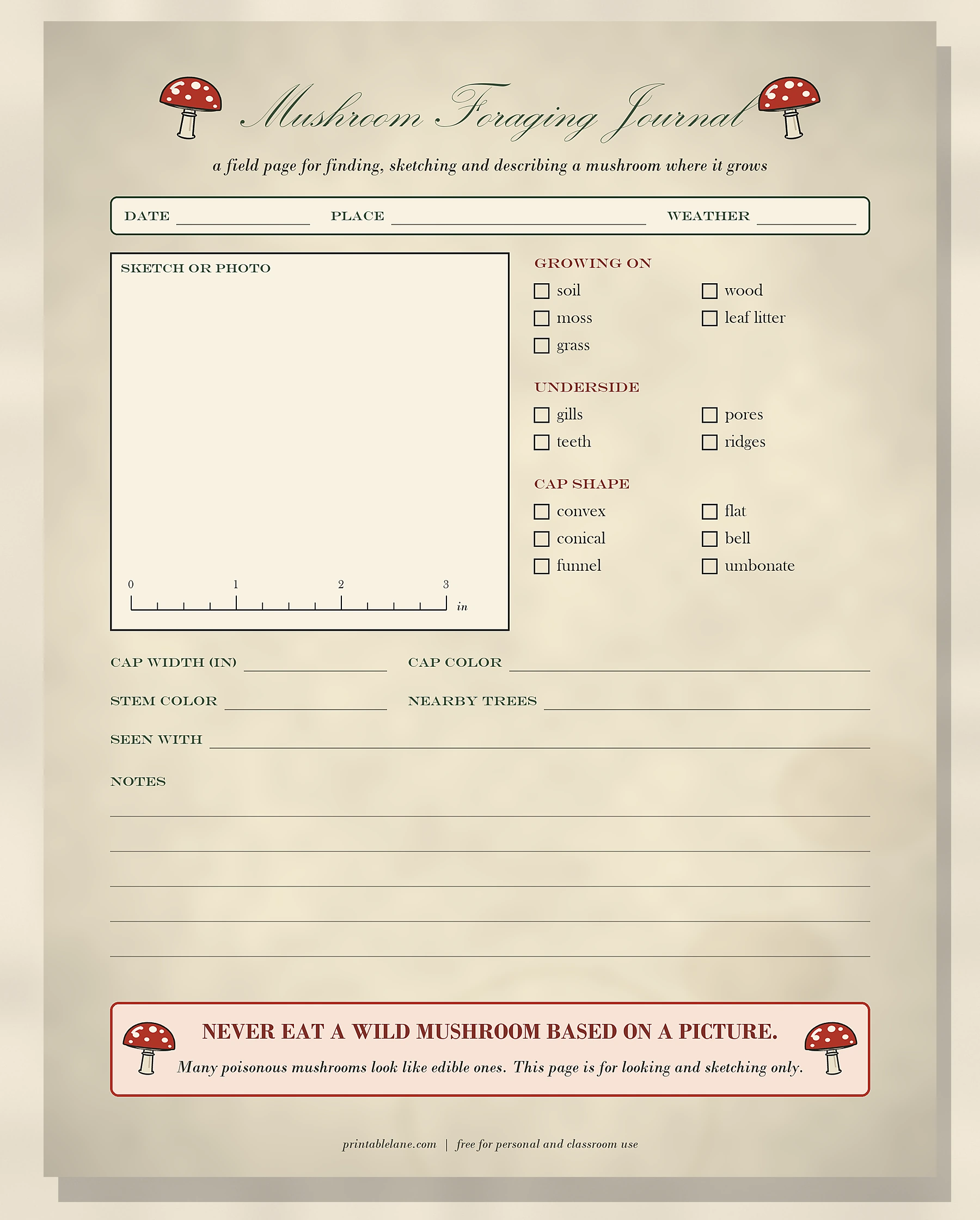
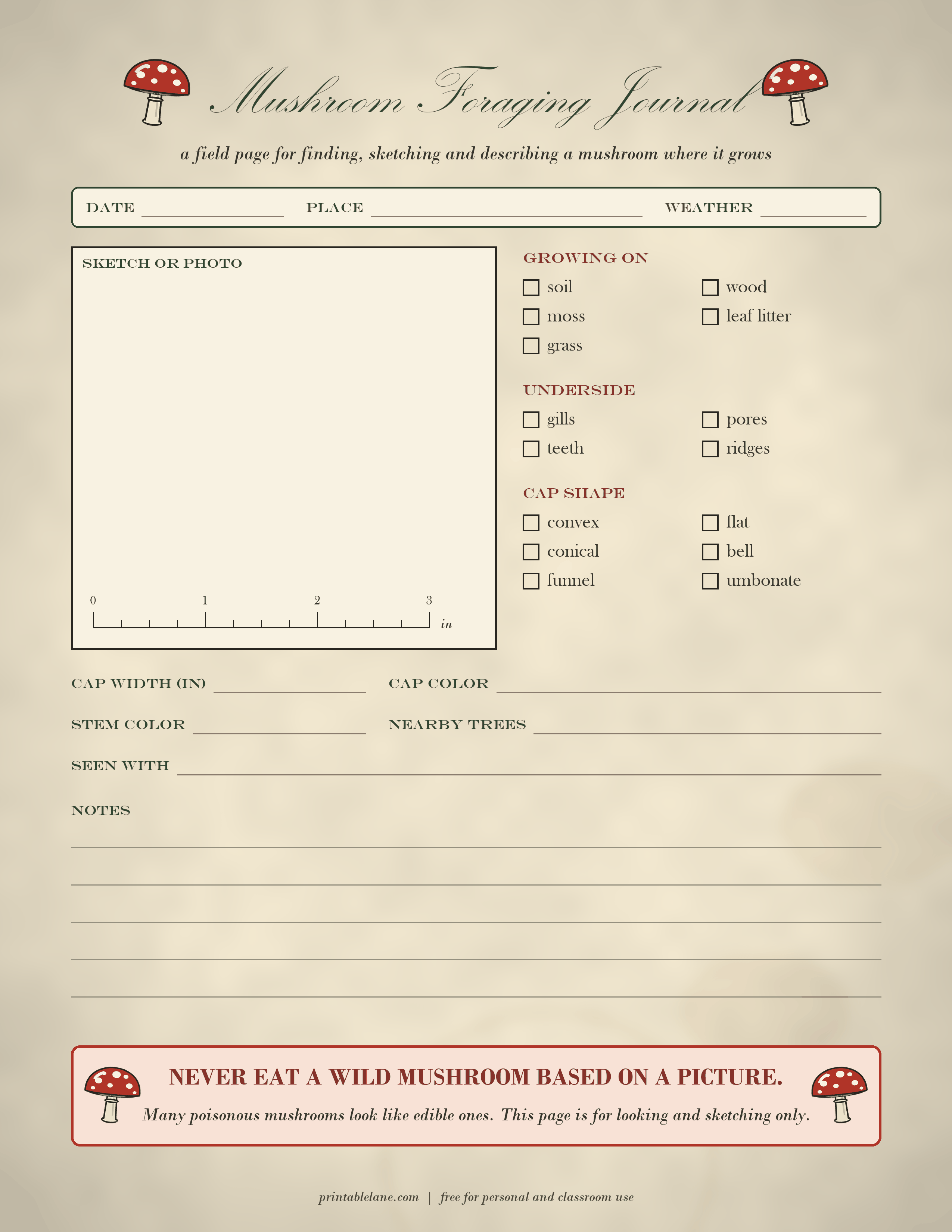
PDF page 5 starts with lines for date, place and weather. Below them sits a large box for a sketch or a printed photo, with a 3-inch ruler along its bottom edge. Checkboxes cover what the mushroom is growing on (soil, wood, moss, leaf litter, grass), its underside (gills, pores, teeth, ridges) and its cap shape. Lines for cap width, cap color, stem color, nearby trees and other things seen with it follow, then 5 note lines and a red box with the safety reminder printed in capitals.
Mushroom Specimen Cards
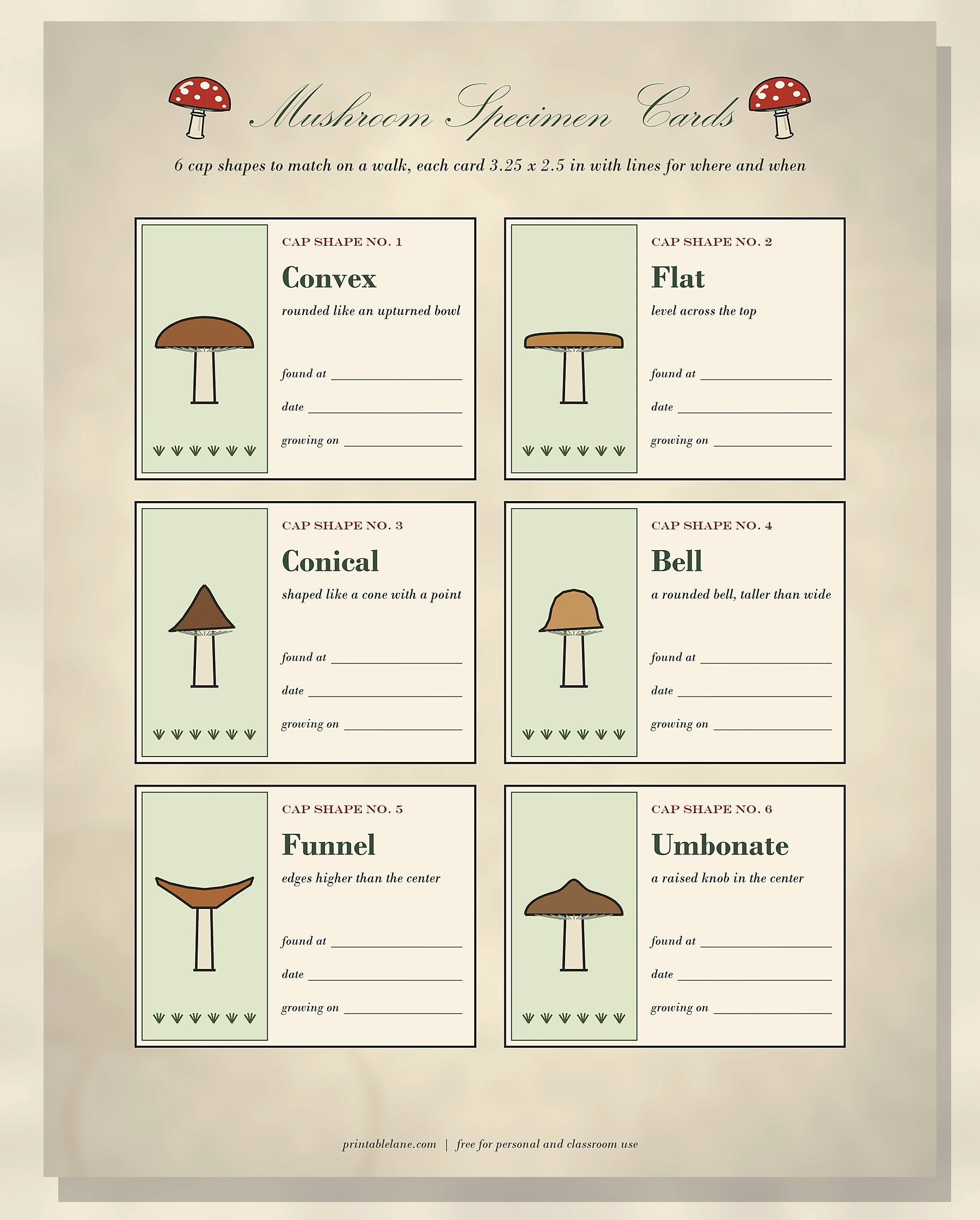
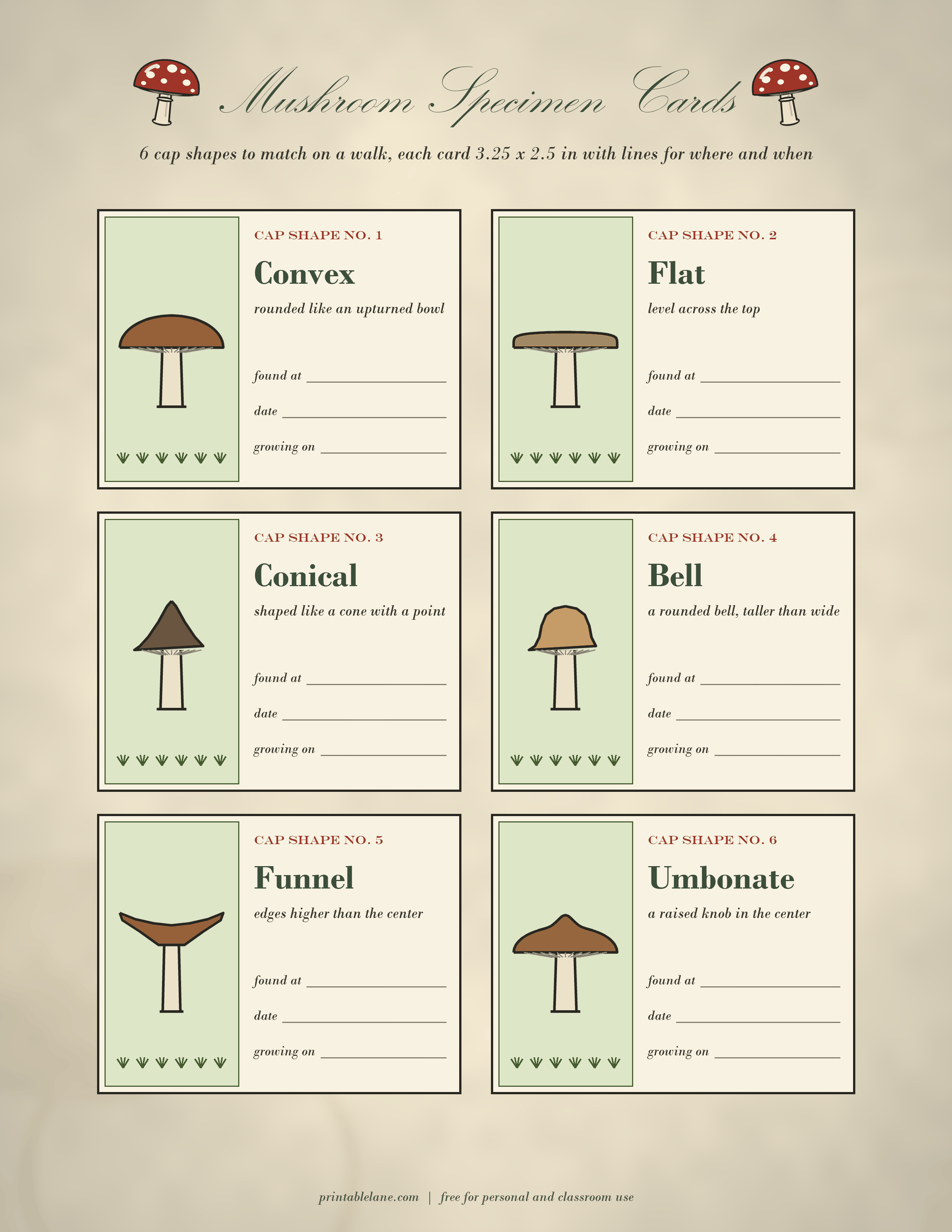
PDF page 6 holds 6 cards, each 3.25 x 2.5 inches. Every card shows one cap shape on a pale green panel with its name, a short description and lines for found at, date and growing on. The shapes are convex, flat, conical, bell, funnel and umbonate.
Reading a cap, a stem and an underside
The words on the cards come from the way field guides describe mushrooms. A few true facts make good captions for your pages:
- A mushroom is only the fruiting body of a fungus. The main part is the mycelium, a web of thin threads hidden in soil, wood or leaf litter.
- Fungi are a kingdom of their own and are not plants. They cannot make food from sunlight.
- Umbonate means the cap has a raised knob, called an umbo, in the middle.
- Under the cap, most mushrooms have gills, while boletes have a spongy layer of pores and tooth fungi have soft spines.
- The classic storybook toadstool, red with white spots, looks like the fly agaric, which is poisonous.
- A spore print, made by resting a cap on paper for some hours, shows the color of the spores, one of the clues experts use for identification.
Tags, envelopes and cut-outs for the forest pages
Woodland Tags
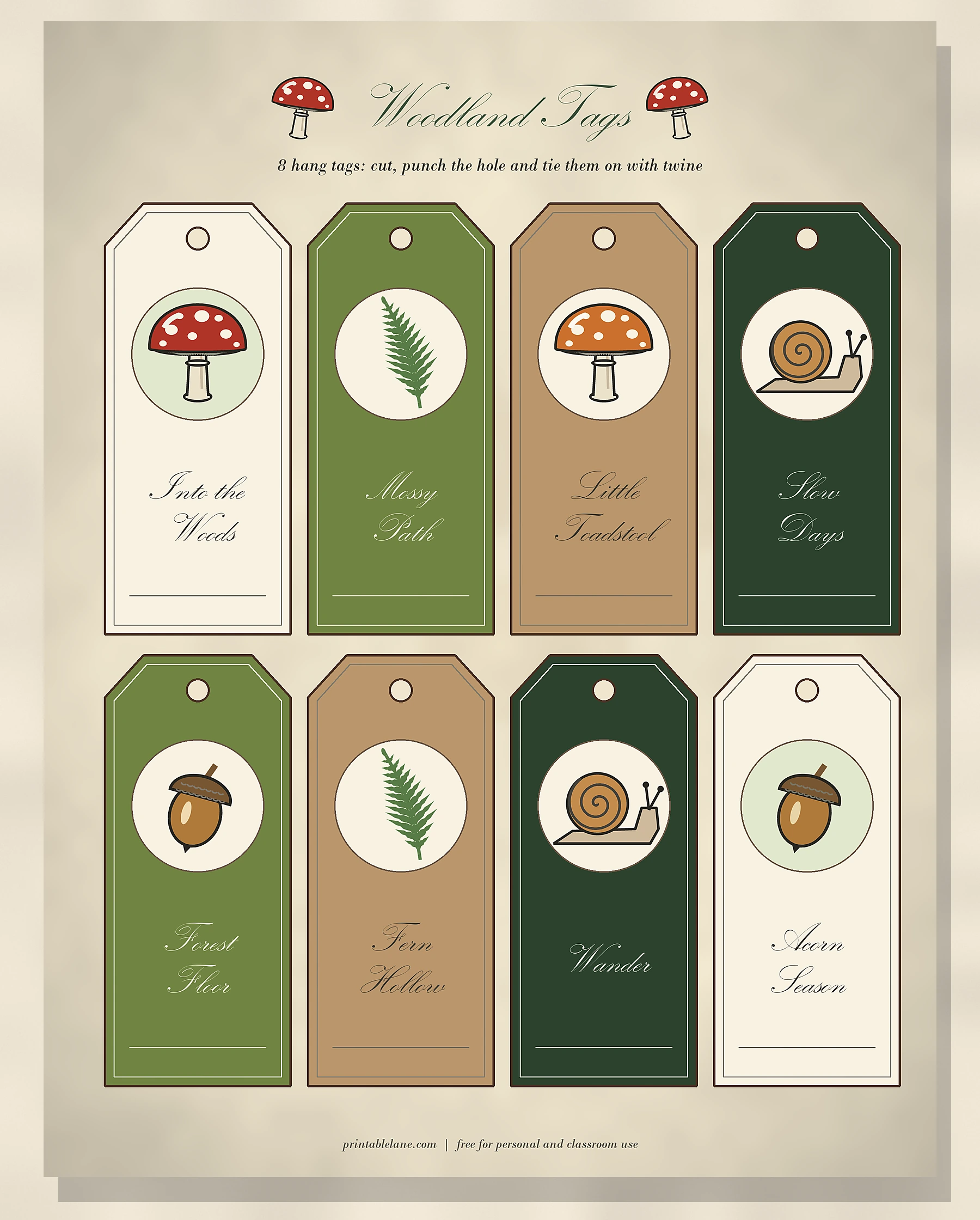
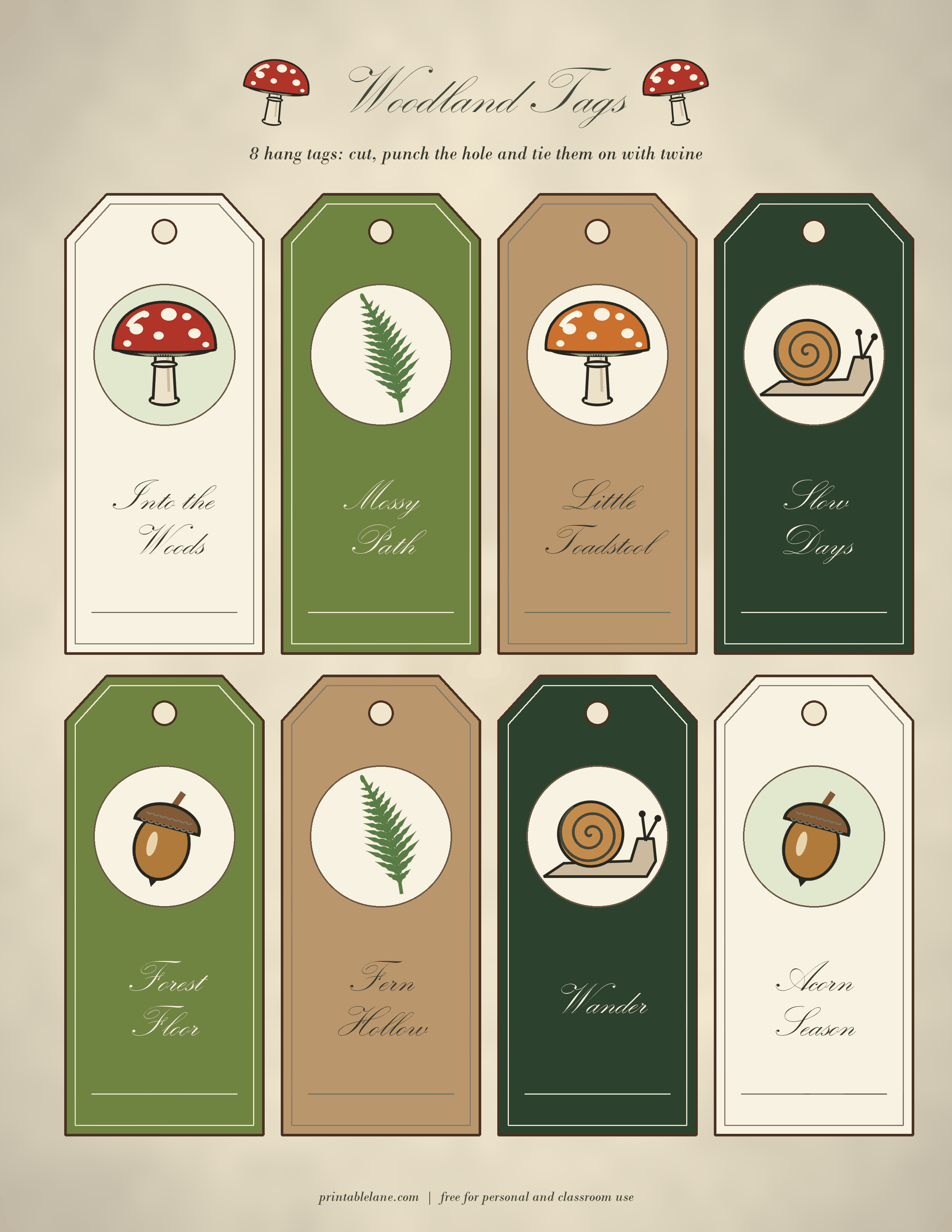
PDF page 7 has 8 hang tags in cream, moss green, tan and forest green, each with a punched-hole circle and a round picture: 2 toadstools, 2 ferns, 2 snails and 2 acorns. The script words read Into the Woods, Mossy Path, Little Toadstool, Slow Days, Forest Floor, Fern Hollow, Wander and Acorn Season.
Mini Woodland Envelopes
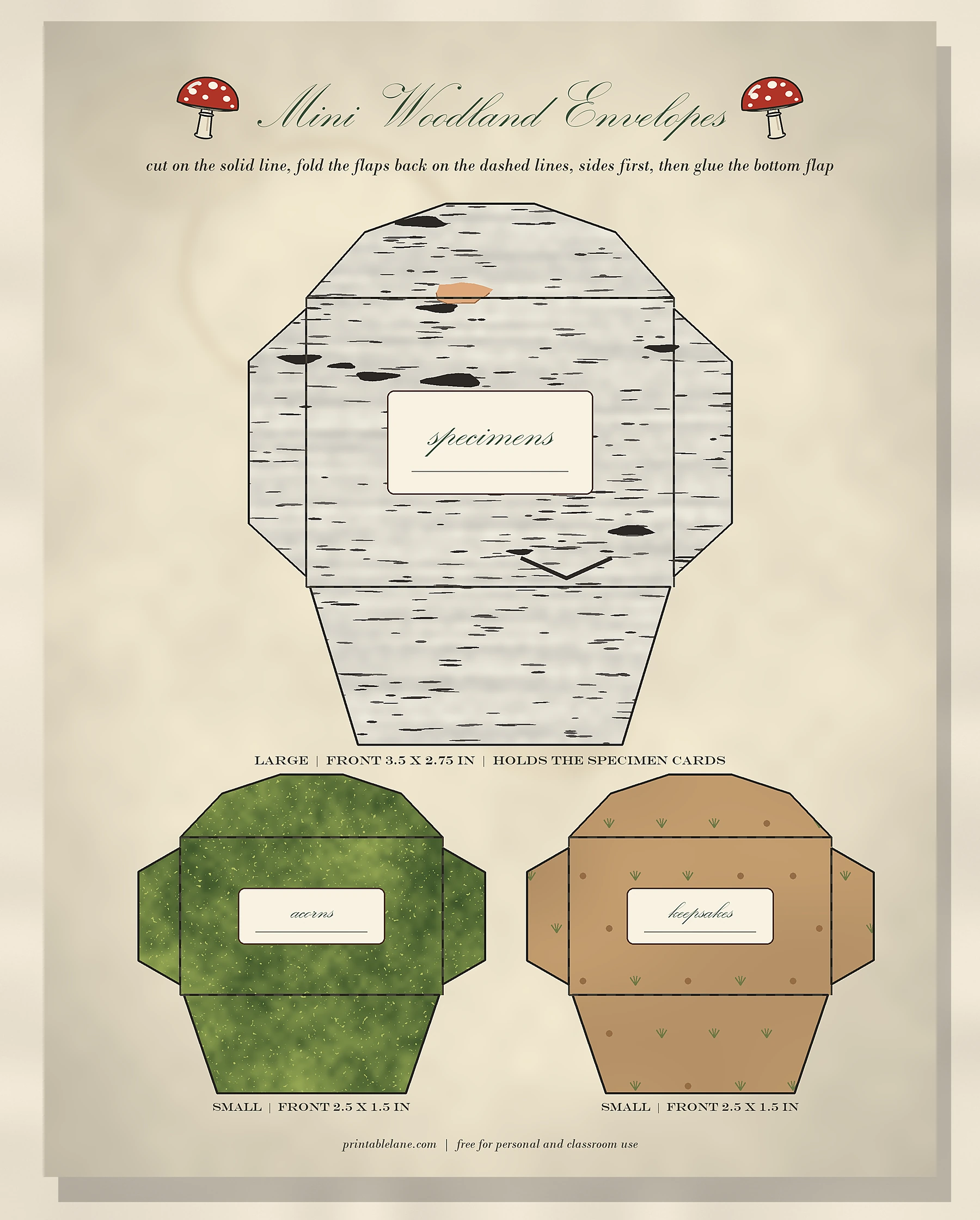
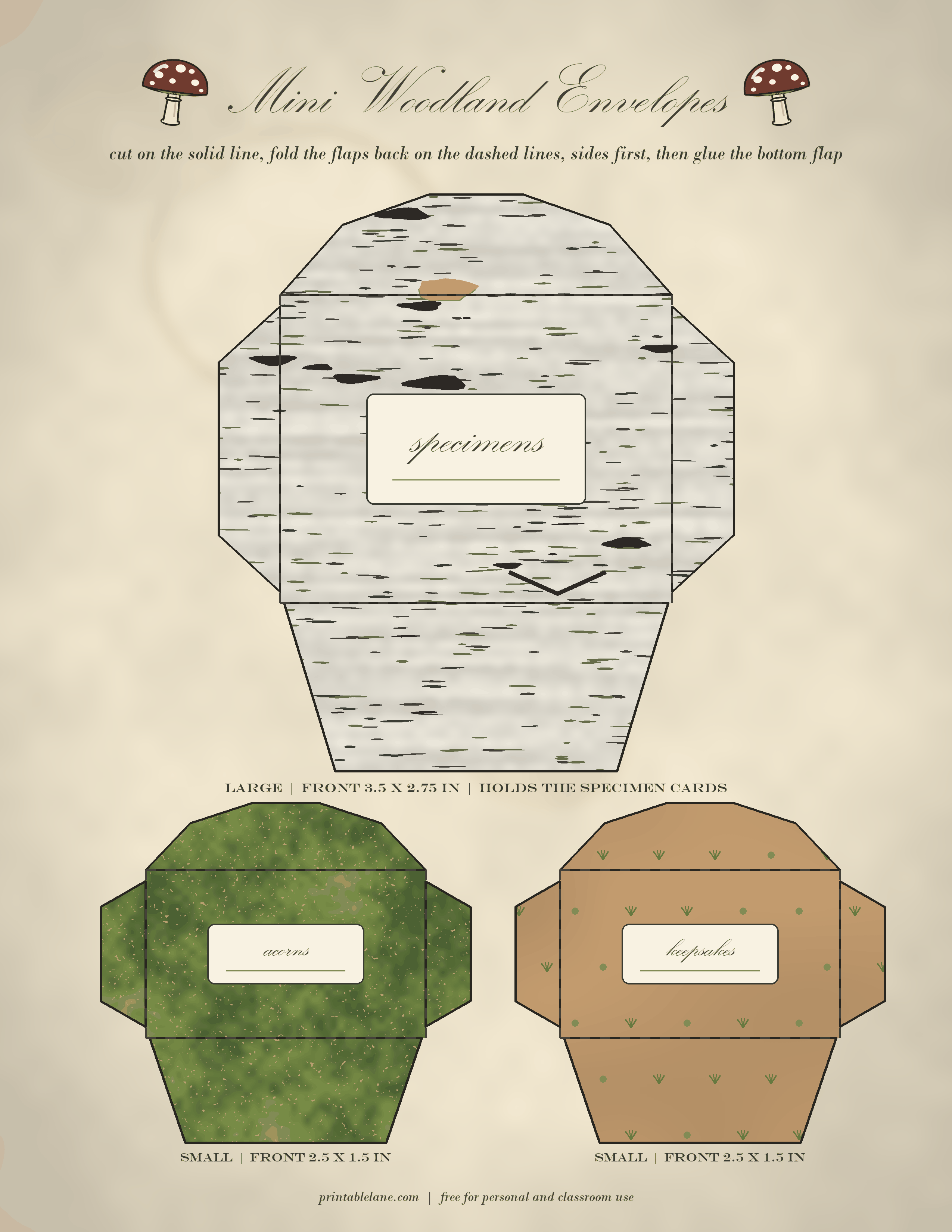
PDF page 8 has 3 envelope nets: a large birch bark one with a 3.5 x 2.75 inch front labeled specimens, which holds the specimen cards, and 2 small ones with 2.5 x 1.5 inch fronts in moss and kraft prints, labeled acorns and keepsakes. Fold the side flaps back first, then glue the bottom flap over them and tuck the top flap.
Woodland Ephemera Cut-Outs
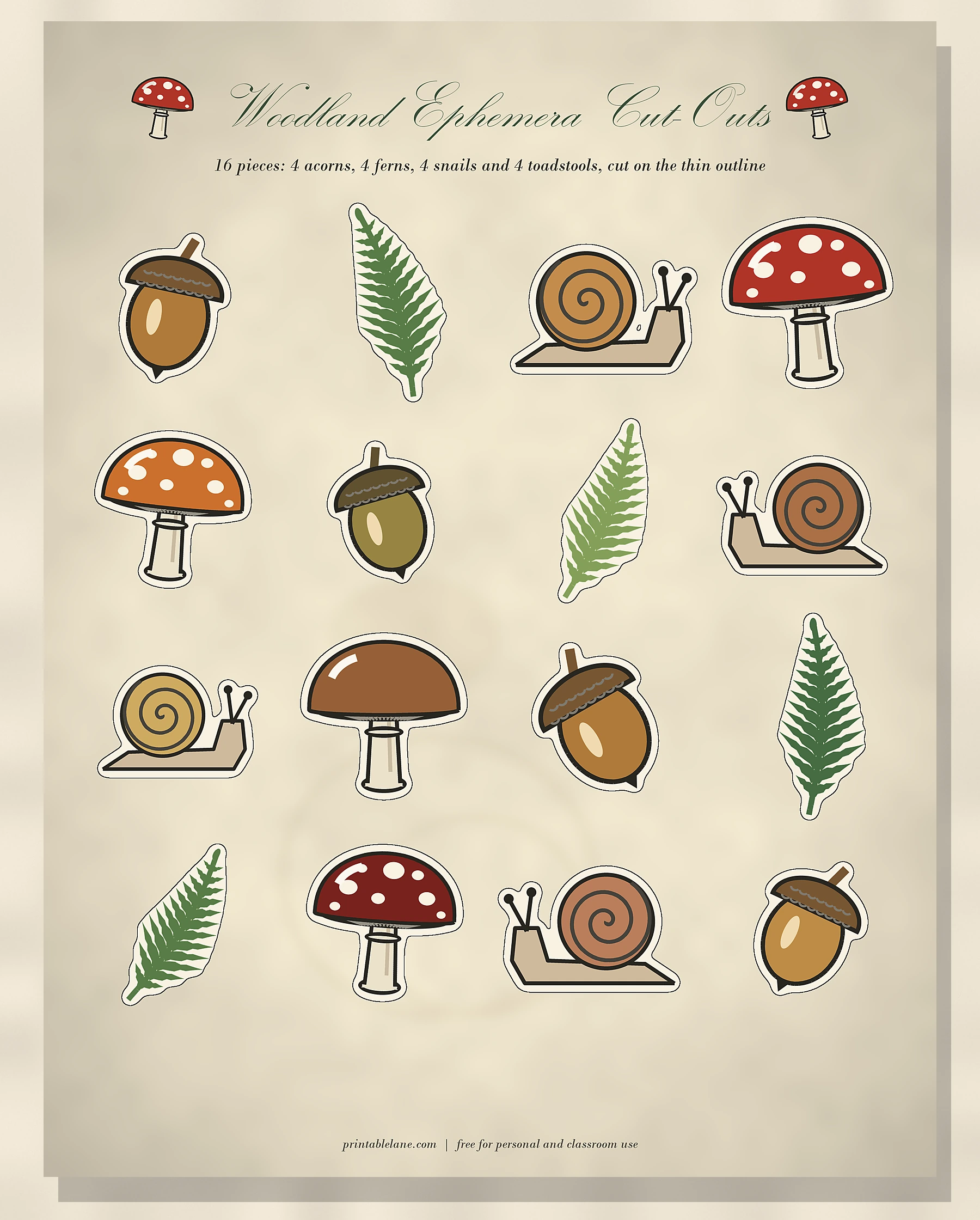
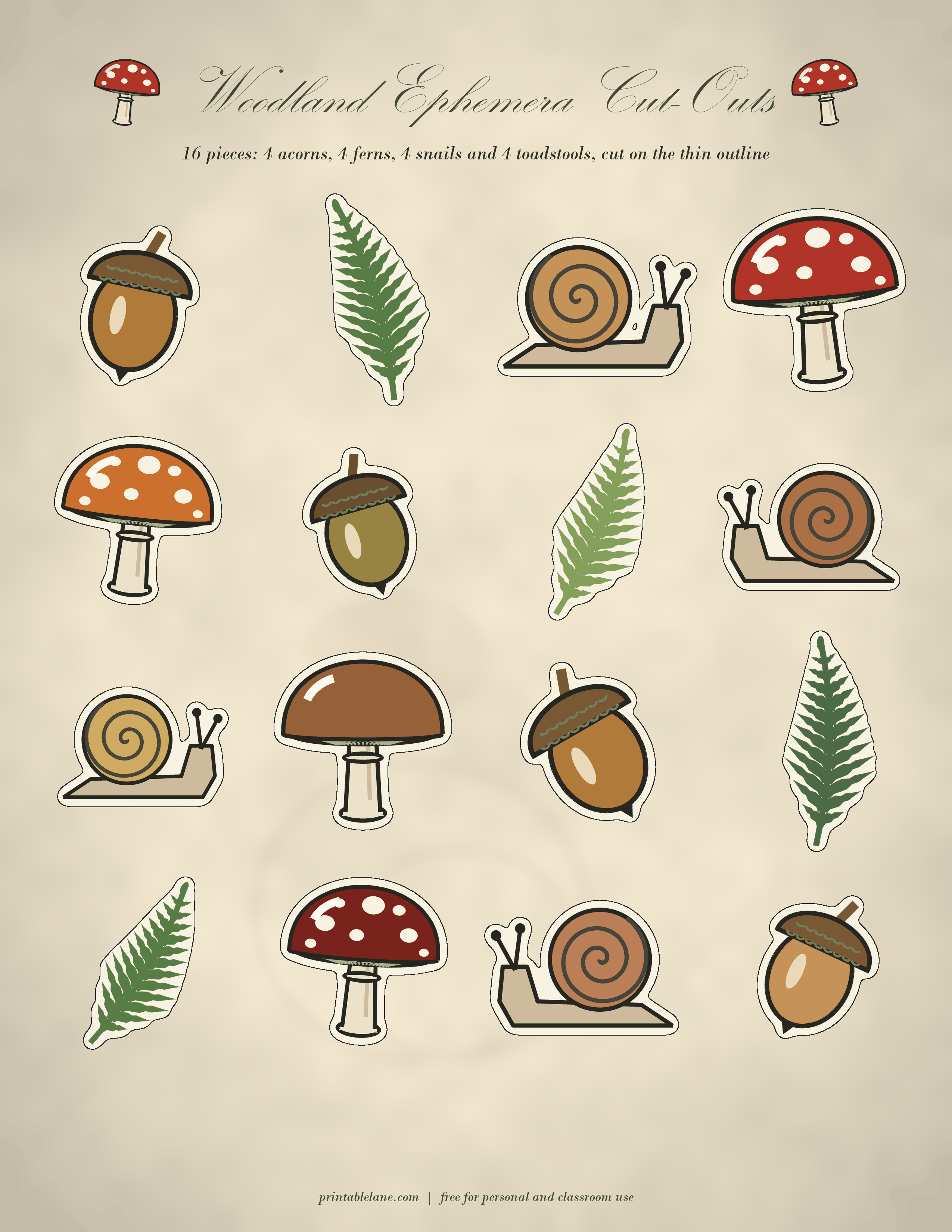
PDF page 9 gives you 16 cut-outs with a cream border and a thin outline to cut along: 4 acorns, 4 ferns, 4 snails and 4 toadstools in red, orange, dark red and plain brown.
A bark pocket, the woodland cover and the full set
Bark Pocket Templates
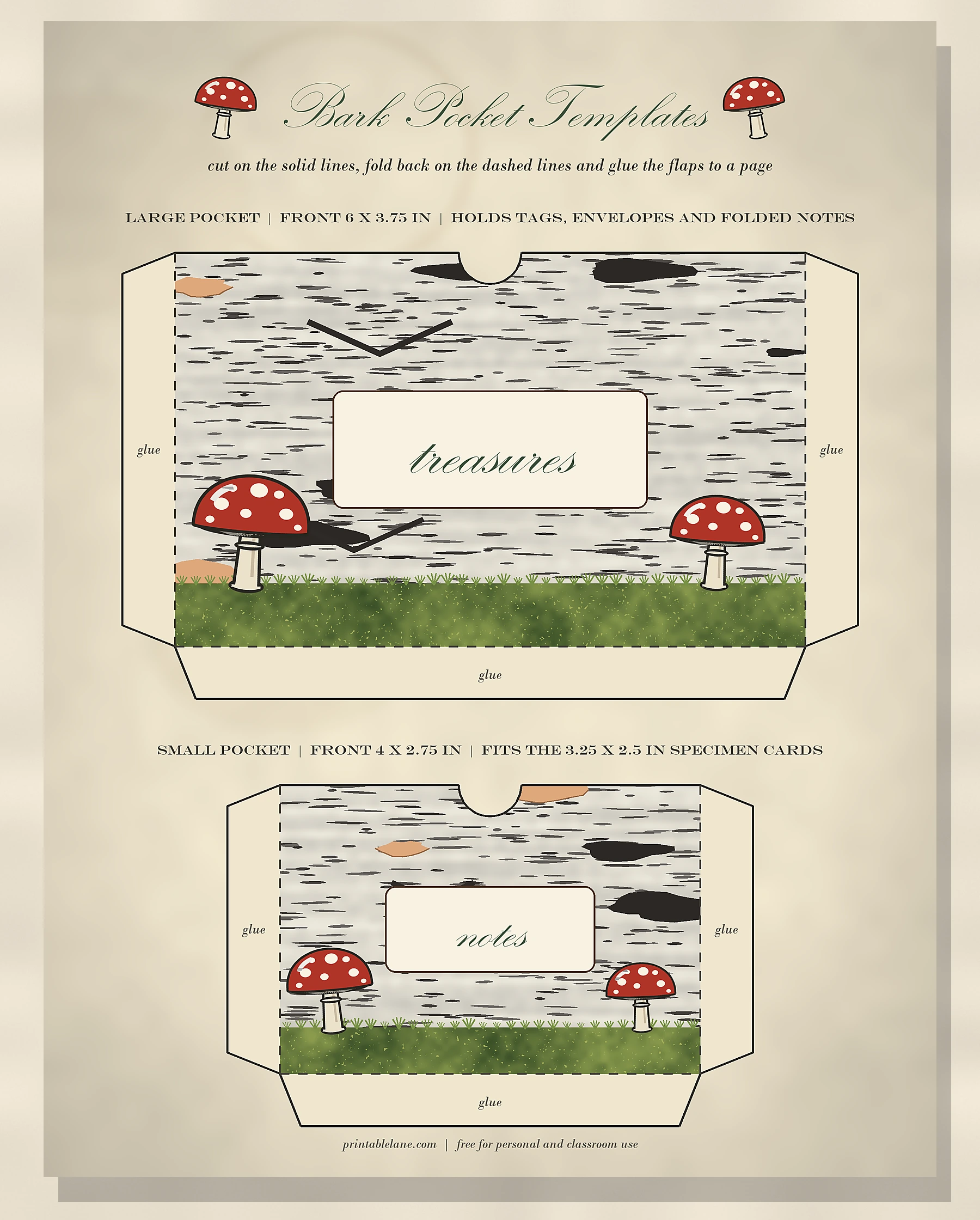
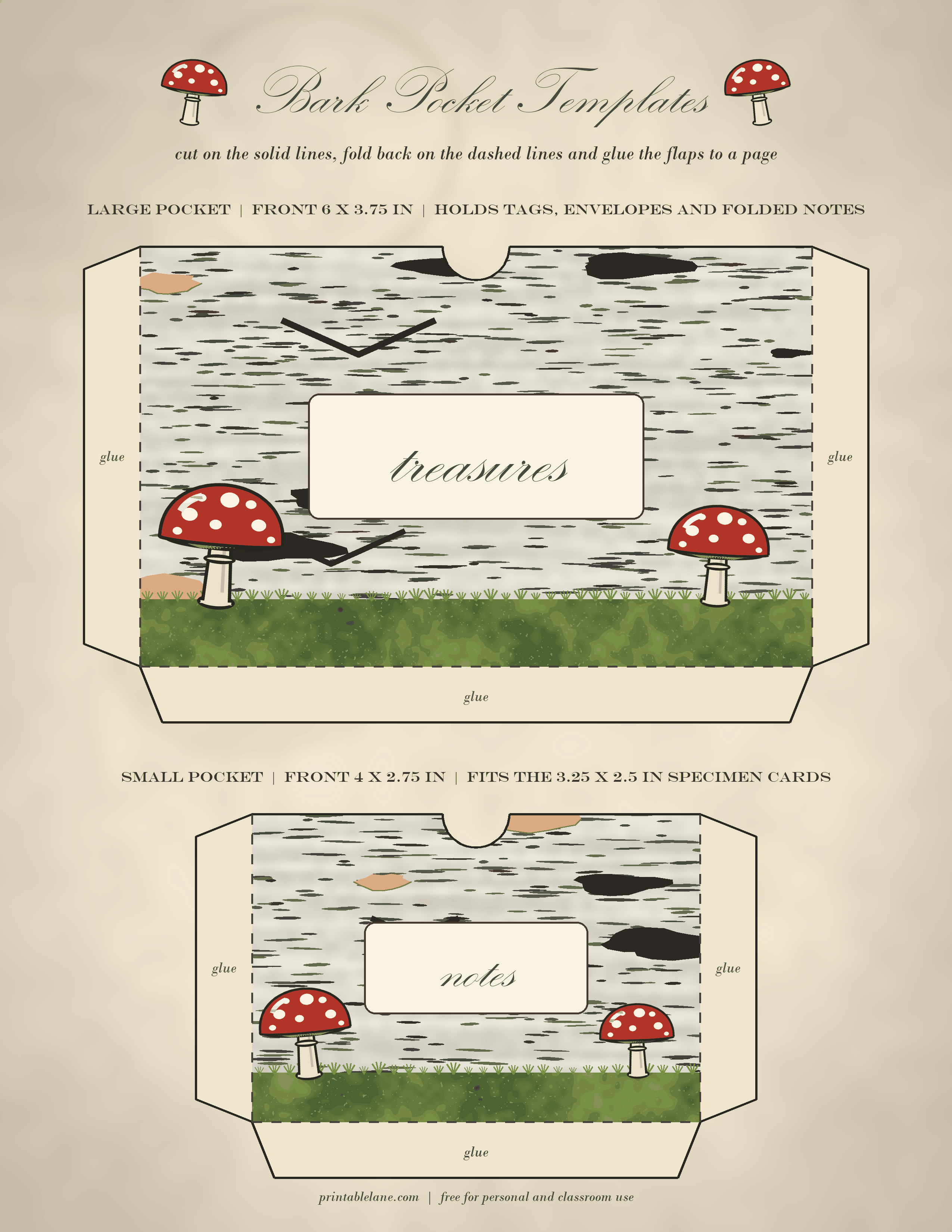
PDF page 10 has 2 pockets with a thumb notch and glue flaps. The large front is 6 x 3.75 inches and says treasures; the small one is 4 x 2.75 inches, says notes and fits the specimen cards. Both fronts show birch bark with a moss strip and toadstools along the bottom.
Woodland Journal Cover
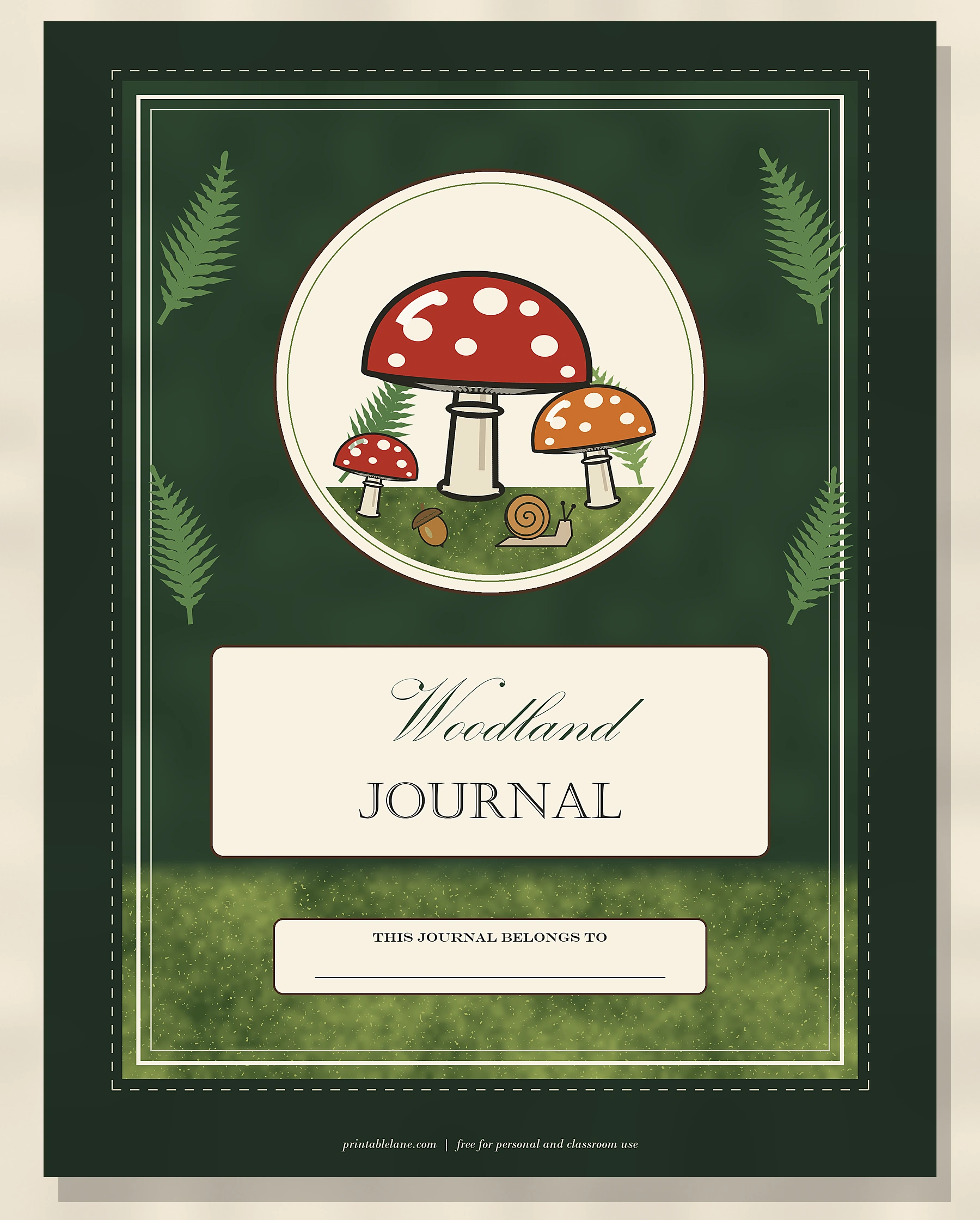
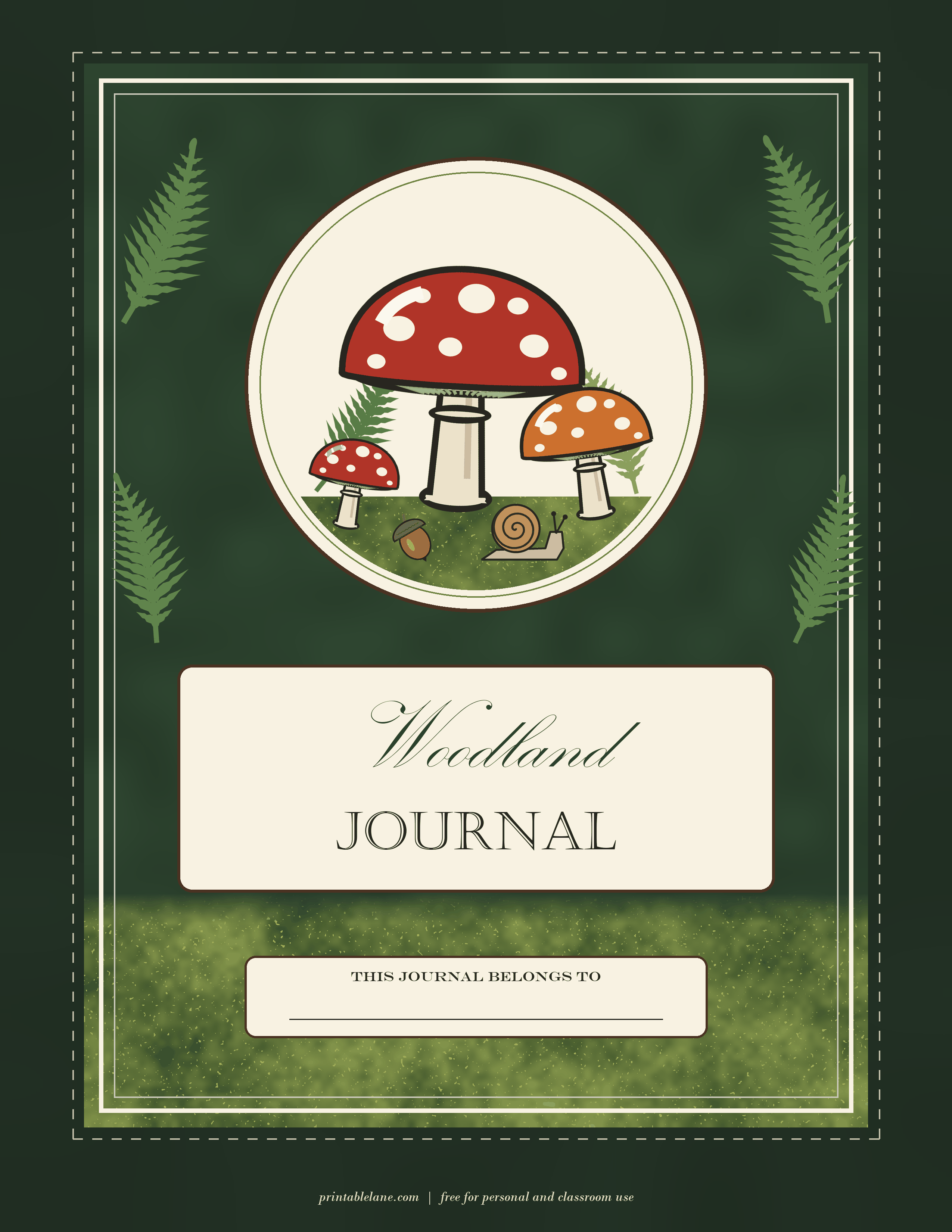
PDF page 11 is a 7 x 9.5 inch forest green panel with a dashed cut line. A cream oval in the middle shows 3 toadstools, ferns, a snail and an acorn on moss, with 4 more ferns around it, a Woodland Journal name plate below and a “this journal belongs to” line at the bottom.
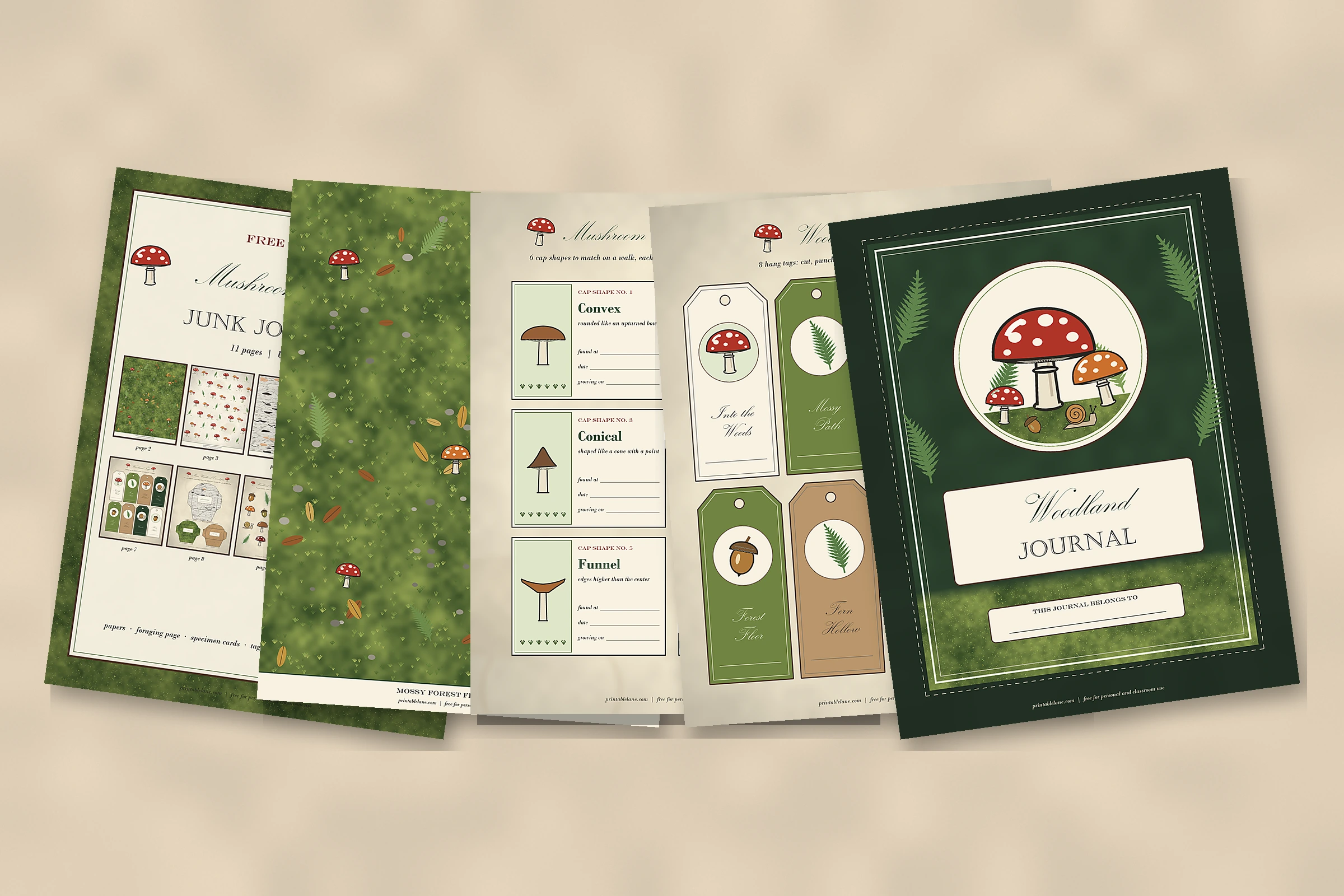
The PDF has 11 pages, the 10 kit pages plus a cover with thumbnails. It is sized for US Letter; on A4, print at 100% (Actual size) so the ruler, envelopes and pockets keep their measurements. Use regular printer paper for the 3 backgrounds and 65 lb cardstock for the tags, cards and cover. Each kit page is also a single PNG file:
- Mossy Forest Floor Paper (PNG)
- Toadstool Pattern Paper (PNG)
- Birch Bark Paper (PNG)
- Mushroom Foraging Journal (PNG)
- Mushroom Specimen Cards (PNG)
- Woodland Tags (PNG)
- Mini Woodland Envelopes (PNG)
- Woodland Ephemera Cut-Outs (PNG)
- Bark Pocket Templates (PNG)
- Woodland Journal Cover (PNG)
Building an autumn walk spread
One walk fills a 2-page spread nicely. This order keeps the bulky pieces off the fold:
- Glue the birch bark paper on the left page and the toadstool paper on the right.
- Tear a strip of the moss paper and run it along the bottom of both pages.
- Fill in the foraging journal page after the walk, fold it in half and keep it in the large bark pocket on the left.
- Glue the small notes pocket on the right page and slip 2 filled specimen cards inside.
- Tie 1 tag to the spine with twine and scatter 3 or 4 cut-outs over the moss strip.
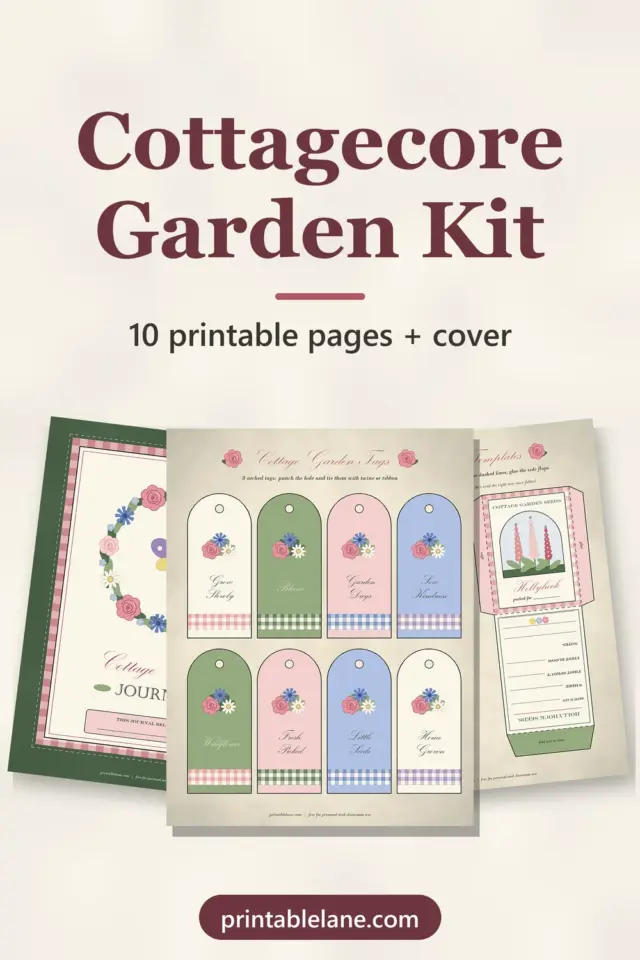
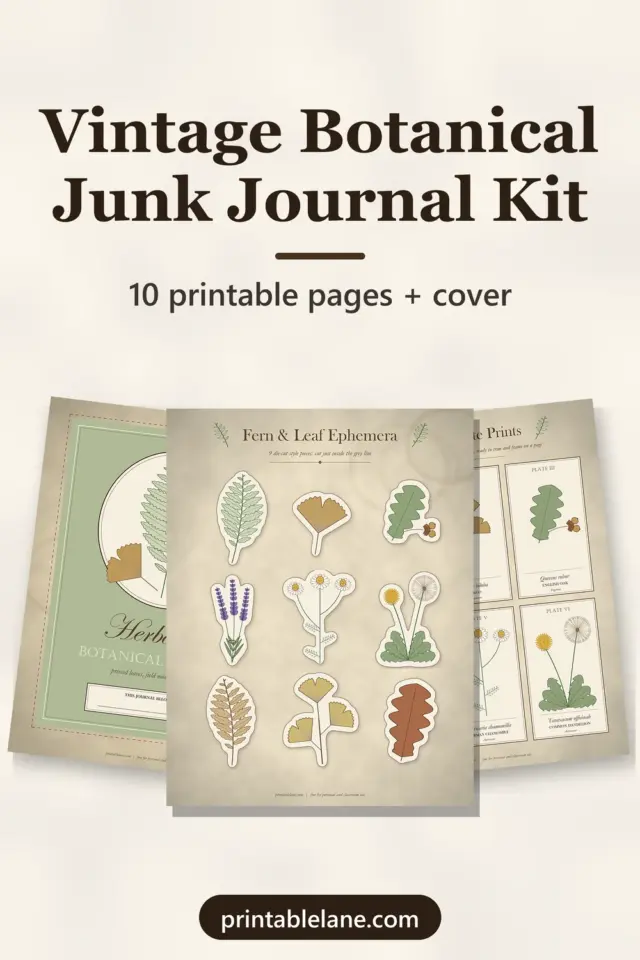
If you want older-looking plant pages next to this kit, the vintage botanical junk journal kit adds a herbarium sheet and fern prints in sepia, and the cottagecore garden junk journal kit covers the garden side of the same season. For quiet evenings, the mushroom coloring pages make good fillers between spreads. Every other kit, paper and ephemera set is listed in the free junk journal printables library, and what is a junk journal explains how to bind the pages into a book.