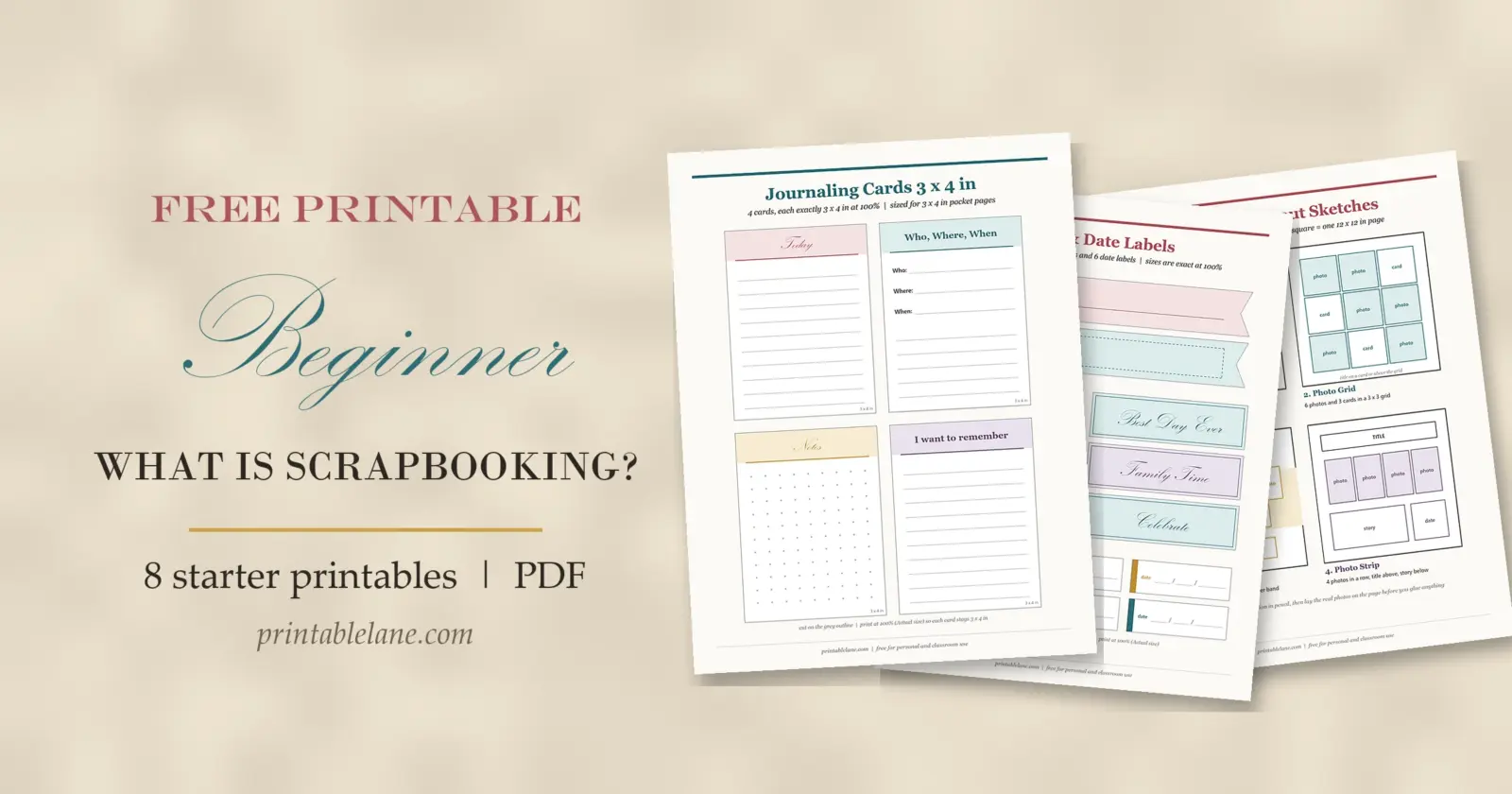
What is scrapbooking? It is the craft of keeping photos and small paper keepsakes on decorated album pages, together with written notes that explain who was there, where it happened and why it mattered. A finished scrapbook reads like a family story told in pictures, tickets and handwriting.
Below: a short history, the styles, page sizes, basic supplies and your first page step by step. The free 9-page PDF adds layouts, journaling cards, labels and planning sheets.
A short history of scrapbooking
Long before patterned paper, people kept commonplace books, notebooks of copied quotes, poems and notes, in England from the 1400s onward. In the 1800s cheap newspapers, cards and programs became easy to collect, and pasting clippings into blank books turned into a popular pastime. Photographs became a regular part of these albums once simple handheld cameras reached ordinary families in the late 1800s.
Common scrapbooking styles
- Traditional albums: one layout per 12 x 12 in page, built on cardstock with photos, paper layers, a title and journaling.
- Pocket-page scrapbooking: clear page protectors divided into pockets, often 3 x 4 in and 4 x 6 in, filled with photos and journaling cards. Fast and tidy.
- Mini albums: small books, often 6 x 6 in or smaller, that cover one trip, holiday or season.
- Digital scrapbooking: pages designed on a computer with digital paper and elements, then printed as photos or a book, or kept on screen.
Standard scrapbook page sizes
The 2 most common sizes are 12 x 12 in (about 30.5 x 30.5 cm) and 8.5 x 11 in, the size of US Letter paper. Most patterned paper is sold for 12 x 12 in albums; 8.5 x 11 in albums fit papers you print at home. Smaller square albums such as 6 x 6 in and 8 x 8 in are popular for mini albums.
How to make your first scrapbook page
- Choose 1 event and pull 3 to 6 photos from it, not 20.
- Pick 1 photo as the star; it gets the biggest spot.
- Choose a base cardstock and 2 or 3 papers that pick up colors from the photos.
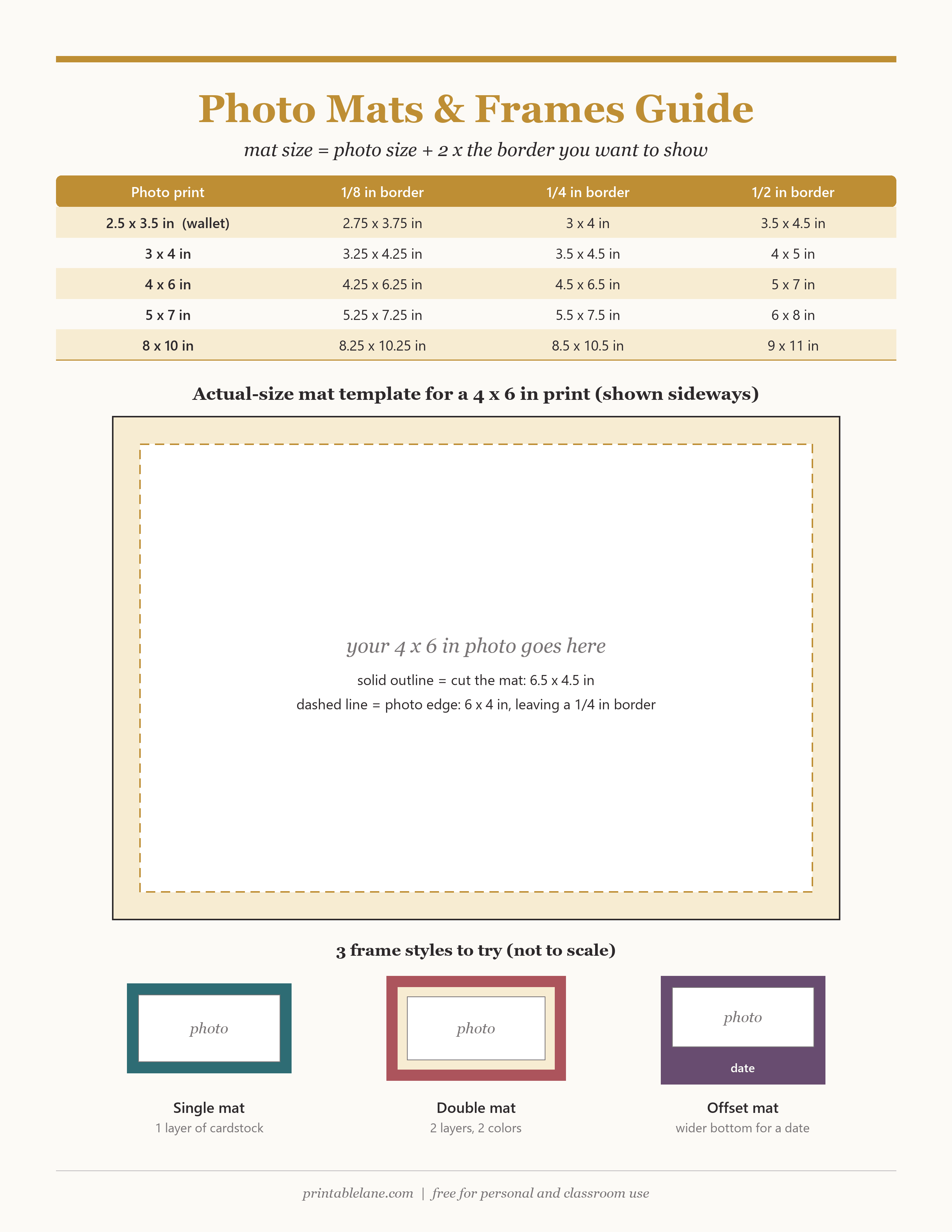
- Mat the star photo with a 1/8 or 1/4 in border so it stands out.
- Lay everything out without glue, following a layout sketch.
- Add a title and a date, then write a few lines of journaling.
- Glue down with photo-safe adhesive, add 2 or 3 accents and slide the page into its protector.
Journaling tips that help later
- Answer who, what, when and where first; those are the facts people forget soonest.
- Then add 1 detail a photo cannot show: a sound, a joke, what someone said.
- Write the full date, including the year.
- Write on a card first, so a mistake costs one card, not the whole layout.
What’s in the PDF (9 pages)
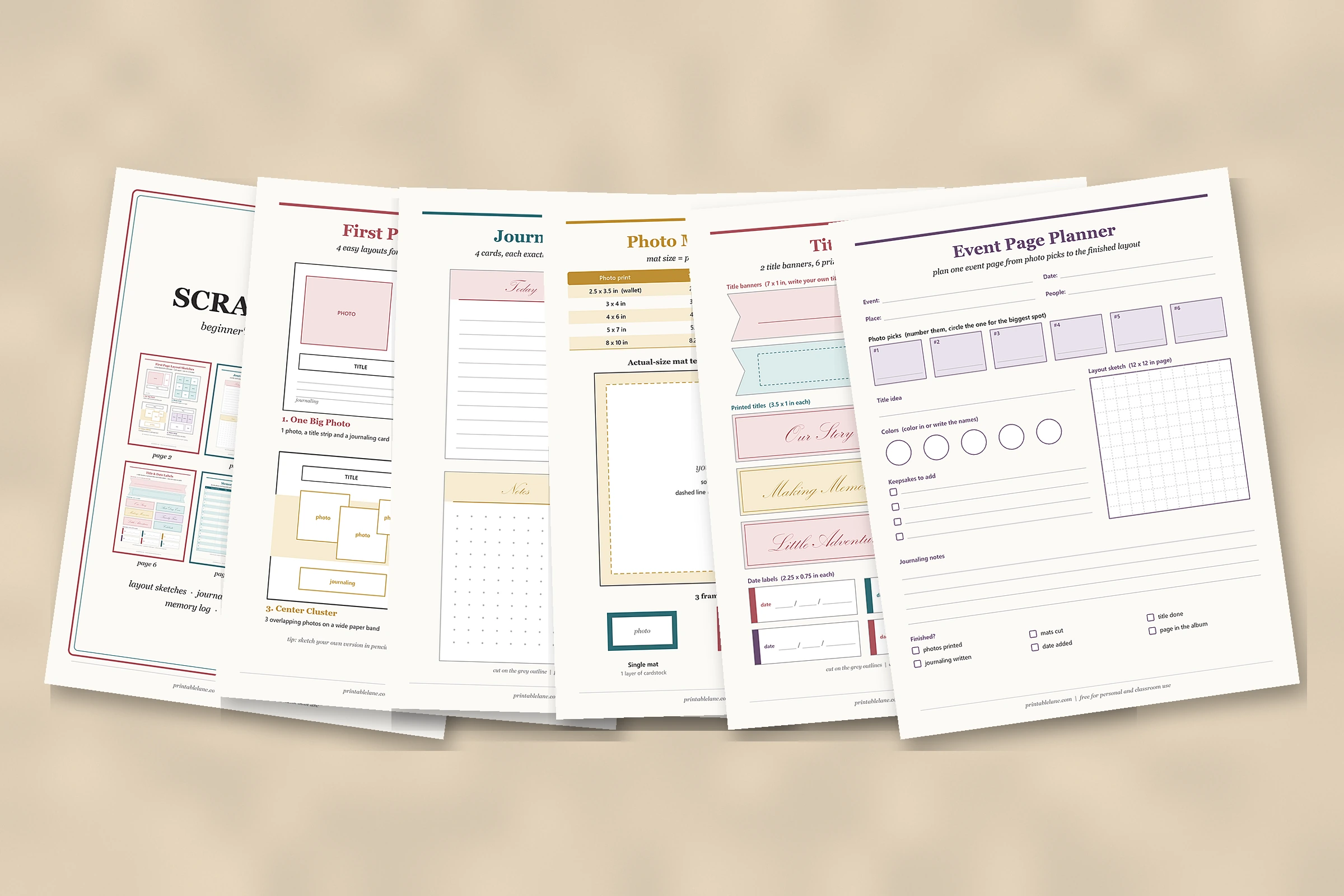
- Page 1: cover with thumbnails of the 8 printable pages.
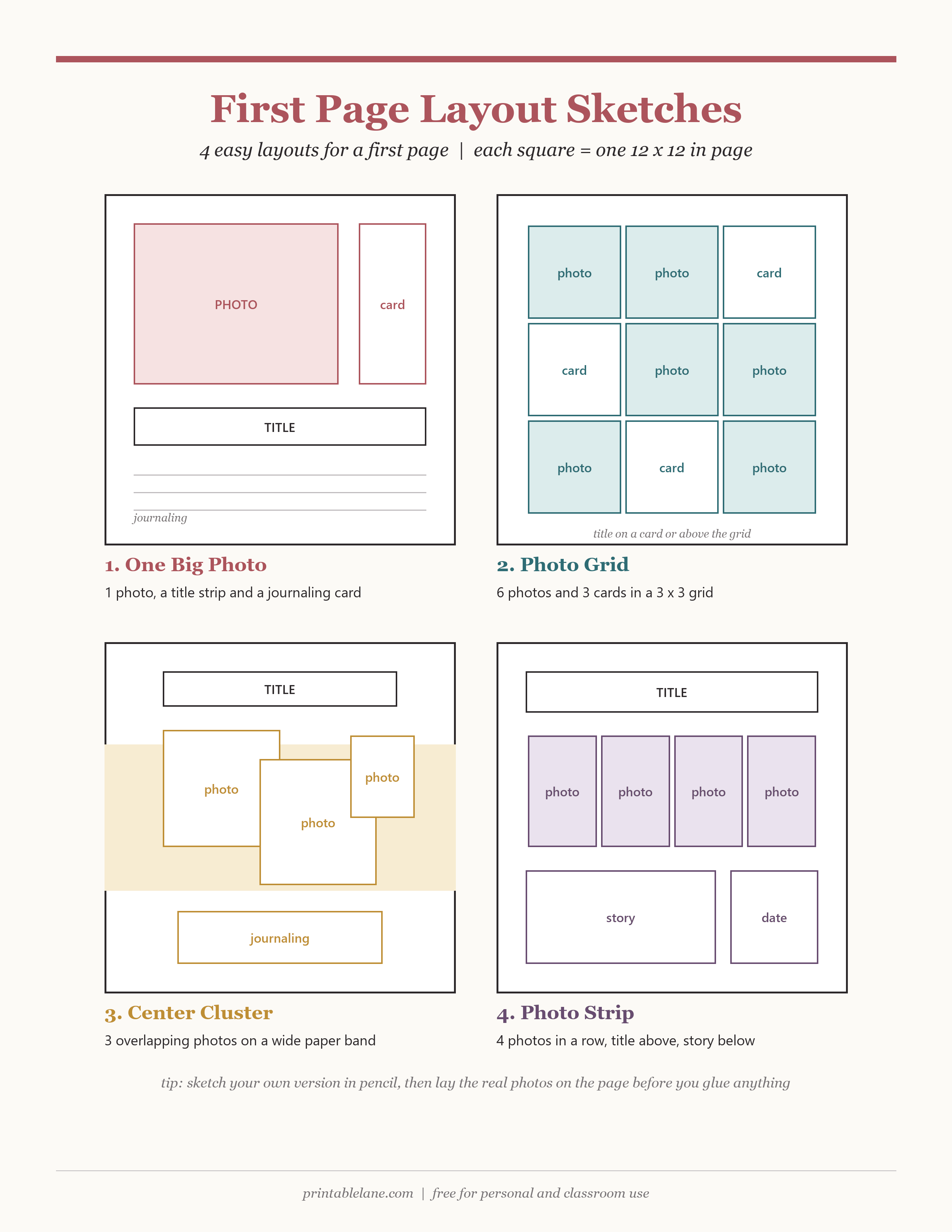
- Page 2: First Page Layout Sketches (4 layouts).
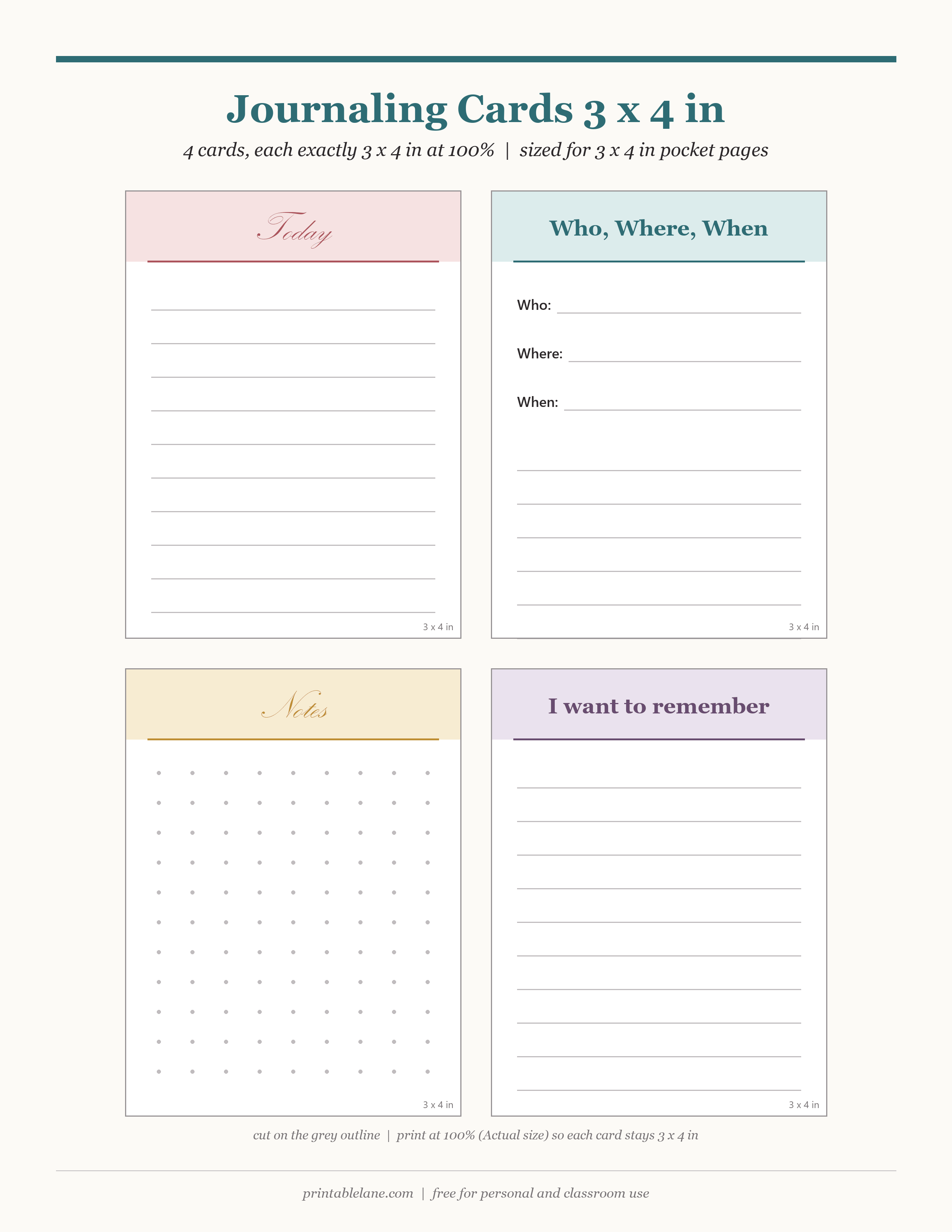
- Page 3: Journaling Cards 3 x 4 in (4 cards).
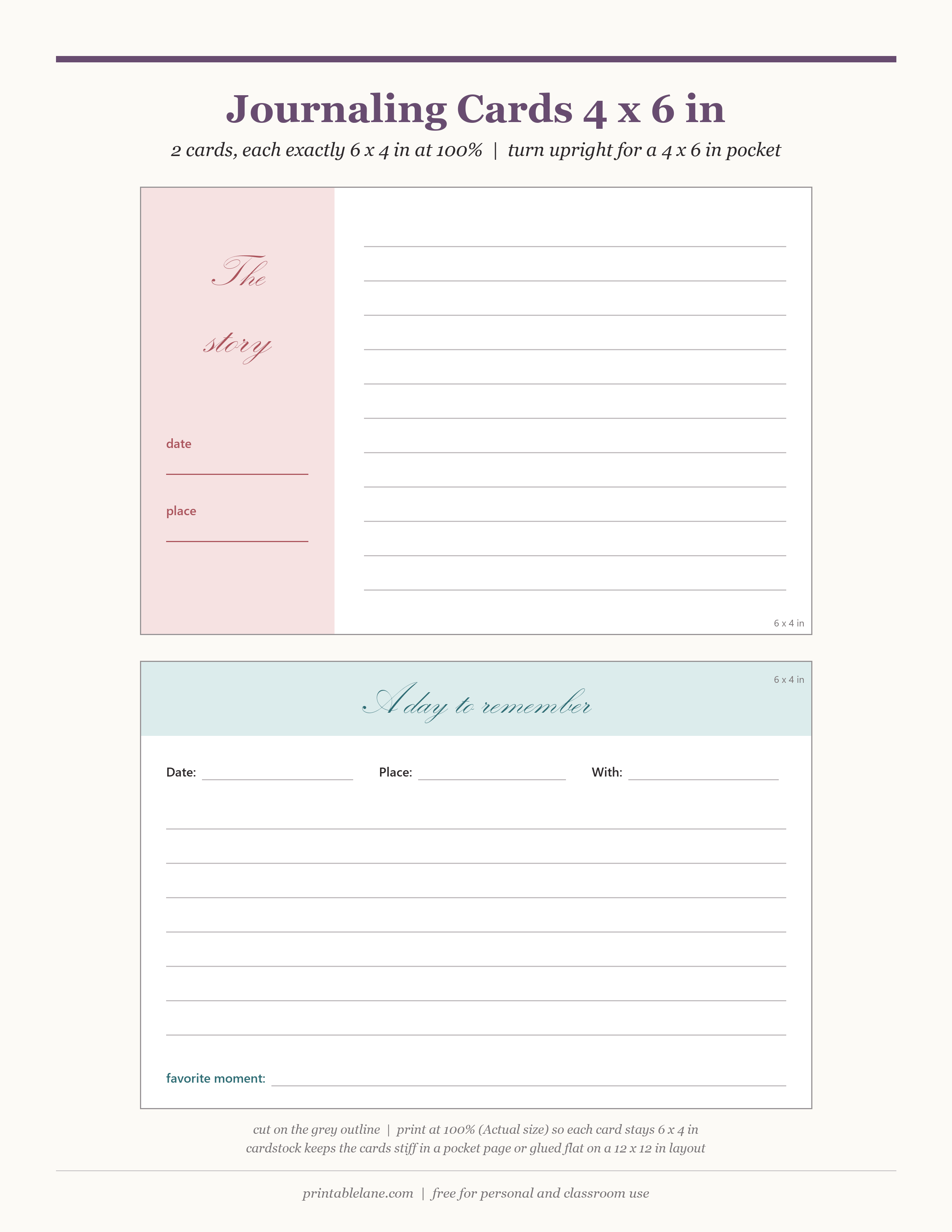
- Page 4: Journaling Cards 4 x 6 in (2 cards).
- Page 5: Photo Mats & Frames Guide.
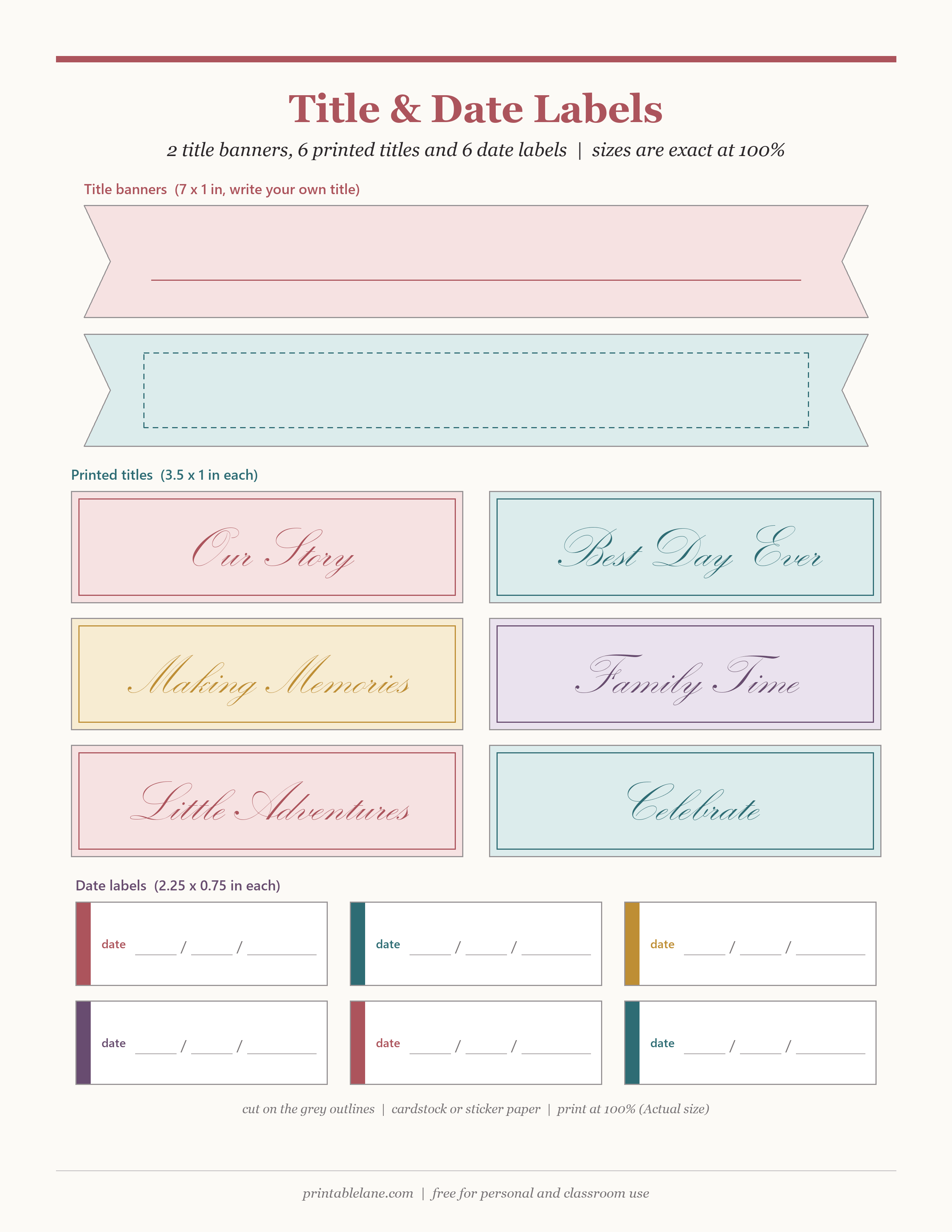
- Page 6: Title & Date Labels (2 banners, 6 titles, 6 date labels).
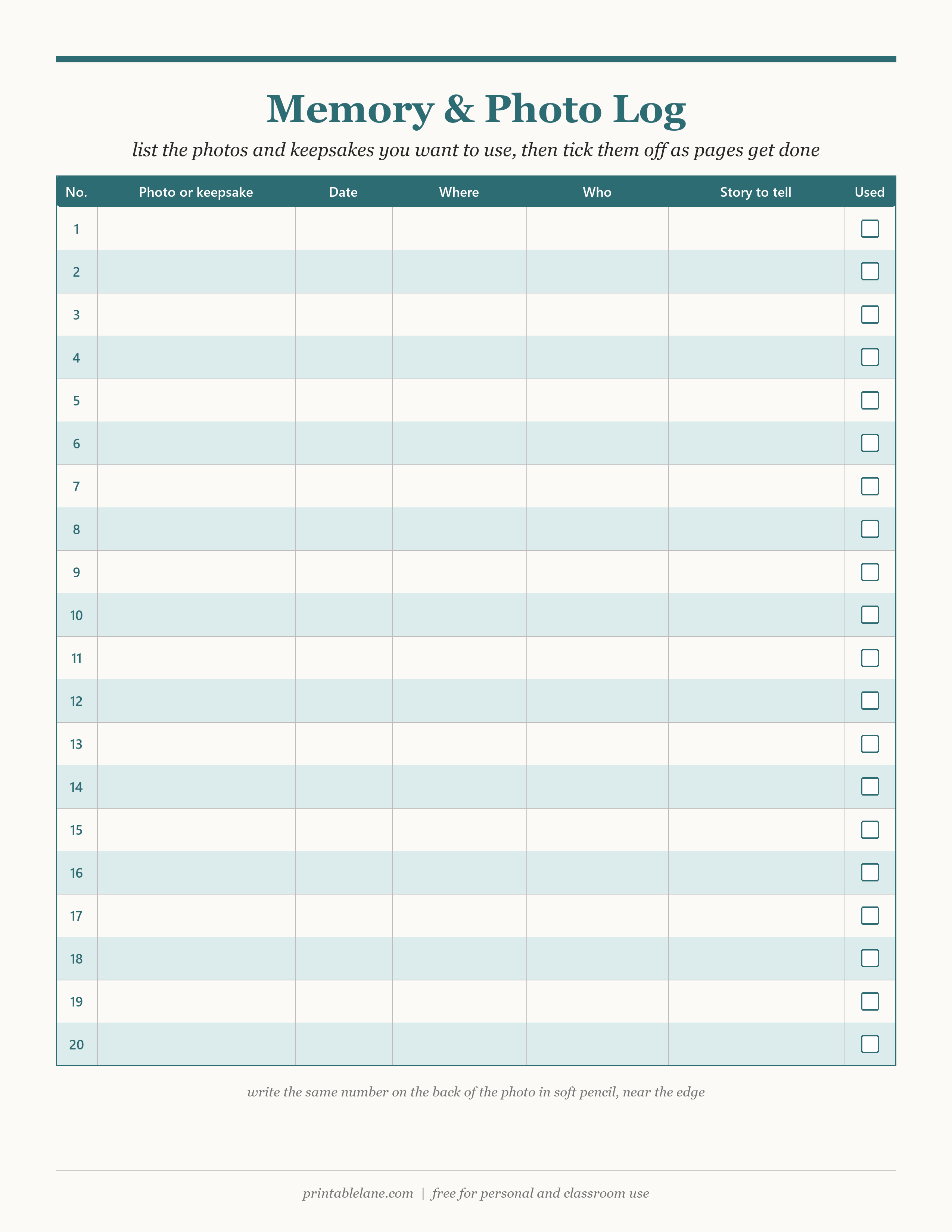
- Page 7: Memory & Photo Log (20 rows).
- Page 8: Event Page Planner.
- Page 9: Scrapbooking Supplies Checklist (23 supplies).
First Page Layout Sketches
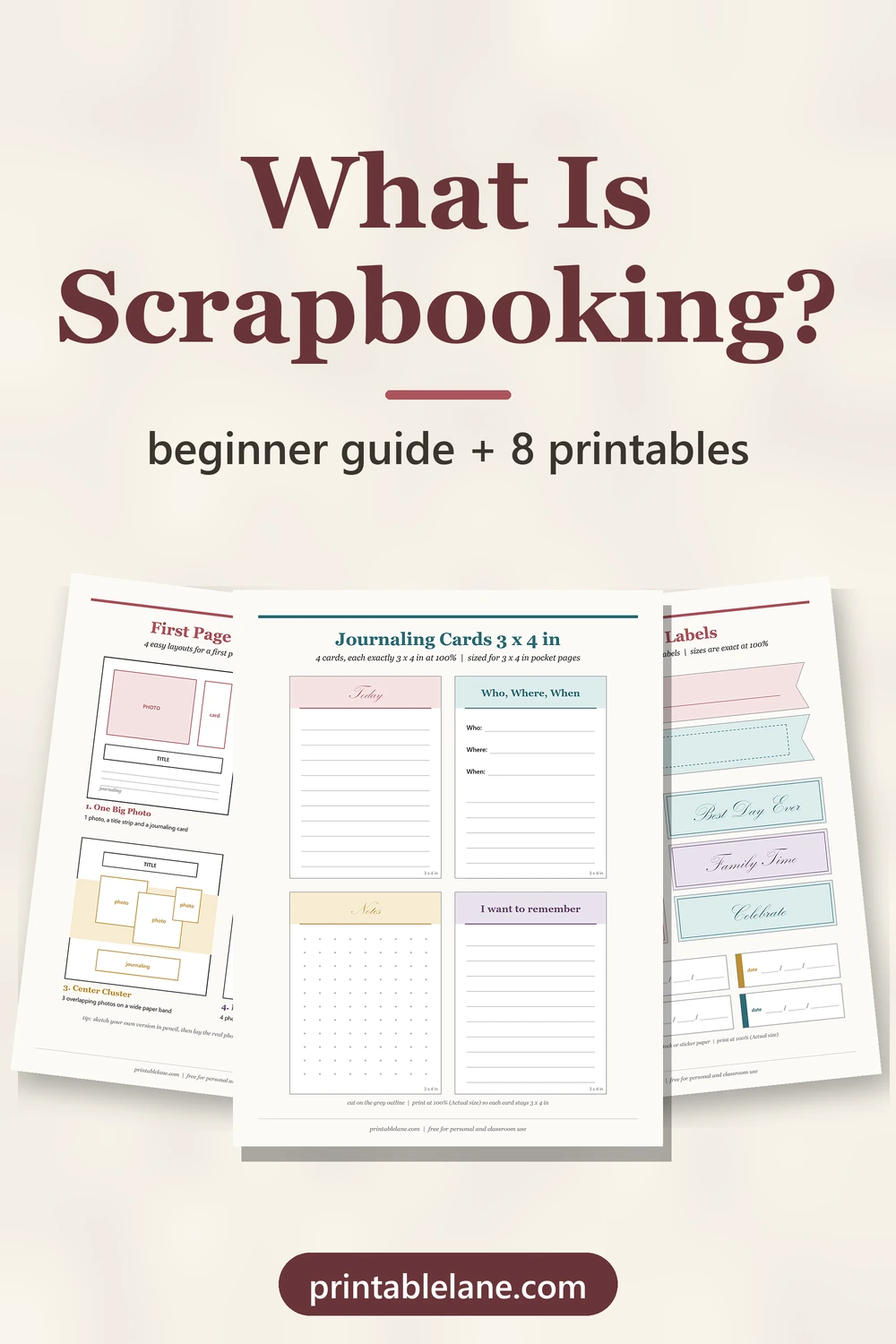
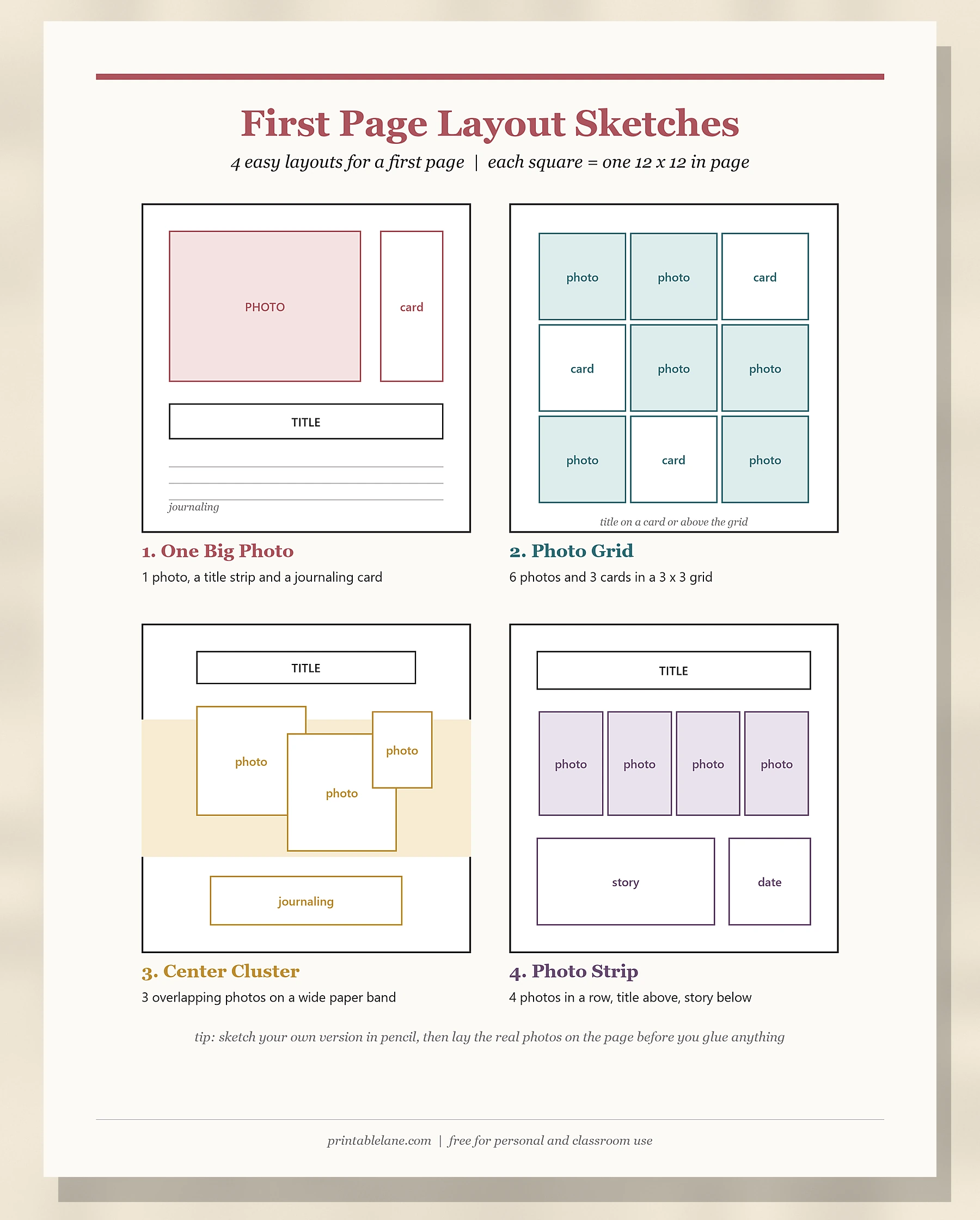
PDF page 2 draws 4 layouts, each square standing for a 12 x 12 in page: One Big Photo (1 photo, a title strip, a card and journaling lines), Photo Grid (6 photos and 3 cards in a 3 x 3 grid), Center Cluster (3 overlapping photos on a paper band) and Photo Strip (a title, 4 photos in a row, a story box and a date box).
Journaling Cards 3 x 4 in
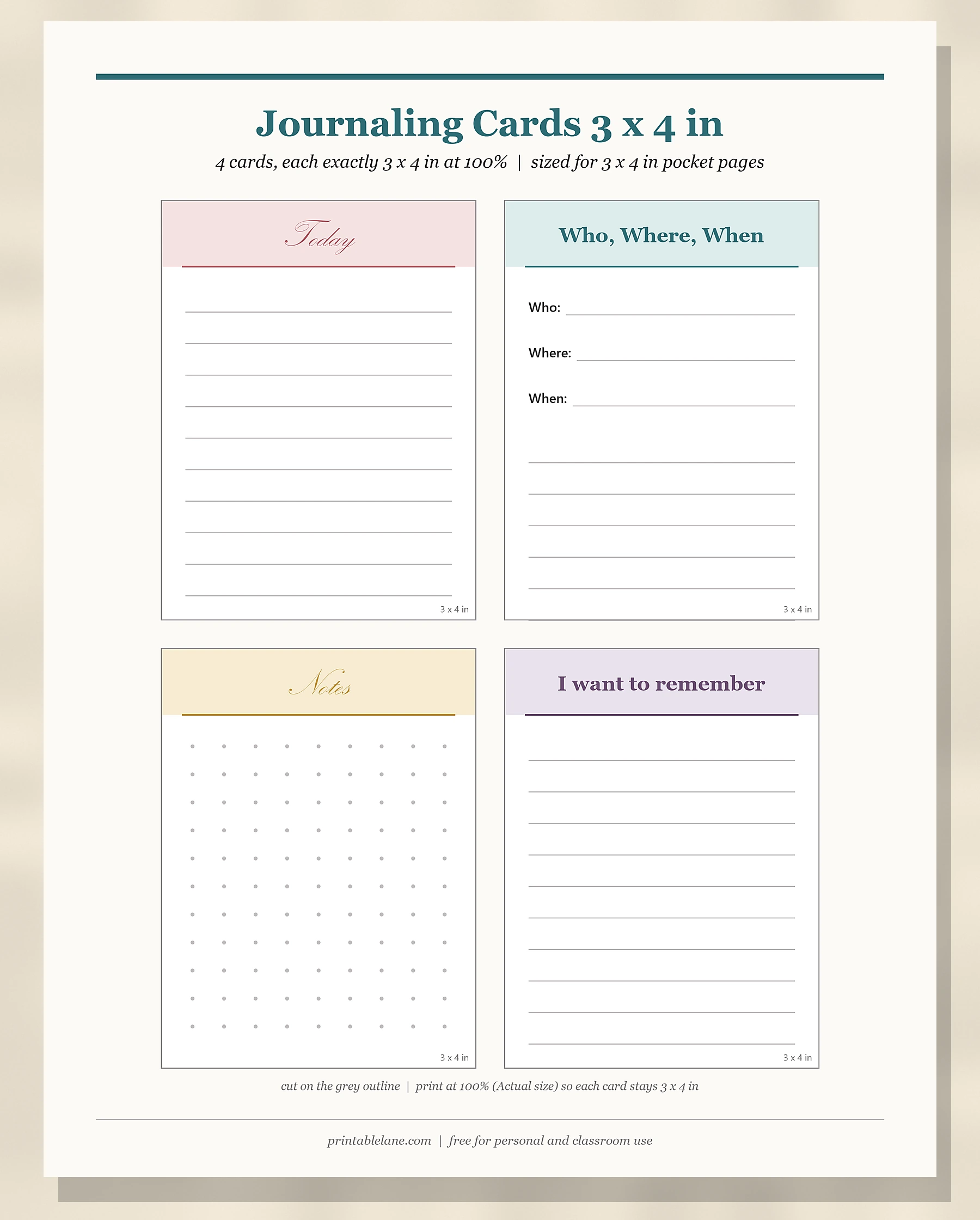
PDF page 3 holds 4 cards, each 3 x 4 in at 100%: Today (lined), Who, Where, When (3 fields and lines), Notes (dot grid) and I want to remember (lined).
Journaling Cards 4 x 6 in
PDF page 4 has 2 landscape cards, each 6 x 4 in: The story, with date and place lines in a side panel, and A day to remember, with Date, Place and With fields, writing lines and a favorite moment line.
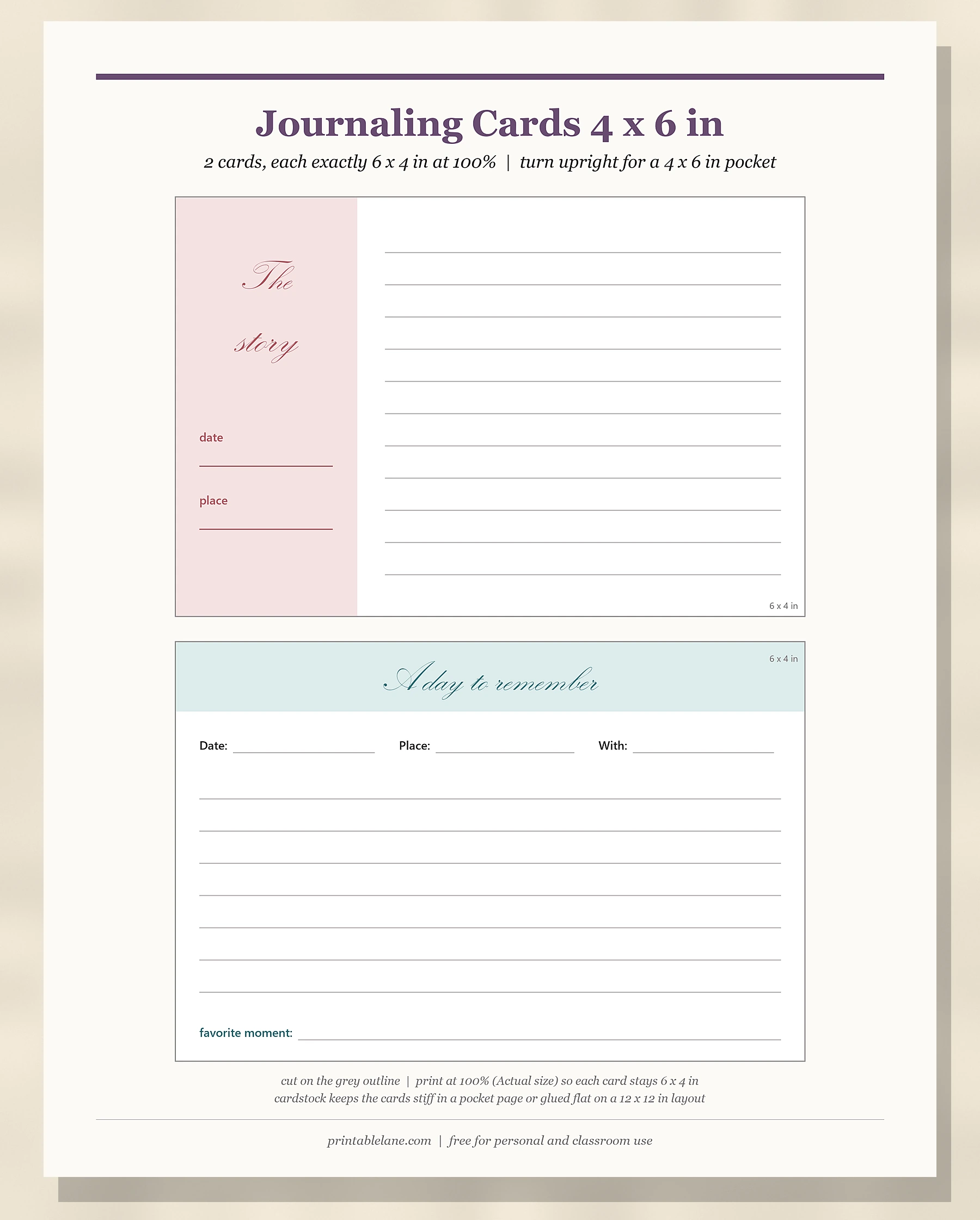
Photo Mats & Frames Guide
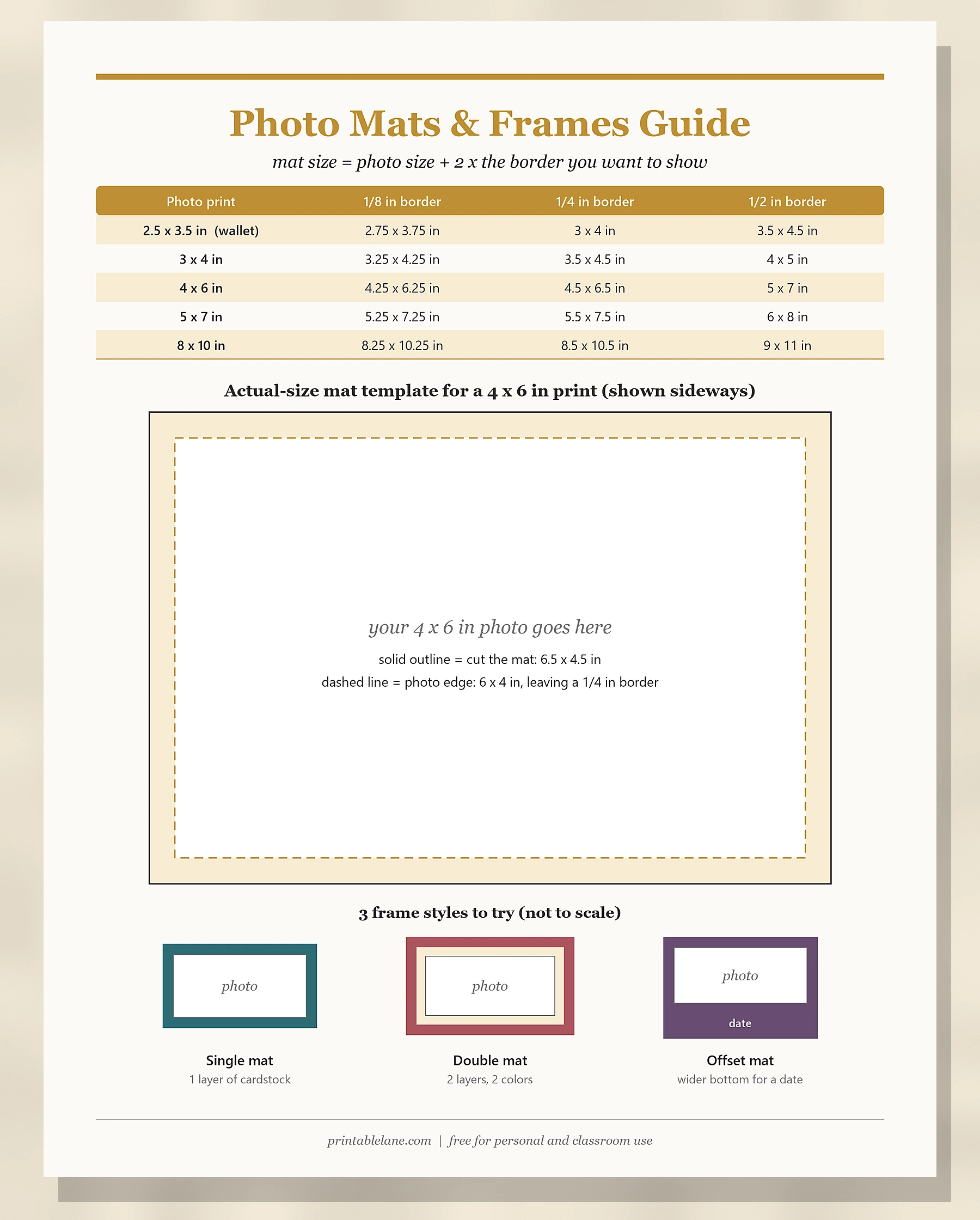
PDF page 5 starts with a size table for 5 common prints, from 2.5 x 3.5 in to 8 x 10 in, with 1/8, 1/4 and 1/2 in borders. Below it is an actual-size 6.5 x 4.5 in mat template for a 4 x 6 in print and 3 frame styles: single, double and offset mat.
Title & Date Labels
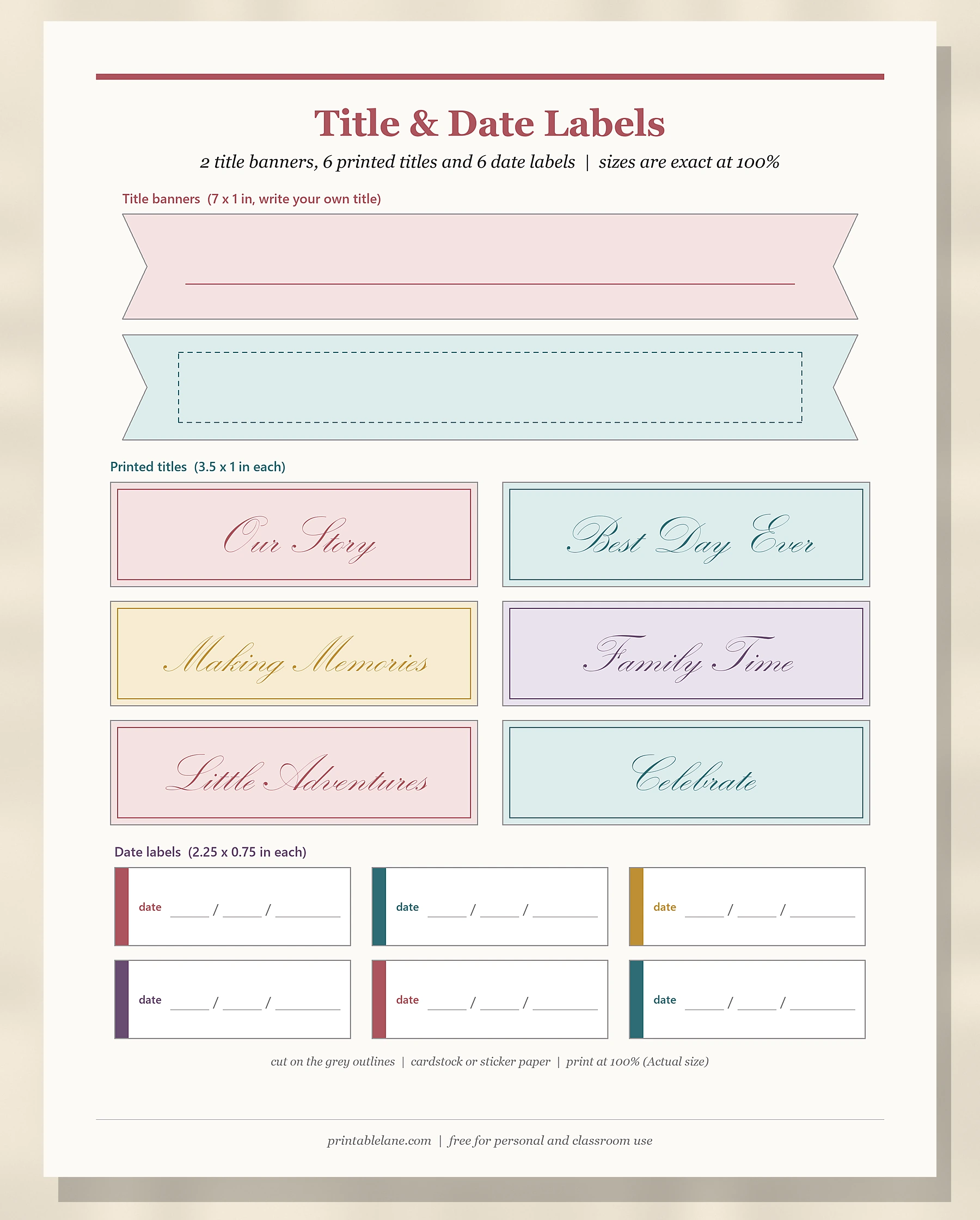
PDF page 6 gives you 2 blank title banners (7 x 1 in) with notched ends, 6 printed titles at 3.5 x 1 in (Our Story, Best Day Ever, Making Memories, Family Time, Little Adventures, Celebrate) and 6 date labels at 2.25 x 0.75 in.
Memory & Photo Log
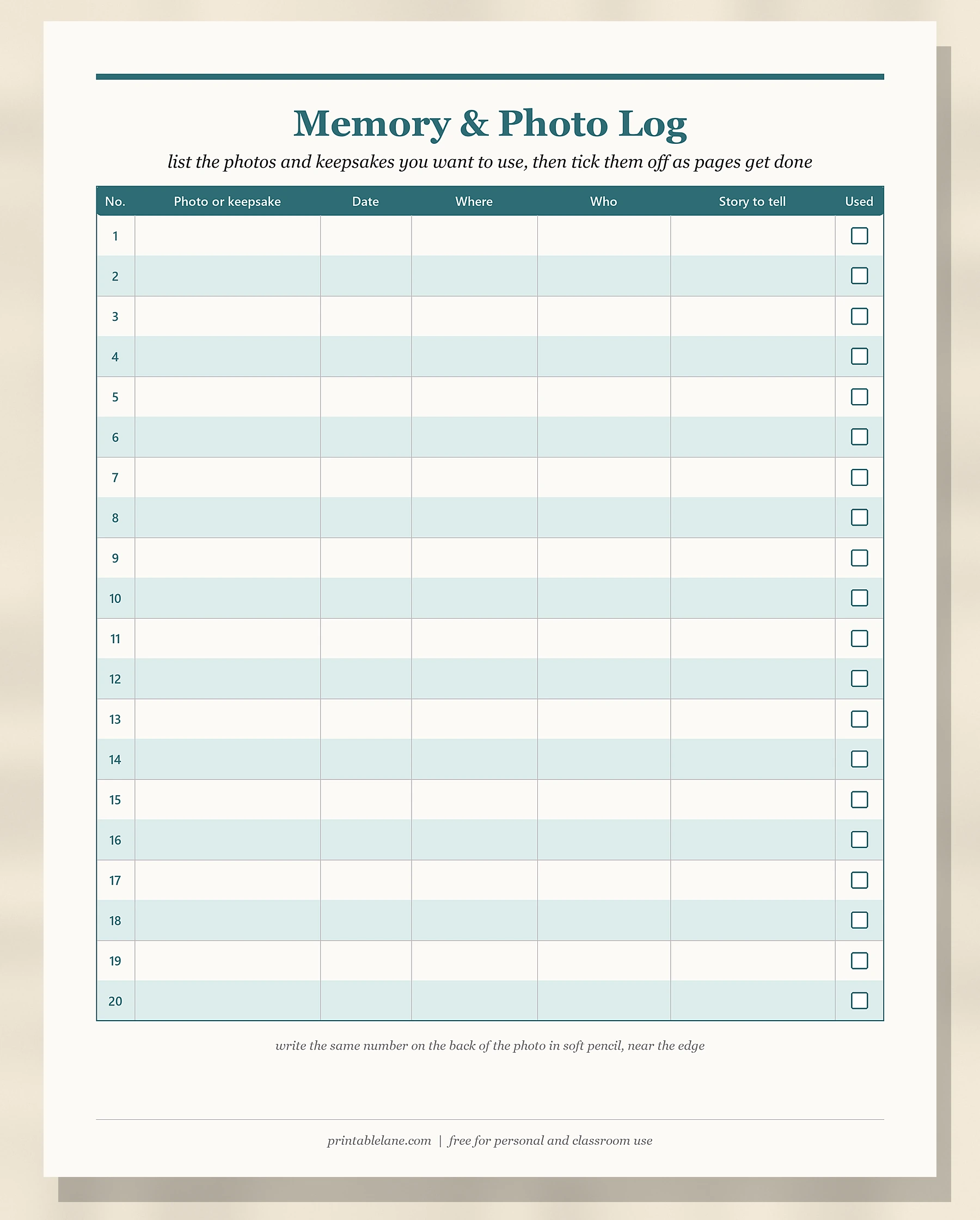
PDF page 7 is a 20-row table with No., Photo or keepsake, Date, Where, Who, Story to tell and Used.
Event Page Planner
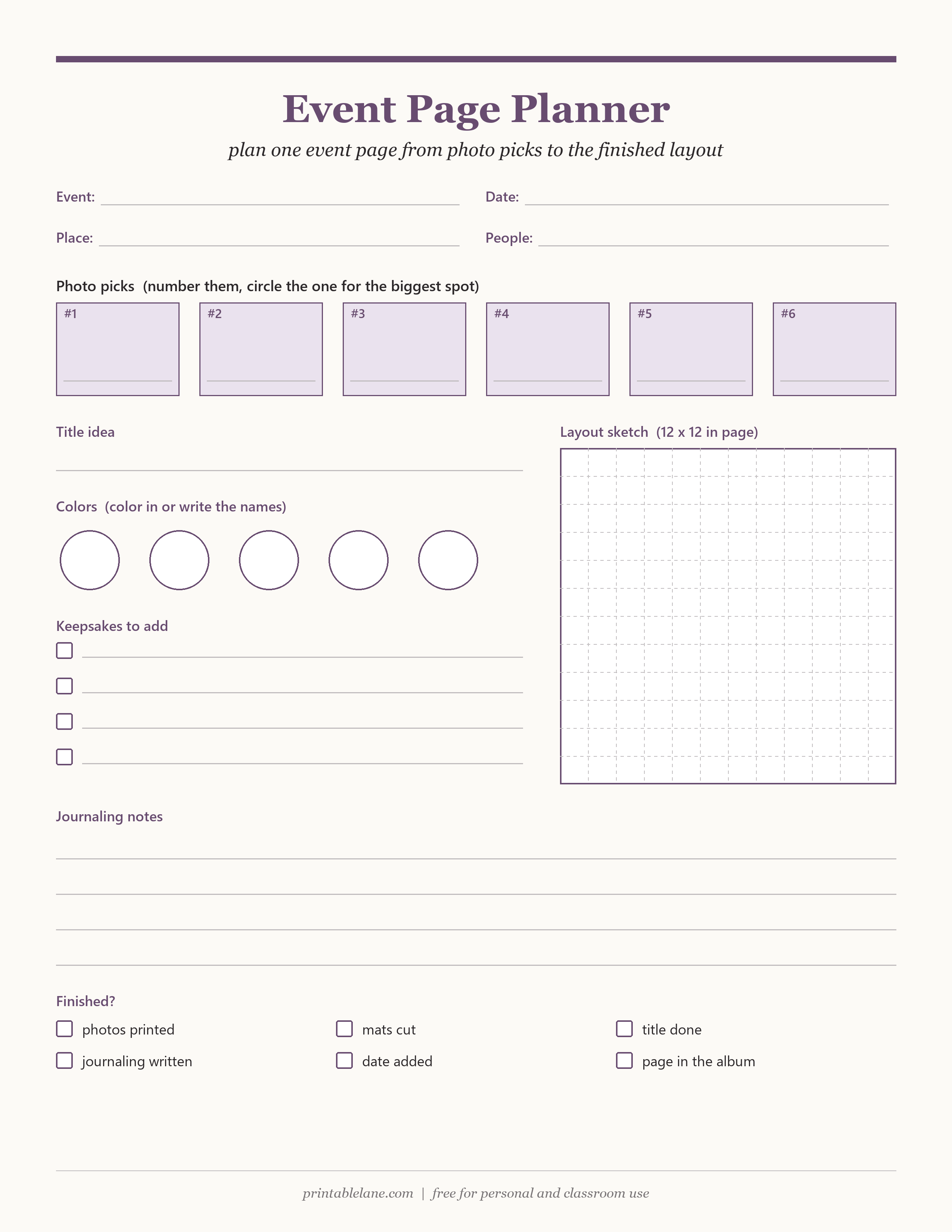
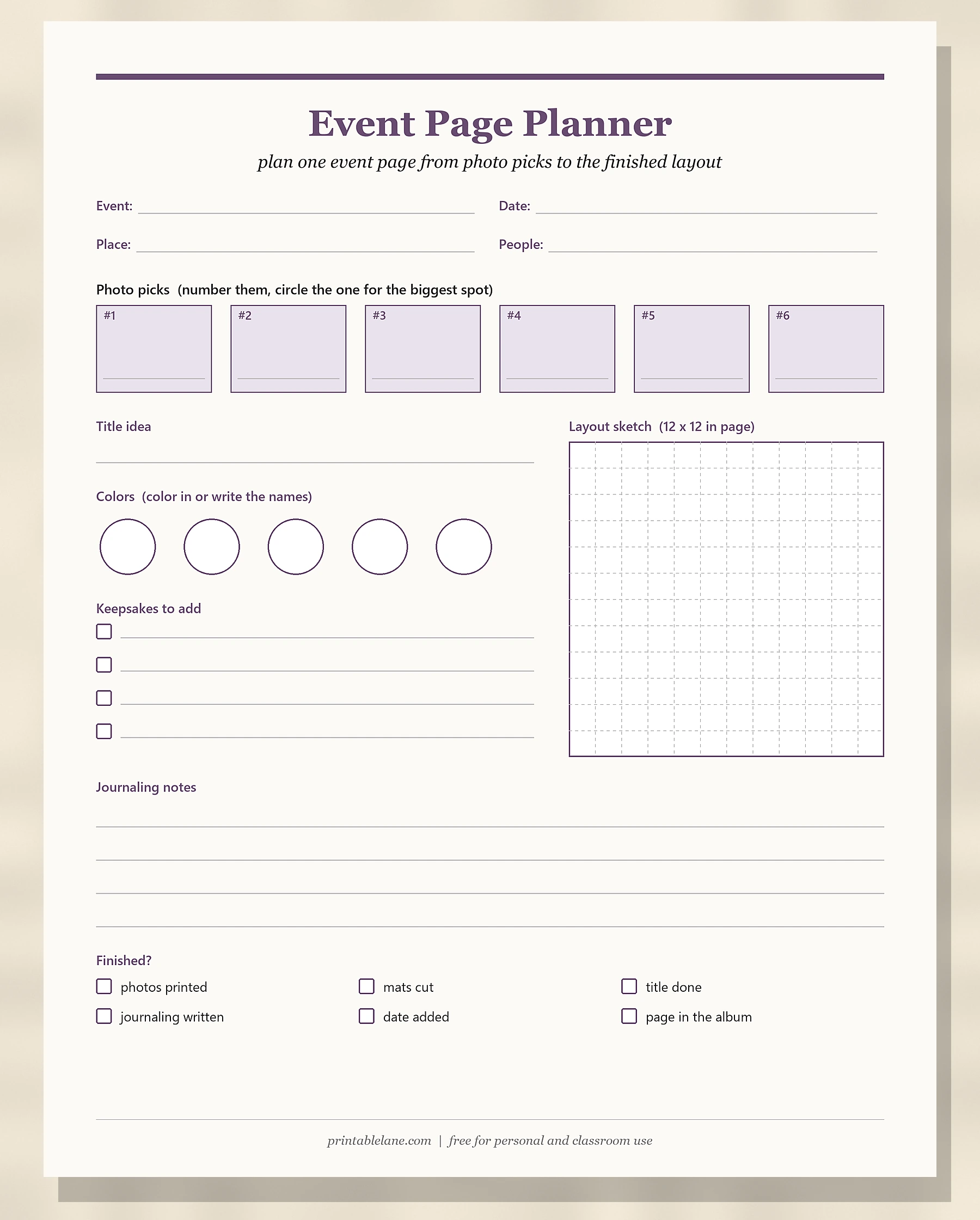
PDF page 8 has fields for Event, Date, Place and People, 6 numbered photo picks, a title line, 5 color circles, 4 keepsake lines, a 12 x 12 in layout sketch grid, journaling notes and a 6-step Finished? checklist.
Scrapbooking Supplies Checklist
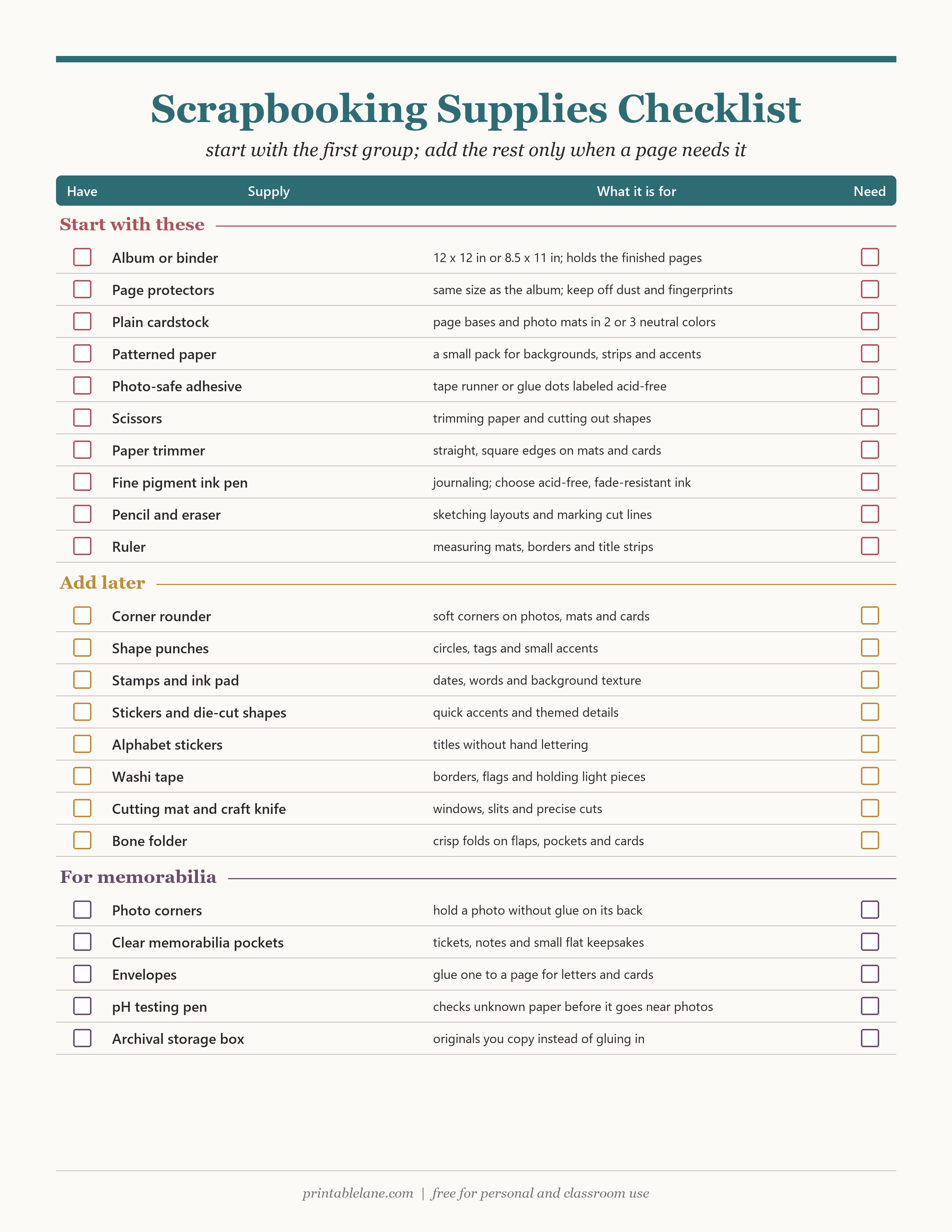
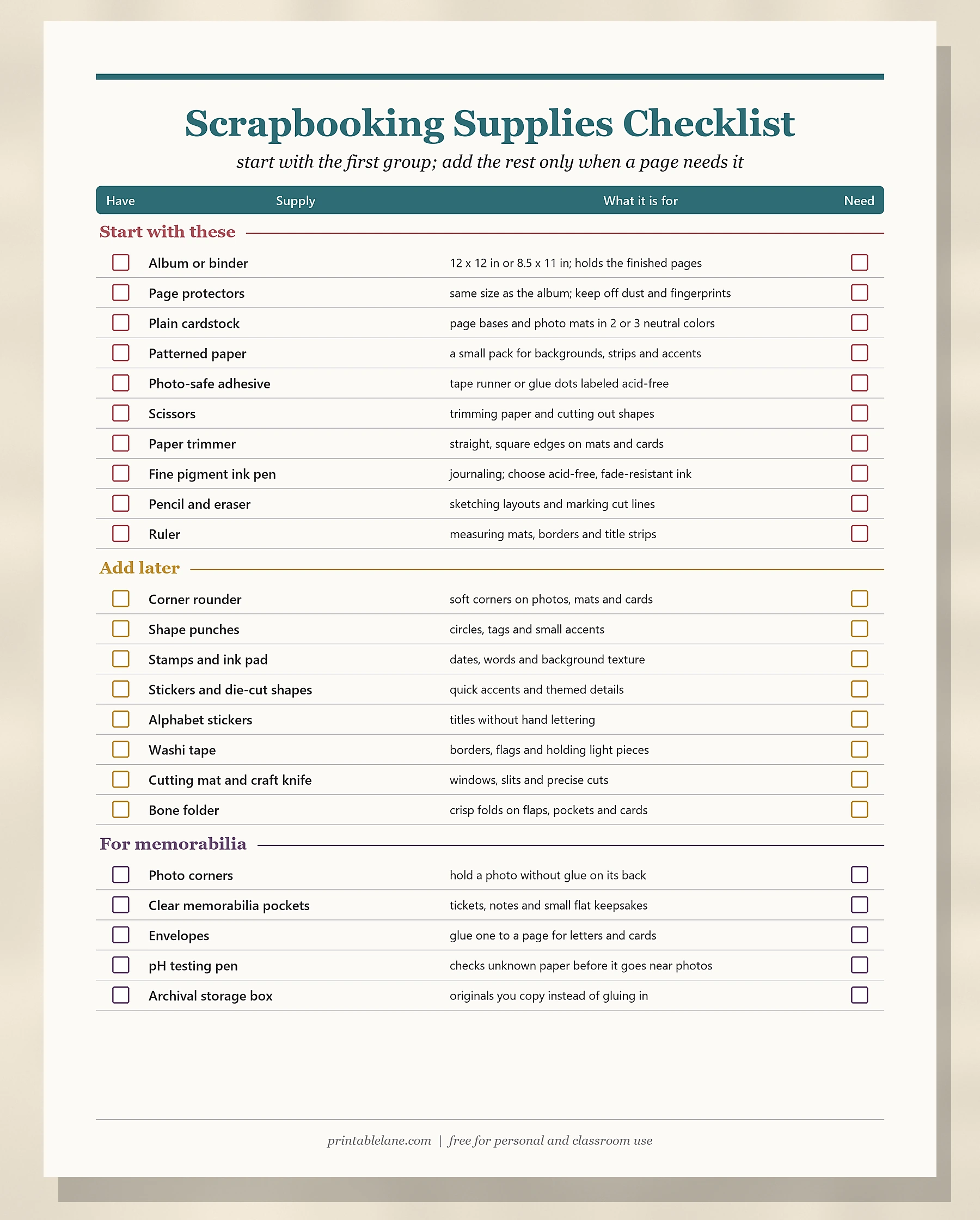
PDF page 9 lists 23 supplies in 3 groups: Start with these (10), Add later (8) and For memorabilia (5), each with what it is for and Have and Need boxes.
Download single pages
Want a fresh set of 3 x 4 in cards for this week, or just the mat table for the cutting desk? Each page below is a separate full-size file.
- First Page Layout Sketches (PNG)
- Journaling Cards 3 x 4 in (PNG)
- Journaling Cards 4 x 6 in (PNG)
- Photo Mats & Frames Guide (PNG)
- Title & Date Labels (PNG)
- Memory & Photo Log (PNG)
- Event Page Planner (PNG)
- Scrapbooking Supplies Checklist (PNG)
Printing tips
- US Letter: print at 100% (Actual size) so the cards stay 3 x 4 in and 6 x 4 in and the mat template stays 6.5 x 4.5 in.
- A4: choose 100% (Actual size), not Fit to page; the content sits at least 0.5 in inside the edges of a Letter page, so nothing is cut off on A4.
- Paper: acid-free cardstock for cards, labels and the mat template; plain paper for the log, planner and checklist.
Scrapbooking vs. junk journaling vs. art journaling
- Scrapbooking: built around photos and keeping memories readable for years, usually in an album with page protectors.
- Junk journaling: a handmade book of found and vintage papers, tickets and scraps; what a junk journal is explains it in full.
- Art journaling: mixed-media pages with paint, collage and lettering, made for self-expression more than record keeping.
They overlap, but the goal differs: a scrapbook protects the story; the other 2 put the making first.
Archival basics for your first album
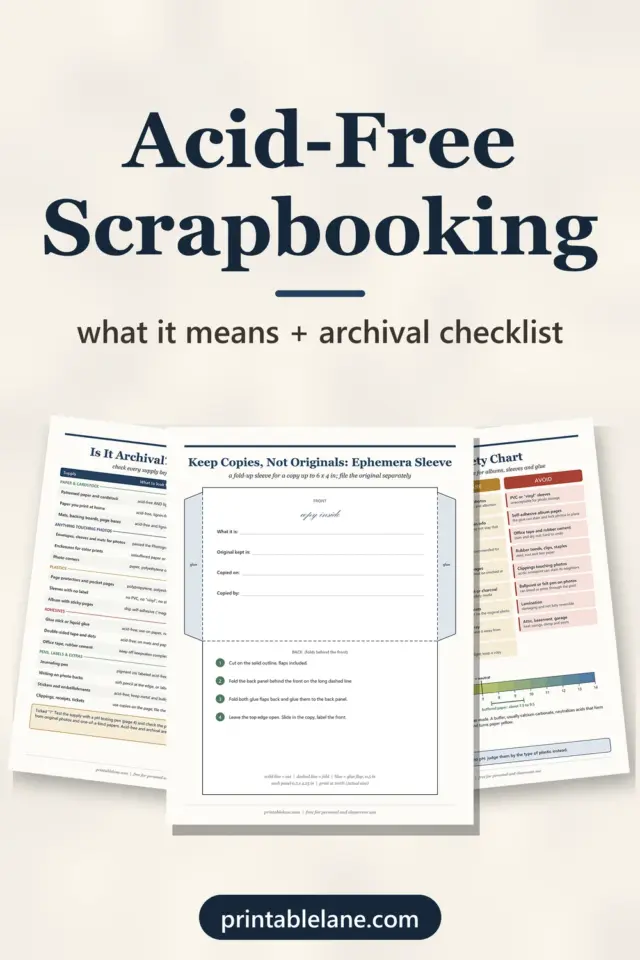
Photos last longest on acid-free, lignin-free paper, held with photo-safe adhesive or photo corners, inside page protectors free of PVC. Read what acid-free means in scrapbooking for labels, plastics and pH pens.
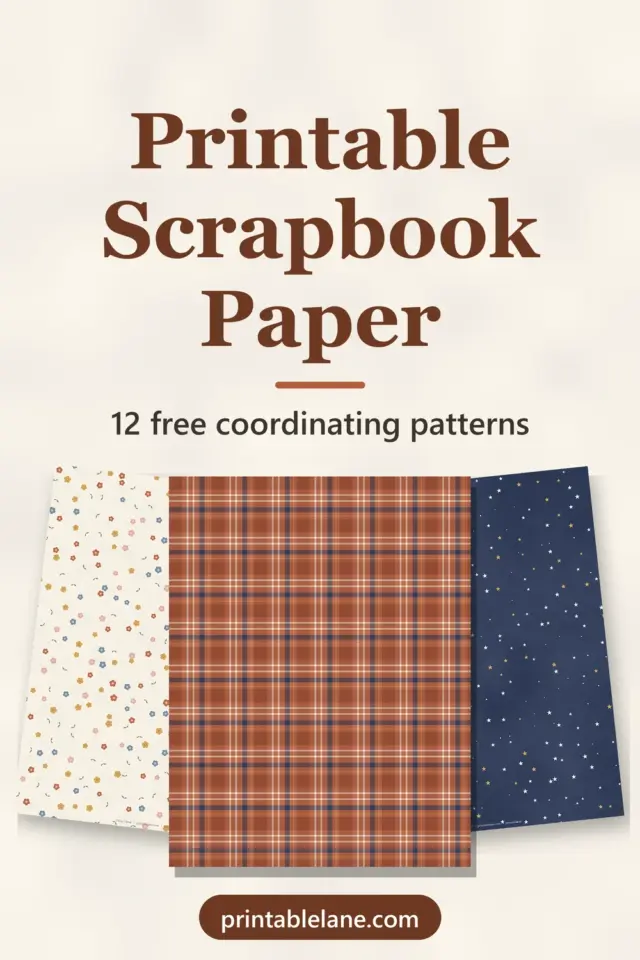
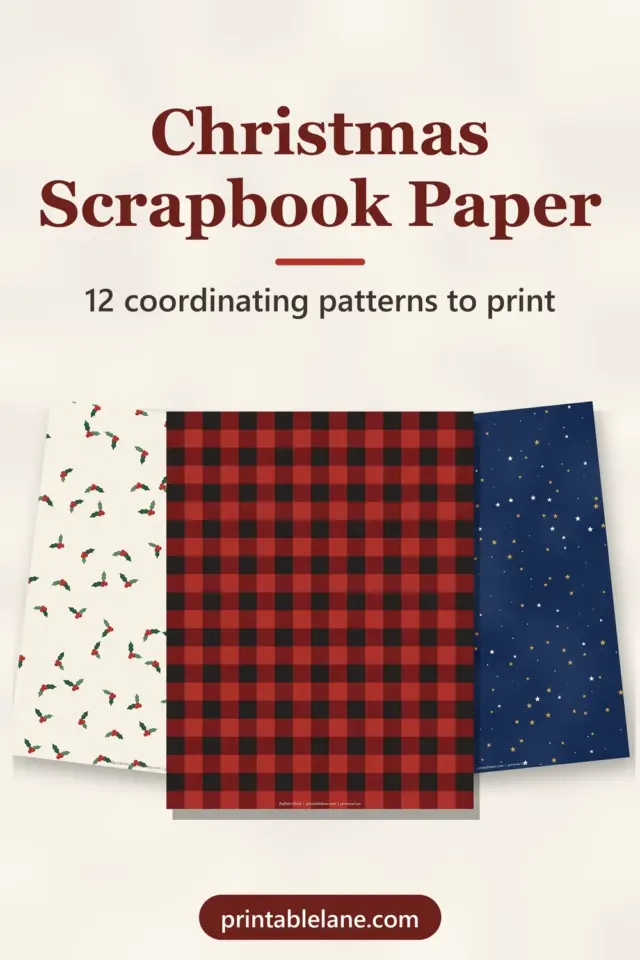
For backgrounds, print our free printable scrapbook paper, and save the Christmas scrapbook paper for holiday pages.
Frequently asked questions
How many pages are in the PDF?
9 pages: a cover plus 8 printables. The journaling cards are on pages 3 and 4, so you can reprint just those when you run out.
Can I print the starter pages on A4 paper?
Yes. Pick 100% (Actual size) so the cards, labels and mat template keep their measured size.
What size scrapbook should a beginner choose?
12 x 12 in gives the widest choice of paper and protectors; 8.5 x 11 in is easier to fill and works with paper from a home printer.
Do I need expensive tools to start scrapbooking?
No. The 10 items in the first checklist group cover a complete page; punches and stamps can wait.
How many photos should go on one page?
3 to 6 is a comfortable range for a 12 x 12 in layout; a Photo Grid page holds 6 with room for 3 cards.